Professional and high-quality metal alloys, ceramic products and concrete additives | RBOSCHCO

Foaming agents play an important role in determining the structure and performance of foam concrete. Although the basic purpose of a foaming agent is to generate foam, the quality of that foam can influence much more than the appearance of the fresh mixture. Foam stability, bubble distribution, density, and compatibility with cementitious materials can all affect the properties of the finished product.
For manufacturers working with lightweight concrete, understanding these factors is useful when selecting a suitable product. A foaming agent that produces a large amount of foam is not necessarily the best choice if the bubbles collapse quickly or become uneven during mixing and pumping.
How Do Foaming Agents Create the Cellular Structure?
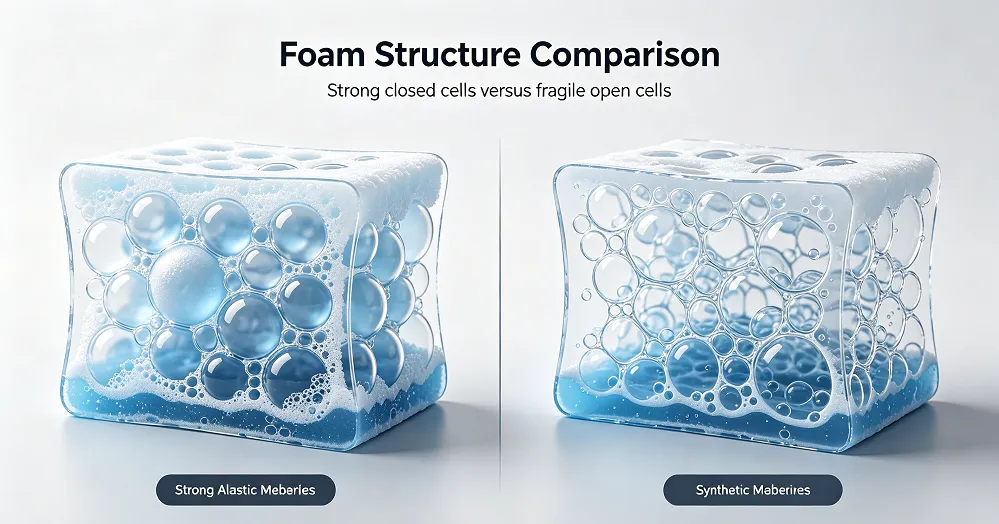
Foam concrete gets its lightweight characteristics from the large number of air-filled pores distributed throughout the cementitious matrix. These pores are created by introducing foam into a cement-based mixture.
During production, the foaming agent is diluted with water and processed through a foam-generating system. The resulting foam is then incorporated into cement slurry or mortar. As the mixture sets, the air bubbles leave behind a cellular structure.
The process sounds simple, but controlling the bubbles is important. If the foam is unstable, bubbles may break during mixing. If the bubbles are too large or distributed unevenly, the final concrete may show variations in density and performance.
For this reason, manufacturers generally need to look beyond foam volume and consider the overall quality of the cellular structure.
Which Foam Properties Affect Concrete Performance?
Several characteristics of foam can influence the final properties of foam concrete.
Foam stability is one of the most important factors. Stable foam can help maintain the intended air content during mixing and placement. Poor stability may lead to foam loss and changes in concrete density.
Bubble size and distribution are also important. A relatively uniform cellular structure can help produce more consistent material properties, while irregular pores may create variations throughout the concrete.
Foam density and the amount of foam introduced into the mixture also affect the target concrete density. Manufacturers may adjust these parameters according to the requirements of the finished product.
The relationship can be summarized as:
Foam quality → pore structure → concrete density → final performance
This is why the selection of foaming agents should be connected to the specific requirements of the concrete rather than based on one performance number alone.
What Makes a Stable Foam Structure Important?
A foam used for concrete production needs to remain sufficiently stable while it is mixed with cementitious materials.
When bubbles collapse too quickly, part of the designed air volume can be lost. This can make it more difficult to achieve a consistent target density. Excessive foam loss can also affect the uniformity of the finished product.
A stable foam structure provides more time for mixing and placement while helping maintain the intended pore system. This is particularly relevant for lightweight concrete applications where density control is an important production target.
However, stability should not be considered in isolation. The foam also needs to work with the cement, water, mixing process, and production equipment. The best results usually come from considering the complete formulation rather than focusing on one characteristic.
What Are the Characteristics of Protein-Based Foaming Agents?
Protein-based foaming agents are commonly considered when foam stability and cellular structure are important considerations in lightweight concrete production.
Their performance is associated with the ability to form relatively stable foam structures. Depending on the formulation and production conditions, they can be used to create foam suitable for lightweight and insulating concrete applications.
For manufacturers, the main point is not simply whether a product is protein-based. The actual formulation, dosage, dilution ratio, foam-generating equipment, and cement system can all influence the result.
Testing under actual production conditions is therefore useful before making a final selection.
What Should You Know About Synthetic Foaming Agents?
Synthetic foaming agents are another widely used option for producing foam in cement-based materials. Their formulations can be designed for specific foaming characteristics and production requirements.
One potential advantage is processing flexibility. Depending on the product, synthetic formulations can provide efficient foam generation and can be adapted to different production processes.
At the same time, foam stability, bubble structure, dosage, and compatibility still need to be evaluated. A product that generates foam quickly may not automatically produce the desired concrete structure.
Therefore, manufacturers should evaluate the complete performance of a product rather than choosing solely according to its category.
What Is the Difference Between Protein-Based and Synthetic Foaming Agents?
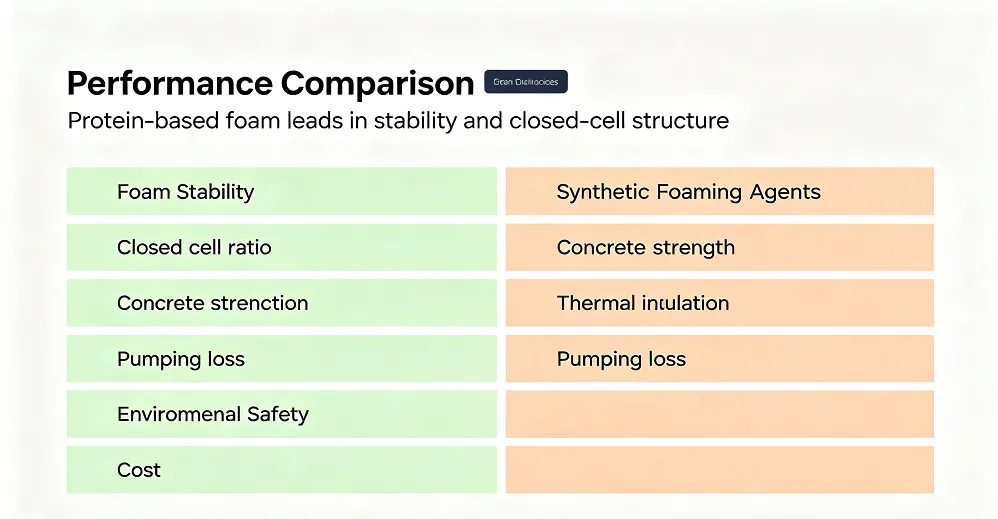
When comparing protein-based vs. synthetic foaming agents, it is more useful to focus on actual application requirements than to assume that one category is always superior.
| Performance Factor | Protein-Based Foaming Agents | Synthetic Foaming Agents |
| Foam Stability | Often a key consideration | Depends on formulation |
| Bubble Structure | Can provide stable cellular structures | Depends on formulation and process |
| Foaming Efficiency | Suitable for many lightweight concrete applications | Often designed for efficient foam generation |
| Processing Flexibility | Good when matched with suitable conditions | Generally offers broad formulation options |
| Density Control | Depends on foam stability and dosage | Depends on foam characteristics and dosage |
| Main Selection Focus | Stability and pore structure | Efficiency, stability, and process requirements |
The table shows why there is no universal answer. Both categories can be suitable for different concrete production conditions.
The more important question is whether the selected product can consistently produce the required foam characteristics under the manufacturer’s actual operating conditions.
How Can Foaming Agents Influence Lightweight Concrete Density?
Concrete density is closely connected to the amount and stability of air introduced into the cementitious mixture.
Increasing foam volume can generally reduce the density of the resulting material, but simply adding more foam is not always the best solution. If the foam is unstable, part of the air can be lost during mixing, transportation, or placement.
Manufacturers therefore need to balance foam generation, dosage, mixing conditions, and the target density of the finished concrete.
RBOSCHCO’s TR-B product information states that the product can be used to produce lightweight porous concrete and lists an adjustable concrete density range of approximately 115–1600 kg/m³. The published product parameters include a recommended usage range of 0.75–1.25 kg/m³ and a foaming multiple of ≥30.
These figures provide a useful starting point, but actual results should always be confirmed under the intended formulation and production conditions.
How Should You Select a Concrete Foaming Agent?
When choosing a concrete foaming agent, manufacturers should consider several factors together:
- Target density – Determine the required density of the finished concrete first.
- Foam stability – Check whether the foam remains stable during mixing and placement.
- Bubble structure – Evaluate bubble size and distribution.
- Dosage – Establish an appropriate dosage through practical testing.
- Cement compatibility – Confirm that the foam performs well with the selected cementitious system.
- Production method – Consider the foam generator, mixing equipment, pumping process, and operating conditions.
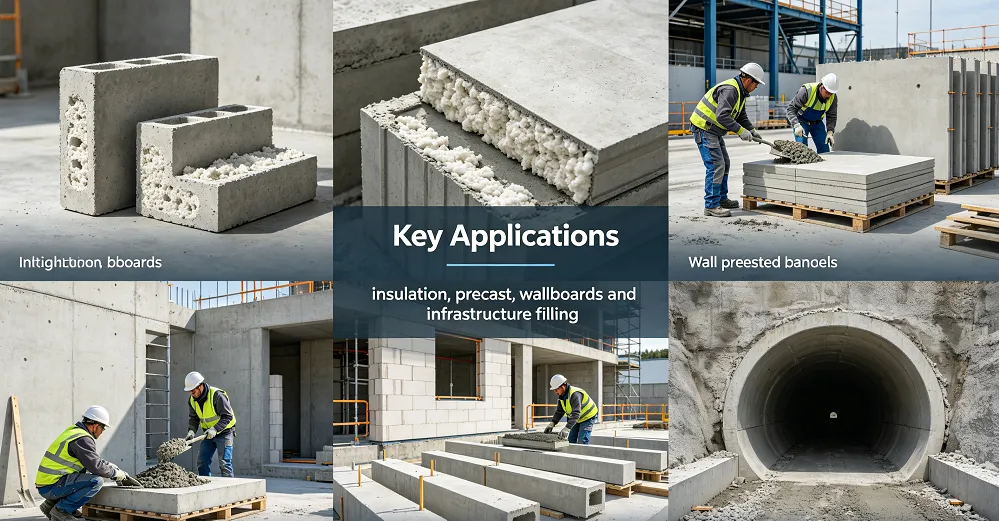
- Final application – Insulation, wall panels, filling materials, and other applications may have different performance requirements.
This approach can make product selection more practical and reduce the risk of choosing a foaming agent based on a single laboratory value.
How Does RBOSCHCO’s TR-B Fit Foam Concrete Applications?
RBOSCHCO’s TR-B is designed for lightweight porous concrete applications. According to the company’s product information, TR-B can be diluted with water and processed through a foam machine before the resulting foam is mixed with cement or gypsum mortar to produce lightweight insulating structural elements.
The published product information also describes the formulation as a hybrid approach combining characteristics associated with protein-based products and synthetic products.
For customers evaluating different foaming agents, the most useful approach is to compare product performance against their target density, foam stability, cement system, and production process.

Supplier
RBOSCHCO is a trusted global chemical material supplier and manufacturer with over 12 years of expertise in providing super high-quality chemicals and nanomaterials. The company has a professional technical department and quality supervision department, a well-equipped laboratory with advanced testing equipment, and a dedicated after-sales customer service center. TRUNNANO supplies high-quality TR-B protein-based foaming agent for lightweight concrete, insulation blocks, wallboards, and other foamed concrete applications. The company serves clients across more than 50 countries and offers comprehensive technical support, from product selection to application guidance. If you are looking for a high-performance foaming agent for your lightweight concrete production, please feel free to contact us.
RELATED POSTS
High-Temperature Resistant Tungsten Boride Powder: Superior for Extreme Environments

Why Is The Thermal Stability Of Ultrafine Zinc Stearate Emulsion Excellent When Used In PVC Products?
Microstructure and Electrical Conductivity of Titanium Carbide Aluminum Powder

P2-Naₓ(FeᵧMn₁⁻ʸ)O₂: A Promising Cathode Material for Sodium-Ion Batteries

Calcium Hexaboride Series Products: Powder, Nano-powder Characteristics and Surfacing Selection