Professional and high-quality metal alloys, ceramic products and concrete additives | RBOSCHCO

Boron carbide nanoparticles are among the most advanced materials available to modern industry, offering a combination of extreme hardness, thermal stability, chemical inertness, and radiation resistance that few other materials can match. Known as one of the hardest materials on Earth—second only to diamond and cubic boron nitride—boron carbide has long been valued for abrasive and wear-resistant applications. When this exceptional material is reduced to the nanoscale, with particle sizes ranging from 1 to 100 nanometers, its inherent properties are significantly amplified, unlocking new possibilities across a remarkably broad range of industries. RBOSCHCO high-purity boron carbide nanoparticles (99% purity) deliver this advanced performance, offering exceptional hardness, thermal stability, chemical inertness, and radiation resistance for applications ranging from abrasives and coatings to nuclear energy and biomedicine. This article explores the unique properties, production methods, and diverse applications of boron carbide nanoparticles that make them an increasingly sought-after material in high-tech industries worldwide. Whether you are developing advanced composites, protective coatings, electronic devices, or nuclear components, boron carbide nanoparticles offer the performance and reliability your application demands.
Understanding Boron Carbide Nanoparticles: A Material Like No Other
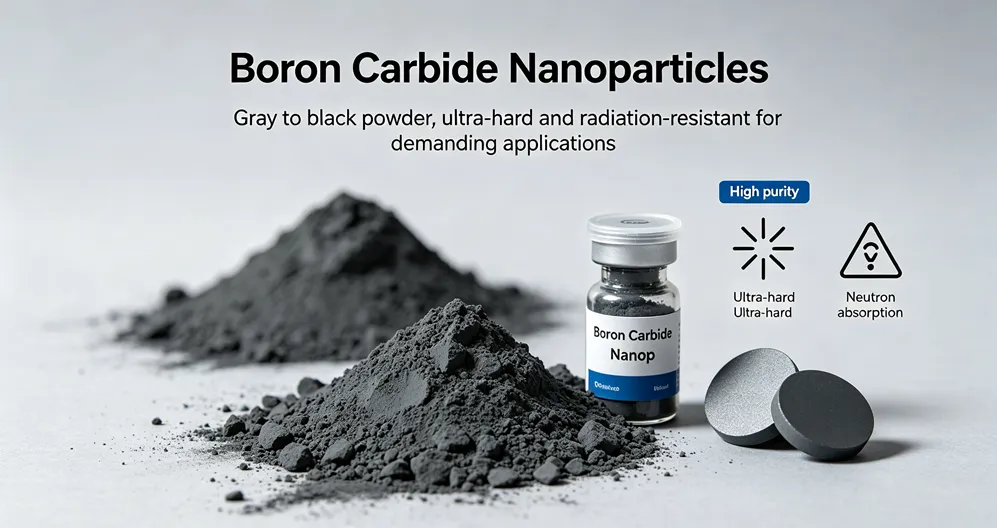
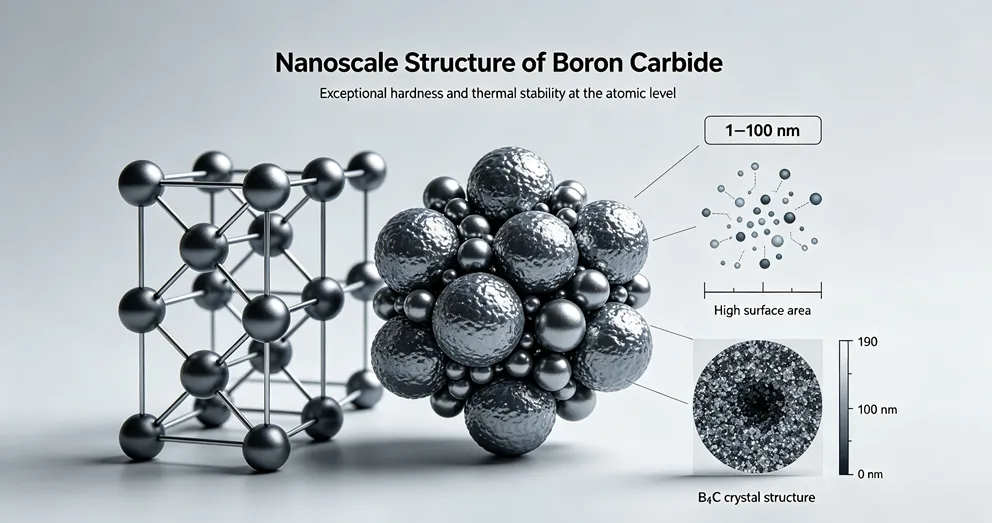
Boron carbide nanoparticles are ultra-fine particles of boron carbide with particle sizes typically ranging from 1 to 100 nanometers. At this scale, the material exhibits physical and chemical properties that differ significantly from its bulk form. The nanoscale size creates a much higher surface-area-to-volume ratio, which enhances reactivity, improves dispersion in composite materials, and unlocks new performance characteristics that cannot be achieved with conventional micron-sized particles.
The chemical formula of boron carbide is B₄C, with a molecular weight of 55.26. It appears as a gray to black powder and has an exceptionally high melting point of 2763°C, making it stable even under extreme thermal conditions. The density of boron carbide is 2.52 g/cm³, and it is insoluble in water, ensuring stability in wet environments. These fundamental properties make boron carbide nanoparticles suitable for applications that demand performance under the most challenging conditions.
RBOSCHCO boron carbide nanoparticles are manufactured to high purity standards (99% purity), ensuring consistent performance across applications. The product is available in custom particle size grades to suit specific application requirements, from fine abrasives to radiation shielding materials. With more than 12 years of expertise in nanomaterials, RBOSCHCO has become a trusted source for boron carbide nanoparticles worldwide, serving clients across more than 50 countries.
Key Properties of Boron Carbide Nanoparticles That Drive Performance
Boron carbide nanoparticles possess a combination of properties that distinguish them from other advanced materials and make them valuable across multiple industries.
Extraordinary Hardness
Boron carbide ranks among the hardest known materials, with a Vickers hardness of 26 MPa. This exceptional hardness makes boron carbide nanoparticles ideal for abrasive applications and wear-resistant coatings. In nanoscale form, the hardness is combined with improved dispersion, enabling more uniform coating application and better performance in cutting tools and precision finishing.
High Thermal Stability
With a melting point of 2763°C, boron carbide can withstand extremely high temperatures without significant degradation. This thermal stability makes boron carbide nanoparticles suitable for high-temperature environments such as furnace components, thermal protection systems, and advanced composites that must maintain performance under extreme heat.
Excellent Chemical Inertness
Boron carbide is resistant to chemical attack, corrosion, and oxidation. This chemical inertness ensures durability in harsh chemical environments, making boron carbide nanoparticles valuable for protective coatings, chemical processing equipment, and applications where resistance to corrosive substances is essential.
Enhanced Thermal Conductivity
At the nanoscale, boron carbide exhibits improved thermal conductivity ranging from 31 to 90 W/m-K. This property makes boron carbide nanoparticles effective in heat transfer applications, such as thermal interface materials and heat-dissipating coatings.
Radiation Resistance
One of the most distinctive properties of boron carbide is its resistance to radiation damage. This makes boron carbide nanoparticles particularly valuable for nuclear applications, where they can be used in fuel cladding, control rods, and other components exposed to high radiation environments. The boron-10 isotope present in natural boron has a high neutron absorption cross-section, making boron carbide an effective neutron shielding material.
Unique Optical Properties
Boron carbide nanoparticles may exhibit special optical properties, such as absorption or scattering of light. These properties make them potential candidates for photonic and optoelectronic applications where light interaction with matter is critical.
Boron Carbide Nanoparticles vs. Bulk Boron Carbide: A Comparative Overview
| Comparison Dimension | Bulk Boron Carbide | Boron Carbide Nanoparticles |
|---|---|---|
| Particle Size | Micron-scale or larger | 1–100 nanometers |
| Surface Area | Low | Significantly higher |
| Reactivity | Lower | Enhanced reactivity |
| Dispersion in Composites | Limited, prone to settling | Excellent, uniform distribution |
| Mechanical Properties | High hardness | Hardness preserved with improved toughness |
| Application Versatility | Established uses | Expanded to new high-tech applications |
The nanoscale form of boron carbide preserves the exceptional hardness and thermal stability of the bulk material while adding new capabilities through improved surface area, dispersion, and reactivity. This makes boron carbide nanoparticles suitable for advanced applications that cannot be achieved with conventional micron-sized particles. The enhanced surface area of boron carbide nanoparticles also enables more efficient incorporation into coatings, composites, and other material systems, where they can provide superior performance at lower loading levels compared to bulk materials.
Applications of Boron Carbide Nanoparticles Across Industries
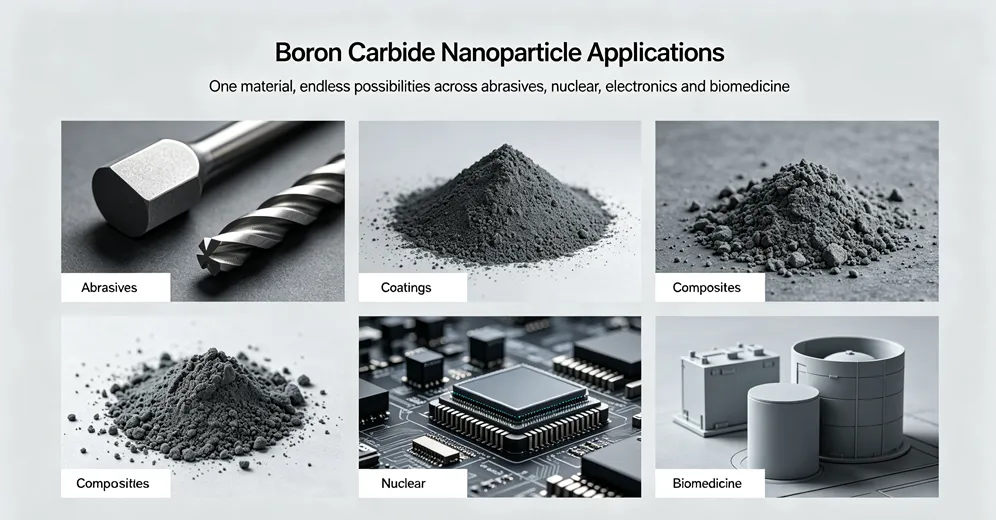
Boron carbide nanoparticles are used across a diverse range of industries due to their unique combination of properties. The versatility of boron carbide nanoparticles makes them valuable in both traditional and emerging applications.
Abrasive Materials
Boron carbide nanoparticles are used in abrasives and cutting tools due to their exceptional hardness and wear resistance. The nanoscale size enables finer finishing and polishing capabilities compared to conventional abrasives, making them valuable in precision manufacturing and optics. Boron carbide nanoparticles can produce smoother surfaces and more precise dimensional control, which is essential in industries such as semiconductor manufacturing and optical component fabrication.
Coatings
These nanoparticles can be used to improve the hardness, wear resistance, and corrosion resistance of surfaces through coating applications. Boron carbide nanoparticle coatings can be applied to industrial components, tools, and equipment to extend service life and reduce maintenance costs. The nanoscale size ensures uniform distribution within the coating matrix, providing consistent protection across the entire surface. Boron carbide nanoparticles in coatings also enhance resistance to chemical attack and oxidation, making them suitable for harsh operating environments.
Advanced Composites
Boron carbide nanoparticles can be incorporated into composites to improve their mechanical properties, thermal stability, and radiation resistance. These advanced composites are used in aerospace, defense, and other high-performance applications where material performance is critical. The addition of boron carbide nanoparticles to polymer, metal, and ceramic matrices enhances stiffness, strength, and thermal conductivity while maintaining lightweight characteristics. Boron carbide nanoparticles also improve the radiation shielding capabilities of composites for nuclear applications.
Electronic Devices
Due to their unique electrical features, boron carbide nanoparticles can be used in electronic devices, such as field emitters and semiconductors. The nanoscale size enables the fabrication of miniaturized electronic components with improved performance. Boron carbide nanoparticles can also be incorporated into electronic packaging materials to improve thermal management and reliability.
Nuclear Reactors
The radiation resistance of boron carbide nanoparticles makes them suitable for use in nuclear reactors, where they can be employed in fuel cladding, control rods, and other critical components. The boron-10 isotope provides effective neutron absorption, making boron carbide an essential material for nuclear safety. In nanoparticle form, boron carbide can be more uniformly distributed within shielding materials, providing more effective radiation protection with lower material usage.
Biological Applications
Boron carbide nanoparticles have shown potential in biological applications, such as drug delivery and cancer therapy. Their ability to target specific cells and tissues, combined with their stability and low toxicity, makes them promising candidates for biomedical research and therapeutic applications. The unique properties of boron carbide nanoparticles also make them useful as contrast agents for imaging and as carriers for therapeutic compounds.
Production Methods for Boron Carbide Nanoparticles
Boron carbide nanoparticles can be produced through several methods, each offering different advantages in terms of particle size control, purity, and production scale.
Chemical Vapor Deposition (CVD)
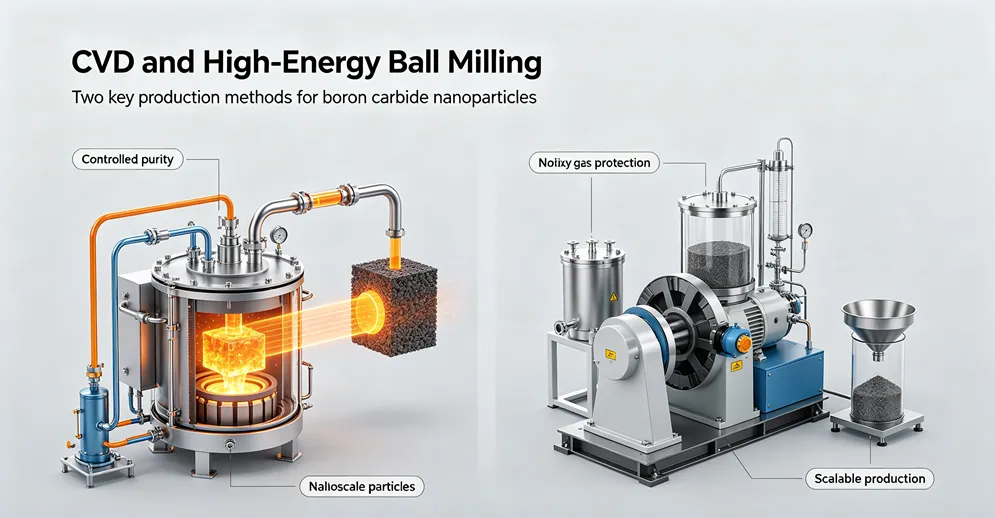
In the CVD method, gaseous precursors such as boron trichloride (BCl₃) and methane (CH₄) are introduced into a reaction chamber. They react at high temperatures (typically 1000–1500°C) in the presence of a catalyst. The chemical reaction leads to the deposition of boron carbide nanoparticles on the substrate surface. This method offers excellent control over particle size and purity, making it suitable for high-value applications where precise specifications are required.
Sol-Gel Method
Metal salts and organic compounds containing boron and carbon are used as raw materials in the sol-gel method. They are dissolved in a solvent to form a homogeneous solution. Through hydrolysis and condensation reactions, a gel is formed. The gel is then dried and calcined at 800–1200°C in an inert atmosphere to obtain boron carbide nanoparticles. This method allows for precise control over composition and particle morphology.
High-Energy Ball Milling
In this method, boron and carbon powders are mixed and subjected to high-energy ball milling. The mechanical energy from the milling process causes the powders to react and form boron carbide nanoparticles. The milling time can range from tens to hundreds of hours, and the process is often carried out in an inert gas atmosphere to prevent oxidation. This method is suitable for large-scale production, though particle size distribution may be broader than other methods.
RBOSCHCO utilizes advanced manufacturing techniques to ensure consistent quality and performance in every batch of boron carbide nanoparticles. With rigorous quality control and advanced testing equipment, RBOSCHCO ensures that its boron carbide nanoparticles meet the highest purity and performance standards required by demanding applications.
A Versatile Material for Advanced Industries
Boron carbide nanoparticles represent a unique combination of properties — extreme hardness, thermal stability, chemical inertness, radiation resistance, and optical characteristics — that make them valuable across a remarkably broad range of industries. From traditional abrasive applications to cutting-edge biomedical research, boron carbide nanoparticles continue to find new uses as researchers explore their potential.
The nanoscale size of boron carbide nanoparticles enhances their reactivity, improves dispersion in composites, and unlocks new performance characteristics that cannot be achieved with conventional micron-sized particles. This makes boron carbide nanoparticles increasingly essential in high-tech manufacturing, defense, energy production, and healthcare.
RBOSCHCO’s boron carbide nanoparticles are manufactured to the highest quality standards, with 99% purity and consistent particle size distribution. Whether you are developing advanced composites, protective coatings, electronic devices, or nuclear components, RBOSCHCO boron carbide nanoparticles deliver the performance and reliability your application demands.
For more information about how RBOSCHCO boron carbide nanoparticles can enhance your products and processes, contact our technical team for personalized support and material recommendations.
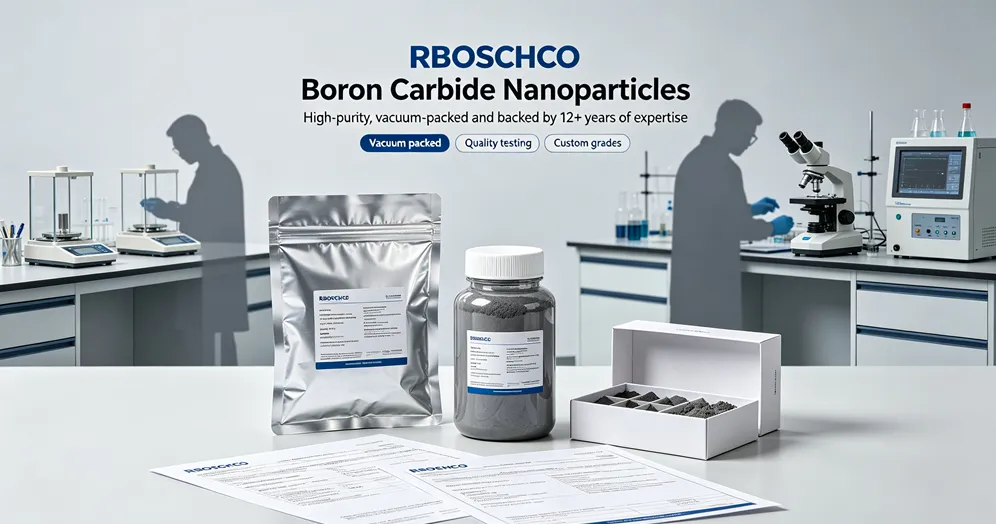
Supplier
RBOSCHCO is a globally recognized boron carbide nanoparticles manufacturer and supplier with more than 12 years of expertise in high-quality nanomaterials, advanced ceramics, and high-purity chemicals. The company has a professional technical department and quality supervision department, a well-equipped laboratory with advanced testing equipment, and a dedicated after-sales customer service center. RBOSCHCO’s boron carbide nanoparticles (99% purity) are available in custom particle size grades and packaging options, suitable for abrasives, coatings, advanced composites, electronic devices, nuclear applications, and biomedical research. The company serves clients across more than 50 countries and offers comprehensive technical support, from material selection to application guidance. If you are looking for high-quality boron carbide nanoparticles, please feel free to contact us.
RELATED POSTS
Why is Molybdenum Disulfide Used As a Lubricant?
Scientific News Boron Nitride Graphene Mixture May Be Suitable For Next-Generation Green Cars

Production of Si3n4 Powder

What is boron carbide?
What Is Aluminum Nitride Used For?
