Professional and high-quality metal alloys, ceramic products and concrete additives | RBOSCHCO

As an indispensable core tool in industrial production and laboratory research and development, silicon carbide crucibles are widely used in metallurgy, chemical industry, electronics, laboratory and other fields due to their excellent high temperature resistance, corrosion resistance, high strength and other characteristics. There are significant differences in characteristics and applicable scenarios among different types of silicon carbide crucibles, silicon carbide graphite crucibles, carbide crucibles, and silicon graphite crucibles.
Core basic characteristics of the silicon carbide crucible
Silicon carbide crucible is made from silicon carbide as the core raw material and sintered at high temperature. It is currently one of the most widely used high-temperature resistant containers in industry and laboratories. Its core characteristics are mainly reflected in three aspects, which are also the key advantages that distinguish it from other material crucibles.
Firstly, it has excellent high-temperature resistance. The operating temperature of a silicon carbide crucible can reach up to 1600 ℃ -1800 ℃, which can withstand severe temperature changes under high temperature environment and is not easy to soften, deform or damage, far superior to ordinary ceramic crucibles and quartz crucibles. It is suitable for high-temperature smelting, material sintering and other scenarios. Even during repeated heating and cooling cycles, it can maintain structural stability without problems such as cracking or edge collapse, which is the core reason why it cannot be replaced in high-temperature operations.
Secondly, it has outstanding corrosion resistance. Silicon carbide itself has stable chemical properties and is not easily reacted with corrosive substances such as acids, bases, and salts. Whether it is strong acids, bases, or metal or non-metal melts in a high-temperature molten state, it is difficult to corrode them. Therefore, it can be used for the treatment and reaction of various corrosive materials.
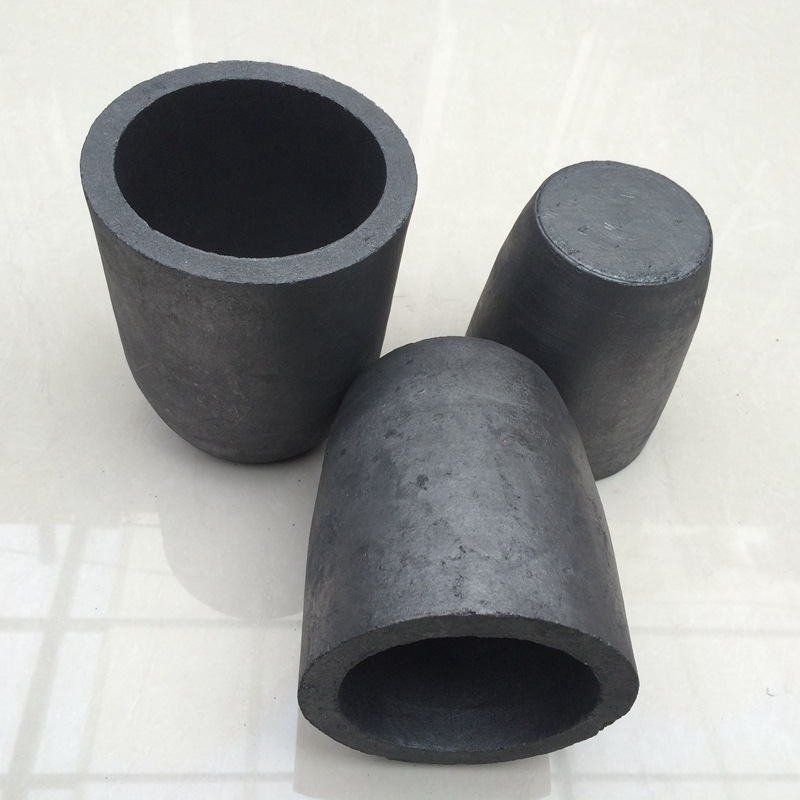
Finally, it has high mechanical strength and good thermal conductivity. Silicon carbide crucibles have a hard texture, strong compressive and impact resistance, and are not easily damaged by collisions or vibrations. At the same time, its thermal conductivity is better than traditional crucibles, which can quickly transfer heat, evenly heat the materials inside the crucible, improve operational efficiency and product quality, especially suitable for scenarios with high temperature control requirements.
Comparison of main categories and characteristics of silicon carbide-related crucibles
Based on different application requirements, there are multiple categories of silicon carbide-related crucibles, among which the most common ones include pure silicon carbide crucibles, silicon carbide graphite crucibles, carbide crucibles, and silicon graphite crucibles. Each category has its own emphasis on materials, performance, and applicable scenarios. The specific comparison is as follows:
1.Pure Silicon Carbide Crucible
A pure silicon carbide crucible is the most basic and widely used category, which is mainly made of high-purity silicon carbide and sintered at high temperature. Its core advantages are high temperature resistance, strong corrosion resistance, high purity, and low impurities. It is suitable for high-temperature smelting, precious metal melting, high-temperature chemical reactions, and other scenarios, such as melting metal alloys and sintering high-temperature materials. Its disadvantages are relatively high cost, brittle texture, and easy damage when subjected to severe impact, so it should be handled with care during use.
2.Silicon carbide graphite crucible
This category is a composite product of silicon carbide and graphite, which combines the advantages of both by adding a certain proportion of graphite to the silicon carbide raw material. On the one hand, it inherits the high temperature and corrosion resistance characteristics of silicon carbide, and on the other hand, it utilizes the good thermal conductivity and lubricity of graphite to further improve the thermal conductivity efficiency of the crucible, while enhancing its toughness and reducing the probability of damage. It has a wider range of applications and can be used for heating small materials in laboratories, melting metal samples, small-scale smelting, etc. It balances practicality and economy and is one of the most commonly used categories in industry and laboratories.
3.Carbide Crucible
The carbide crucible is composed of silicon carbide as the core component, and other carbide auxiliary materials are added to further enhance the high-temperature resistance and impact resistance of the crucible. Compared with pure silicon carbide crucibles, it has better thermal shock resistance and performs more stably in repeated heating and cooling scenarios. It is suitable for high-temperature and high-frequency operations, such as continuous metal melting, batch sample processing, etc. However, the cost is relatively high, and it is mostly used in high-end scenarios that require high crucible performance.
4.Silicon graphite crucible
Silica graphite crucible is mainly made of graphite and modified with silicon. Compared with silicon carbide-related crucibles, it has better thermal conductivity, lighter weight, and is easy to handle and operate. It is suitable for material heating and reaction in small laboratories and small-scale production. However, its high temperature resistance is slightly inferior to that of silicon carbide series crucibles, and its operating temperature generally does not exceed 1400 ℃. It is suitable for medium and low temperature operation scenarios, such as ordinary chemical reactions and material drying.
Applicable scenarios and selection suggestions for various crucibles
Combining the characteristics and differences of various categories, a reasonable selection is the key to improving operational efficiency and reducing costs. The selection suggestions for different scenarios are as follows:
If used in scenarios such as high-temperature smelting, precious metal melting, and high-temperature chemical reactions, and with extremely high requirements for high temperature and corrosion resistance of crucibles, pure silicon carbide crucibles are preferred. Their stable high-temperature performance can meet strict operational requirements, ensuring operational safety and product quality.
If used for routine laboratory experiments, heating of small materials, melting of ordinary metals, and other scenarios, seeking practicality and economy, silicon carbide graphite crucibles can be selected, which balance high temperature resistance and toughness, have higher cost-effectiveness, and can meet the needs of most routine operations.
If used for medium and low temperature operations, small-scale batch processing, and emphasizing operational convenience, silica ink crucibles are a more suitable choice. They are lightweight, have fast thermal conductivity, and are suitable for daily laboratory use; Carbide crucibles are more suitable for high-frequency, high-strength, high-temperature operations and are suitable for large-scale production scenarios.
Precautions for use and maintenance points
Regardless of which type of silicon carbide-related crucible is chosen, the following points should be noted during use and maintenance to extend the service life of the crucible and ensure operational safety:
One is to avoid sudden cooling and heating. After heating the crucible, it should not be immediately placed in cold water or a low-temperature environment to prevent cracking due to thermal expansion and contraction; Secondly, it should be placed steadily during use to avoid collision, falling, and damage to the crucible; Thirdly, it cannot be used to hold strong oxidizing substances to avoid reacting with strong oxidants at high temperatures and damaging the crucible; Fourthly, it is necessary to promptly clean the residual materials on the inner wall of the crucible after use to avoid clumping of residual materials, which may affect the next use.
Supplier
RBOSCHCO is a trusted global Silicon Carbide Crucible supplier & manufacturer with over 12 years of experience in providing super high-quality chemicals and Nanomaterials. The company export to many countries, such as USA, Canada, Europe, UAE, South Africa, Tanzania, Kenya, Egypt, Nigeria, Cameroon, Ugand, Turkey, Mexico, Azerbaijan Be lgium, Cyprus, Czech Republic, Brazil, Chile, Argentina, Dubai, Japan, Korea, Vietnam, Thailand, Malaysia, Indonesia, Australia, Germany, France, Italy, Portugal etc. As a leading nanotechnology development manufacturer, RBOSCHCO dominates the market. Our professional work team provides perfect solutions to help improve the efficiency of various industries, create value, and easily cope with various challenges. If you are looking for Silicon Carbide Crucible, please feel free to contact us.
RELATED POSTS

Silicon Nitride vs. Silicon Carbide: A Comprehensive Comparison of Properties and Applications for Industrial Use
Instant Sodium Silicate Powder — Versatile Industrial Material for Construction, Detergents, Textiles, and Water Treatment
Silicon Nitride: Powder and Ceramic – Characteristics and Industrial Applications

Revolutionizing Zinc Sulfide Technologies: Pioneering Monosulfide & Oxide Innovations to Dominate Surging Global Demand
Comparison Of Comprehensive Performance Of Mainstream Aerogel Powders: SiO₂ Vs. Carbon-Based Vs. Others