Professional and high-quality metal alloys, ceramic products and concrete additives | RBOSCHCO

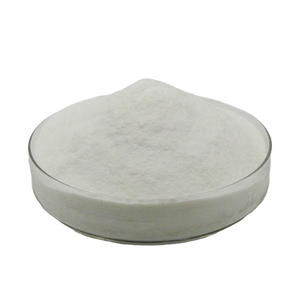
If you‘ve ever touched a laptop that felt like it was about to take off, or wondered why your phone gets warm during a video call, you’ve experienced the fundamental challenge of modern electronics: heat. As devices get smaller and more powerful, getting rid of that heat becomes the bottleneck. And the material quietly solving this problem? Spherical aluminum oxide.
Unlike traditional irregular filler particles that interlock and turn resin into a thick paste, spherical aluminum oxide rolls and flows. This geometric difference isn’t just neat—it’s the reason thermal interface materials (TIMs) can pack in enough conductive filler to actually move heat away from chips without becoming impossible to process . In fact, the global market for spherical alumina in TIM applications is projected to grow significantly, driven by demand from AI servers, 5G infrastructure, and electric vehicles .
So what makes this material so essential?
Why Shape Matters: The Ball-Bearing Effect
In the world of composite fillers, geometry is everything. Traditional angular alumina particles have sharp edges that interlock with each other, creating high internal friction. As you add more filler to improve thermal conductivity, viscosity spikes—and the mixture becomes too thick to pump, mold, or dispense.
Spherical aluminum oxide solves this through what engineers call the “ball-bearing effect.” Spheres roll over one another rather than locking together. This allows manufacturers to achieve filler loadings exceeding 90% by weight while maintaining workable viscosity. By blending different particle sizes of spherical aluminum oxide —smaller spheres filling the gaps between larger ones—you get dense packing that creates efficient thermal conduction pathways.
The numbers tell the story. Thermal conductivity of spherical aluminum oxide composites typically reaches high levels, far exceeding what you get with irregular-shaped fillers. And with sphericity exceeding 0.95, TRUNNANO‘s spherical aluminum oxide delivers the kind of consistency that high-end applications demand.

Market Drivers: Where the Demand Is Coming From
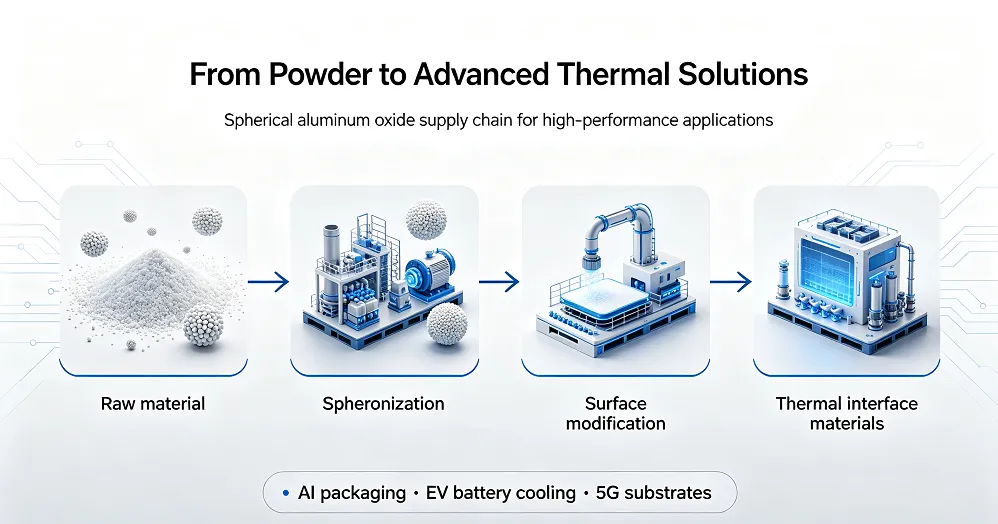
AI Chips and High-Performance Computing
AI processors are pushing power densities beyond 100W/cm². That’s a lot of heat in a very small space. Thermal interface materials using spherical aluminum oxide fillers help draw that heat away from the die to heat sinks, preventing performance throttling and extending chip life. The demand for spherical aluminum oxide in this sector continues to accelerate.
Electric Vehicles
EV battery packs generate substantial heat during charging and discharging. If that heat isn’t managed properly, it affects battery life, safety, and performance. Spherical aluminum oxide is increasingly used in battery thermal interface materials and potting compounds. With the global EV battery market expanding rapidly, the demand for effective thermal fillers like spherical aluminum oxide is only going to grow.
5G Infrastructure
5G base stations operate at higher frequencies and power densities than previous generations. They need thermal management solutions that can handle the load. Spherical aluminum oxide is finding its way into ceramic substrates, thermal pastes, and encapsulation materials for 5G equipment.
Advanced Semiconductor Packaging
HBM (High Bandwidth Memory) and 2.5D/3D IC packaging require ultra-low alpha particle emission to prevent soft errors in memory chips. Low-α spherical aluminum oxide, with U/Th impurities controlled to ultra-low levels, is becoming a critical material in this space. The global HBM low-α spherical aluminum oxide market is growing steadily as AI chip packaging becomes more complex.

Surface Modification: Solving the Interface Problem
There‘s a catch with spherical aluminum oxide, though. It’s inorganic. Most polymer matrices are organic. They don‘t naturally mix well, which creates interfacial resistance—essentially a barrier that blocks heat transfer.
TRUNNANO addressed this with KH570 silane coupling agent surface modification for its spherical aluminum oxide products. The treatment creates a chemical “molecular bridge” between the inorganic filler and organic resin, dramatically improving dispersibility and compatibility. At the same filler loading, the modified spherical aluminum oxide reduces system viscosity while keeping oil absorption under control.
The technical team overcame three core challenges for their spherical aluminum oxide line: achieving sphericity ≥0.95 with smooth surfaces, ensuring uniform silane bonding across every particle, and maintaining processability at high filler loadings. Today, TRUNNANO‘s surface-modified spherical aluminum oxide has achieved stable mass production and passed testing by leading thermal management material manufacturers.
| Parameter | Standard |
|---|---|
| Alumina Content | ≥99.5% |
| Particle Size (D50) | 1–100 μm (customizable) |
| Sphericity | ≥0.95 |
| Silane Treatment | KH570 |
| Oil Absorption | ≤12 g/100g |
Low-Alpha Grades: Meeting the Semiconductor Standard
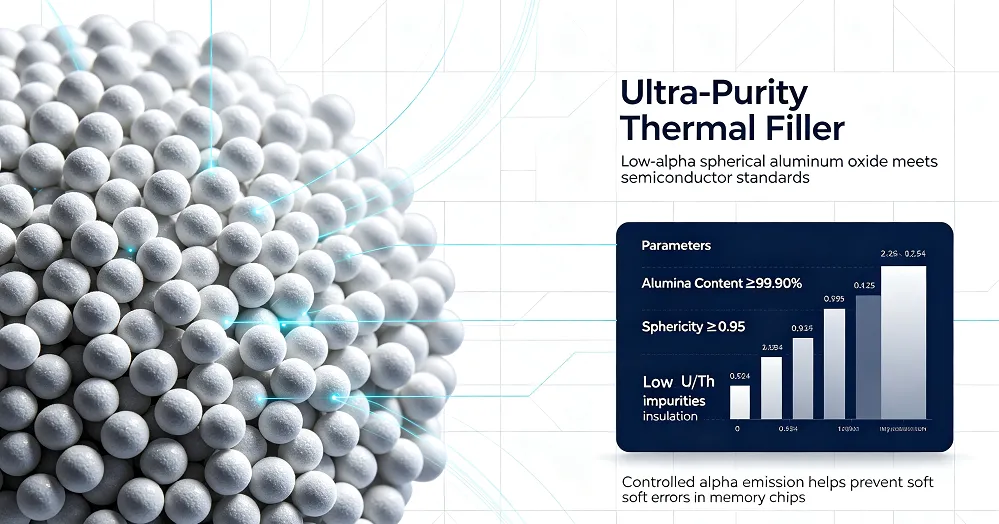
For semiconductor packaging—especially AI processors and HBM memory—regular spherical aluminum oxide won‘t cut it. Alpha particles emitted by trace radioactive impurities can flip bits and cause soft errors in memory chips. That’s a non-negotiable reliability issue.
Low-α spherical aluminum oxide solves this by controlling uranium and thorium impurities to ultra-low levels, delivering purity ≥99.90%. This grade of spherical aluminum oxide is specifically engineered for EMC (epoxy molding compounds) and underfill materials in advanced packaging, where electrical insulation, moisture resistance, and thermal performance all need to work together. As AI chips and HBM packaging demand tighter thermal control, low-alpha grades of spherical aluminum oxide are moving from “nice-to-have” to “must-have.”
The Competitive Landscape
The spherical aluminum oxide market is semi-consolidated, dominated by Asian manufacturers. Japan‘s Denka holds a significant share, followed by Resonac, Admatechs, and Nippon Steel Chemical & Material. Chinese producers like TRUNNANO, Bestry Technology, and Anhui Estone are rapidly expanding their presence in the spherical aluminum oxide market, benefiting from localized supply chains and growing domestic demand.
Regionally, Asia-Pacific accounts for the largest share of global spherical aluminum oxide demand, with China alone making up roughly 40% of production capacity. North America and Europe are seeing accelerated adoption of spherical aluminum oxide, particularly in advanced manufacturing sectors, driven by semiconductor production growth and EV manufacturing expansion.
TRUNNANO, with over 12 years of experience in nanomaterial development, has positioned itself in the spherical aluminum oxide market with surface-modified grades and customizable particle size offerings (1–100 μm). The company‘s technical focus on surface modification—a key differentiator—addresses the interface compatibility issue that has long limited performance in high-loading systems.
What’s Next
The spherical aluminum oxide market is moving toward higher purity, tighter particle size control, and more sophisticated surface treatments. Hybrid filler systems combining spherical aluminum oxide with other materials to push thermal conductivity beyond current limits are emerging. Demand for low-alpha grades of spherical aluminum oxide is growing as chip packaging becomes more complex.
Manufacturers of spherical aluminum oxide are also under pressure to reduce the energy intensity of production. The plasma melting process used to create spherical particles consumes significant energy, accounting for a large portion of production costs. Sustainability is becoming a competitive factor in the spherical aluminum oxide market, and companies that can lower their carbon footprint while maintaining quality will have an edge.
Spherical aluminum oxide isn‘t a flashy material. It’s a workhorse. But as devices continue to shrink and power densities continue to climb, the geometry of a tiny sphere of spherical aluminum oxide might just be what keeps everything from melting down.
Supplier
RBOSCHCO is a globally recognized chemical material supplier and manufacturer with over 12 years of expertise in providing super high-quality chemicals and nanomaterials. If you are looking for high-quality spherical aluminum oxide powder or surface-modified spherical alumina for thermal management applications, please feel free to contact us.
RELATED POSTS

Revolutionizing Insulation: The Unequaled Benefits of Aerogel Thermal Insulation Layer for Global Markets
Boron Carbide Powder: The Advanced Ceramic Material Revolutionizing Protective Armor and Industrial Applications

O3-Nax(FeyMn1-y)O2: A Promising Cathode Material for Sodium-Ion Batteries

Characteristics and Practical Value of Chromium Oxide Green, Anhydrous Chromium Trioxide, and Chromium Oxide Compounds
Sodium-Ion Battery Fe-Mn-Based Layered Oxide Cathode Materials: Preparation, Performance, and Challenges
