Professional and high-quality metal alloys, ceramic products and concrete additives | RBOSCHCO

Choosing the right water reducer is crucial in concrete construction. It directly affects concrete performance, cost, and project quality. Currently, Polycarboxylate superplasticizers have become the main choice in the market.

Why is Polycarboxylate superplasticizer a better choice?
Simply put, Polycarboxylate superplasticizers perform better in most modern engineering projects. They have better overall performance, are more environmentally friendly, and are more cost-effective in the long run. Next, we will compare them in detail from several aspects.
1. Performance and Effect Comparison
The core functions of both Traditional water reducer and Polycarboxylate superplasticizer are to reduce water usage and increase strength. However, their effects differ significantly.
1.1 Water Reduction Rate and Strengthening Effect
Traditional water reducers, such as naphthalene-based ones, typically have a water reduction rate of 15%-25%. They can effectively increase strength, but the effect is limited.
Polycarboxylate superplasticizer can achieve a water reduction rate of 25%-40% or even higher. This means they can use less water to achieve higher fluidity, thereby significantly improving the final strength and durability of concrete.
1.2 Retention of Concrete Workability
This is one of the most critical differences between the two. Traditional water reducers typically experience rapid slump loss. After mixing, concrete will dry and harden if transported or left for an extended period, causing problems during construction.
Polycarboxylate superplasticizers, through their special molecular structure design, can maintain the fluidity and plasticity of concrete for a longer period. This allows for wider construction time constraints and easier pumping.
1.3 Adaptability and Environmental Friendliness
Traditional water reducers have relatively poor adaptability to cement and mixing water. Furthermore, their production process and the products themselves are not environmentally friendly.
Polycarboxylate superplasticizers have wide adaptability and good compatibility with various types of cement. At the same time, their production is more environmentally friendly, containing no formaldehyde or other harmful substances, aligning with the trend of green environmental protection.

2. Economic Analysis: How to View Initial Costs vs. Overall Costs?
From a unit price perspective, the procurement cost of Polycarboxylate superplasticizer is generally higher than that of Traditional water reducer. This is a reason why many people hesitate. However, the situation changes after calculating the overall cost.
First, using high-performance Polycarboxylate superplasticizer can significantly reduce cement usage. Because of its better water-reducing and strengthening effect, the same strength standard can be achieved with less cement. Cement is the bulk of concrete costs; saving cement directly reduces the total material cost.
Second, the ease of construction it brings can save money. The longer workability retention time of concrete reduces the risk of on-site adjustments and scrap, improves construction efficiency, and shortens the construction period.
So, although the unit price is high, Polycarboxylate superplasticizer can help reduce the overall project cost and provide a stable quality.
3. How to Choose Based on Project Scenario?
No single product is suitable for all situations. Your choice should be based on specific project requirements.
Scenarios suitable for Traditional water reducer:
Ordinary projects with low requirements for concrete performance.
Projects with very tight budgets, simple construction conditions, and the ability to pour concrete quickly.
Short-term, small-scale temporary facilities.
Highly recommended applications for polycarboxylate superplasticizers include:
High-performance concrete (HPC) and self-compacting concrete (SCC): These are its primary application areas, perfectly meeting the requirements of high fluidity and high strength.
Precast component production: Requires concrete with extremely high early strength, excellent appearance, and precise dimensions.
High-strength pumped concrete: Especially for high-rise buildings and long-distance pumping, concrete requires excellent pumpability and long-term workability.
Key infrastructure: Such as bridges, hydroelectric dams, and high-speed railways, has stringent requirements for durability and lifespan.
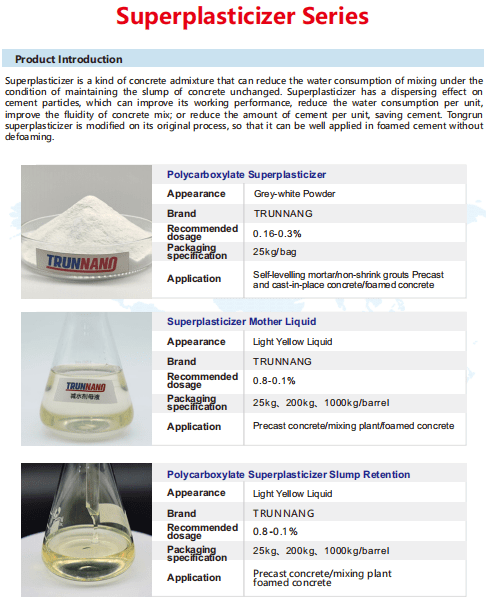
Choosing a high-quality water reducer requires a reliable manufacturer. RBOSCHCO is a company specializing in the research and development, and production of high-performance concrete admixtures.We offer a full range of Polycarboxylate Superplasticizer products. Our products feature high water reduction, low slump loss, and environmental safety. We also produce a variety of traditional water reducer products to meet the specific needs of different customers.
RBOSCHCO has a professional technical team that can provide you with the most suitable product selection and technical support solutions based on your project characteristics and raw material conditions. Our goal is to help you optimize concrete mix design, ensuring excellent project quality while controlling costs.
RELATED POSTS
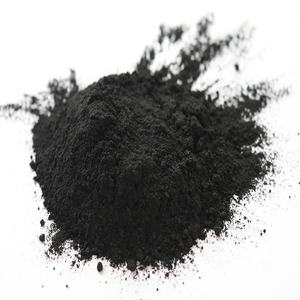
New breakthrough in the application of SE Powder in the aerospace manufacturing industry
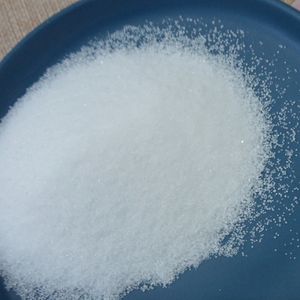
Desamidation of Stearic Acid Amide
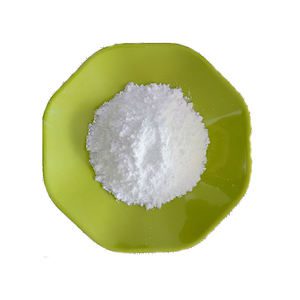
A leader in the washing industry: SAES Synthesized Alcohol Ether Sulphate

Is Molybdenum Disulfide Safe?
Lithium Silicate and Sodium Silicate: Which Is Better for Your Industrial Project?
