Professional and high-quality metal alloys, ceramic products and concrete additives | RBOSCHCO

Abstract
In the research on cathode materials for sodium-ion batteries (SIBs), P2-type layered oxides have attracted significant attention due to their high specific capacity, low cost, and high stability. Among them, P2/O3-Nax(FeyMn₁₋y)O₂ (i.e., iron-manganese-based sodium-ion cathode materials) exhibits excellent electrochemical performance by adjusting the ratio of iron (Fe) to manganese (Mn). This article will delve into the characteristics, synthesis processes, and physical properties of this material, providing a reference for the research and development of sodium-ion batteries.

I. Material Characteristics
(1) Crystal Structure
P2/O3-Na (FeyMn y)O ˇ is a mixed-phase layered oxide that contains two phases: P2 type (Na ˇ/[Ni/Mn/]O ˇ type structure) and O3 type (Na[Ni ˇ Mn]O ˇ type structure). The P2 phase has a hexagonal layered structure, consisting of alternating NaO6 octahedra and MO6 octahedra, forming a two-dimensional sodium ion diffusion channel; the O3 phase has a triangular layered structure, providing additional sodium ion storage sites. The synergistic effect of the two phases significantly improves the ion diffusion rate and structural stability of the material.
(2) Element Composition and Adjustment
By adjusting the ratio of Fe to Mn (y value), the electrochemical properties of the material can be optimized:
Low y values (rich in Mn): The Mn³/Mn redox pair provides a high voltage plateau (approximately 3.0-3.5 V vs Na+/Na), but excessive Mn triggers the Jahn-Teller effect, leading to structural distortion and capacity degradation.
High y value (Fe-rich): The Fe³⁺/Fe⁴⁺ redox couple contributes to high specific capacity (theoretical specific capacity approximately 150-180 mAh/g), but Fe dissolution and phase transition issues need to be suppressed through doping or coating.
(3) Physical Properties
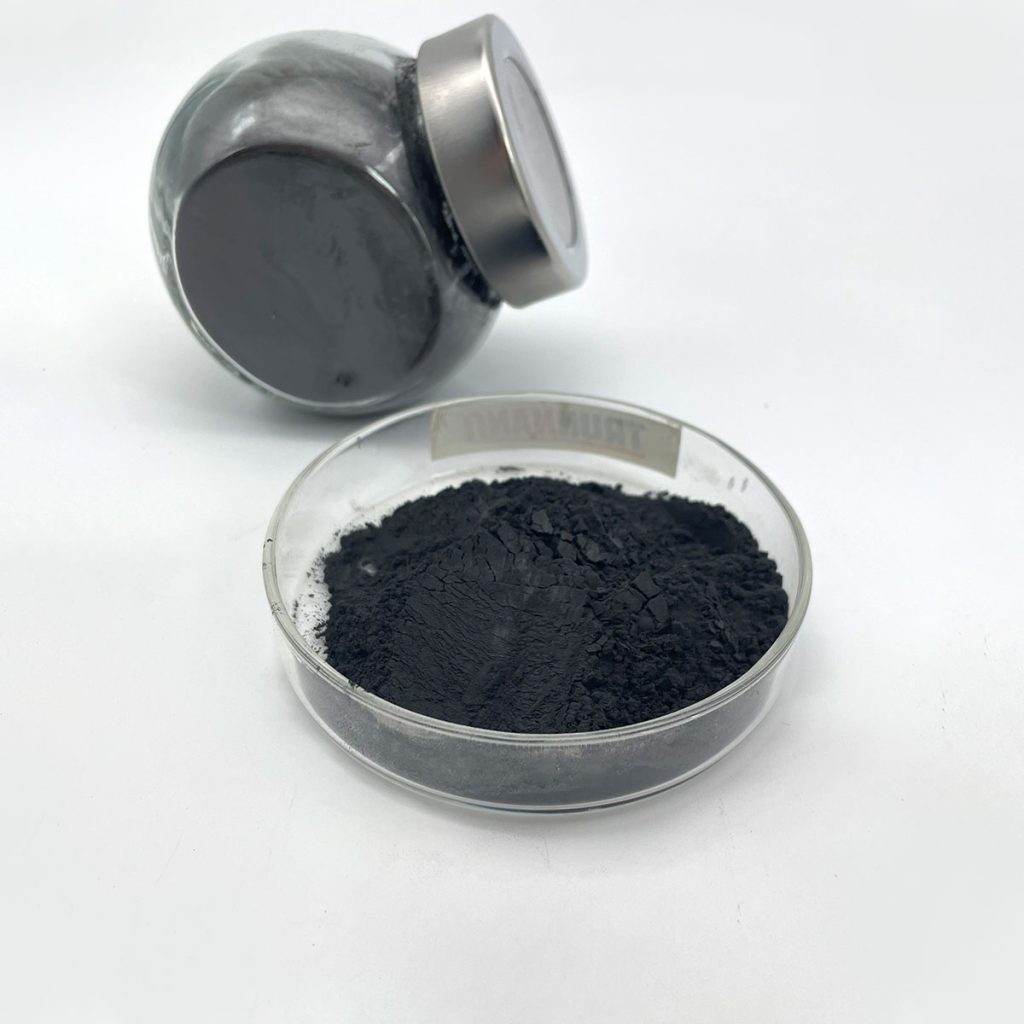
Color: Gray-black or dark gray, varying with the Fe/Mn ratio. Mn-rich materials appear dark gray, while Fe-rich materials are slightly lighter.
Tap Density: 1.2-1.5 g/cm³, significantly influenced by the synthesis process. Optimizing sintering conditions can increase it to above 1.8 g/cm³.
Dry Particle Size D50: 5-15 μm. Particle size distribution needs to be controlled to improve electrode processing performance. A narrower particle size distribution leads to better uniformity in electrode coating.
Residual Alkali pH Value: Should be controlled below 9. A value that is too high can trigger side reactions and gas generation. Water washing or acid washing can effectively reduce residual alkali.
II. Electrochemical Performance
(1)charge-discharge specific capacity
Theoretical specific capacity: The theoretical specific capacity of P2/O3-Na (FeyMn y)O ˇ is about 140-160 mAh/g, and the actual value is affected by residual alkali and phase transition. The actual specific capacity of Fe-rich materials can reach 120-140 mAh/g, and that of Mn-rich materials can reach 100-120 mAh/g.
(2)Voltage platform: The average discharge voltage is 2.8- 3.0V (vs Na+/Na). Increasing Fe content can increase the voltage to above 3.2V.
(3)Cycle stability: Mn-rich materials have poor structural stability and worse cycle performance than Fe-rich materials. Fe-rich materials can retain more than 80% capacity after 200 cycles, while Mn-rich materials are only 60-70%.
(4)Capacity decay mechanism: Irreversible phase transition (such as P2→O2 phase transition) and transition metal dissolution are the main factors. Surface coating (such as Al ˇ O) suppresses phase transformation, and doping (such as Mg²) enhances structural stability.
(5)coulombic efficiency
First effect and cycle efficiency: The first effect is affected by interfacial side reactions, and cycle efficiency can be improved through surface coating. The first effect of Fe-rich materials is about 85%, and the cycle efficiency reaches more than 98%; the first effect of Mn-rich materials is about 80%, and the cycle efficiency is 95%.
Influencing factors: residual alkali, phase change and electrolyte compatibility. Optimizing the sintering atmosphere and introducing buffer layers can significantly improve efficiency.
(6)energy density
(7)Actual energy density: 350-450 Wh/kg, close to the level of lithium iron phosphate batteries. Fe-rich materials have a higher energy density, reaching more than 400 Wh/kg.
Improvement ways: Optimize the proportion of elements, inhibit phase transformation, and increase compaction density. For example, synthesis of precursors by coprecipitation can improve material density and thus increase energy density.
III. Synthesis Process
(1) Synthesis Routes
Solid-state method: Simple process but prone to introducing impurities; requires precise control of oxygen partial pressure. Suitable for small-scale laboratory preparation.
Sol-gel method: Produces uniform products but has higher costs. Suitable for high-performance material preparation.
Coprecipitation method: Produces highly uniform precursors, suitable for large-scale production. By controlling precipitant concentration and pH value, precursors with a narrow particle size distribution can be synthesized.
(2)sintering parameters
Sintering temperature: 900-1000℃. If too high, the grain will be coarsened; if too low, the reaction will be incomplete. Optimizing temperature can increase material crystallinity and ion diffusion rate.
Sintering time: 10-15 hours, too long may cause phase transformation. Reaction efficiency and structural stability can be balanced by staged sintering (such as low temperature first and then high temperature).
(3)post-treatment process
Washing: Water washing or acid washing removes residual alkali and reduces the risk of side reactions. Pickling can more thoroughly remove surface impurities, but the acid concentration needs to be controlled to avoid material corrosion.
Drying: Control the moisture content to avoid moisture absorption of materials. Vacuum drying or inert atmosphere drying can improve material stability.
IV. Challenges and Solutions
(1)phase change problem
Challenge: Irreversible phase transitions during charge and discharge (such as the P2→O2 phase transition) lead to voltage degradation and capacity degradation.
Solution: Surface coating (such as Al ˇ O) or doping (such as Mg²) stabilizes the structure. For example, Al ˇ O coating suppresses phase transformation and improves cycle stability.
(2)air stability
Challenge: It is easy to react with H ˇ O/CO ˇ to cause side reactions, resulting in degradation of material properties.
Solution: Storage in an inert atmosphere or a hydrophobic coating on the surface. A hydrophobic coating can effectively isolate moisture and improve the stability of the material in the air.
(3)Cost and scale
Challenge: Large-scale production requires optimizing processes to reduce costs and improve consistency.
Solution: Develop low-cost synthesis processes (such as coprecipitation methods) and introduce automated equipment to improve production efficiency. For example, unit costs can be significantly reduced through continuous production.

V. Future Prospects
As a cathode material for sodium-ion batteries, P2/O3-Nax(FeyMn₁₋y)O₂ possesses significant advantages in terms of cost, energy density, and safety. Future research can focus on:
(1) Element Doping and Coating: Further optimize cycling stability and rate performance. For example, enhance structural stability by doping elements like Ti or Al, combined with surface coating to suppress phase transitions.
(2) Interface Engineering: Suppress side reactions and improve first-cycle efficiency through surface modification. For example, introducing buffer layers can reduce interfacial side reactions and extend material cycle life.
(3) Industrial Production: Develop low-cost, high-consistency synthesis processes to promote the commercialization of sodium-ion batteries. For example, improve production efficiency and reduce unit costs through continuous production and automated equipment.
Conclusion
Although P2/O3-Nax(FeyMn₁₋y)O₂ materials face challenges such as phase transitions and air stability, through element adjustment, interface optimization, and process improvements, they are expected to become a core cathode material for next-generation sodium-ion batteries. With deepening research, their commercialization process will further accelerate, providing more sustainable solutions for the energy storage field.d process optimization will be critical for commercialization.
Tags: Sodium-ion batteries (SIBs), Cathode material, P2/O3-Nax(FeyMn₁₋y)O₂
RELATED POSTS
Nano Manganese Tetroxide (Mn₃O₄): Superior Air Stability and Cycling Performance Beyond MnO for Advanced Battery Anodes
Recrystallised Silicon Carbide: The Ultimate Choose in High-Temperature Industrial
Comparison Of Comprehensive Performance Of Mainstream Aerogel Powders: SiO₂ Vs. Carbon-Based Vs. Others
Tungsten SilicidePowder: A High-Performance Conductive Porcelain Product for Advanced Electronic Devices and High-Temperature Applications
How to Use concrete fibers to prevent concrete cracking