Professional and high-quality metal alloys, ceramic products and concrete additives | RBOSCHCO

Concrete is the most widely used man-made material on Earth. Skyscrapers, cross-sea bridges, undersea tunnels, urban utility corridors—almost every piece of modern infrastructure depends on it. But its environmental cost is staggering: cement production accounts for approximately 7% to 8% of global CO₂ emissions. For every ton of cement produced, nearly a ton of CO₂ is released into the atmosphere.
In the past, the industry’s response was straightforward: “use less cement”—replacing a portion of clinker with industrial byproducts like fly ash and slag. This approach worked for decades, but it’s reaching its limits. Fly ash comes from coal-fired power plants. Slag comes from steel mills. As the global energy transition accelerates, both of these byproducts are becoming increasingly scarce.
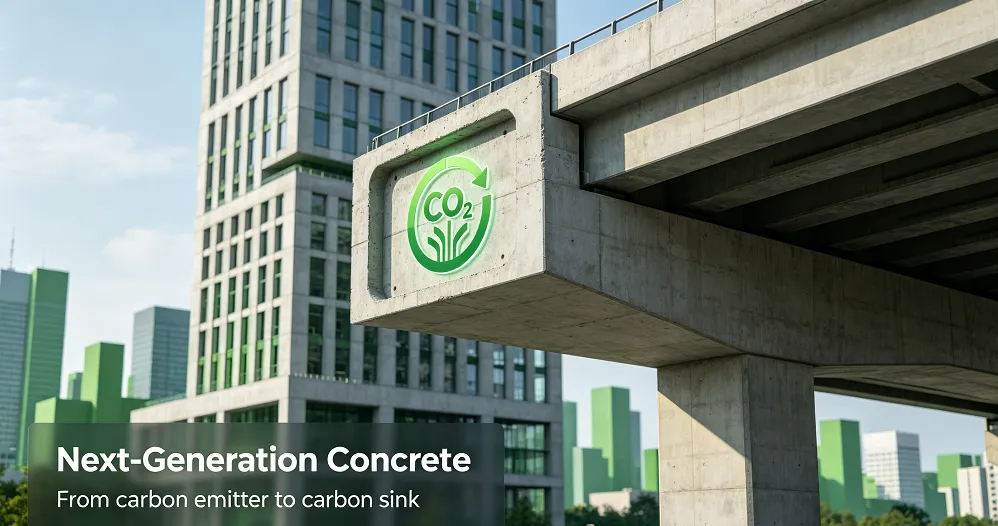
Next-generation concrete is breaking out of this framework. It doesn’t just aim to “emit less carbon”—it aims to absorb carbon. It doesn’t just aim to be stronger—it aims to heal itself. It doesn’t just support buildings—it changes how buildings are built. These five technology trends are rewriting the definition of concrete.
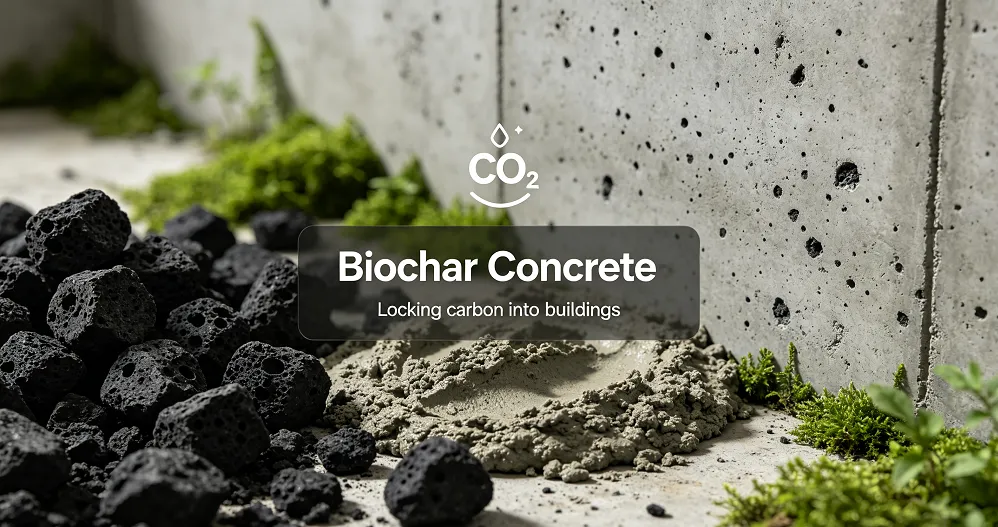
Biochar Concrete: Turning Buildings into Carbon Sponges
Biochar is a carbon-rich material produced by pyrolyzing biomass (branches, straw, coffee grounds, etc.) under oxygen-limited conditions. Its porous structure makes it a natural carbon storage medium—each kilogram of biochar can stably sequester about three kilograms of CO₂, remaining locked in the soil for centuries.
In 2025, Holcim and Canary Wharf Group completed field trials of biochar concrete in London. They turned pruned branches and waste coffee grounds into biochar and incorporated it into the concrete mix. The optimized formulation achieved a net global warming potential of -14 kg CO₂e/m³—a true “net-zero concrete.”
Research from Heriot-Watt University further confirmed that replacing just 1% of fine aggregate with biochar can increase concrete’s compressive strength by approximately 10%. The porous structure of biochar also improves internal moisture regulation and reduces permeability.
The underlying principle is simple: trees absorb CO₂ from the air through photosynthesis during their growth. After pyrolysis, that carbon is fixed in a stable form. When added to concrete, the carbon is permanently locked into the building structure—buildings become carbon sinks rather than carbon sources.
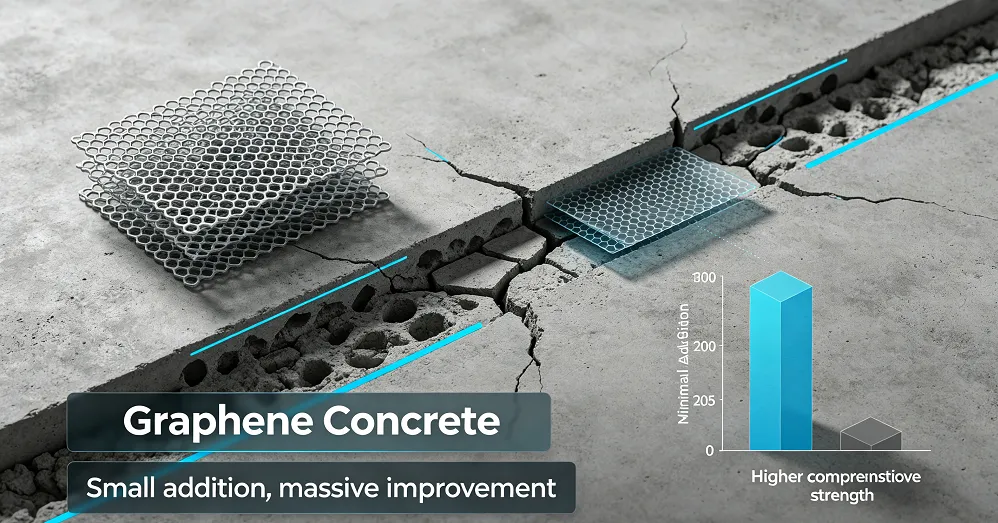
Graphene-Enhanced Concrete: Big Impact with Tiny Additions
Graphene is a single layer of carbon atoms arranged in a two-dimensional honeycomb lattice. It’s one million times thinner than a sheet of paper, but 200 times stronger than steel. Adding just a tiny amount of graphene to concrete—typically 0.01% to 0.05% of cement weight—can significantly improve mechanical performance.
Holcim’s trial data showed that graphene-containing concrete achieved over 50% carbon reduction compared to traditional CEM I concrete, while also demonstrating higher compressive strength and better durability. Higher strength means less material is needed to achieve the same structural performance—which is itself a pathway to carbon reduction.
The toughening mechanism of graphene lies in its two-dimensional sheet structure, which bridges micro-cracks, prevents crack propagation, and improves the microstructure of the interfacial transition zone. Studies have also found that graphene promotes the ordered growth of cement hydration products, improving hydration efficiency.
In 2025, transparent and standardized Environmental Product Declaration (EPD) rules were established, paving the way for the commercial application of graphene-enhanced concrete. This technology is moving from the lab to the construction site.
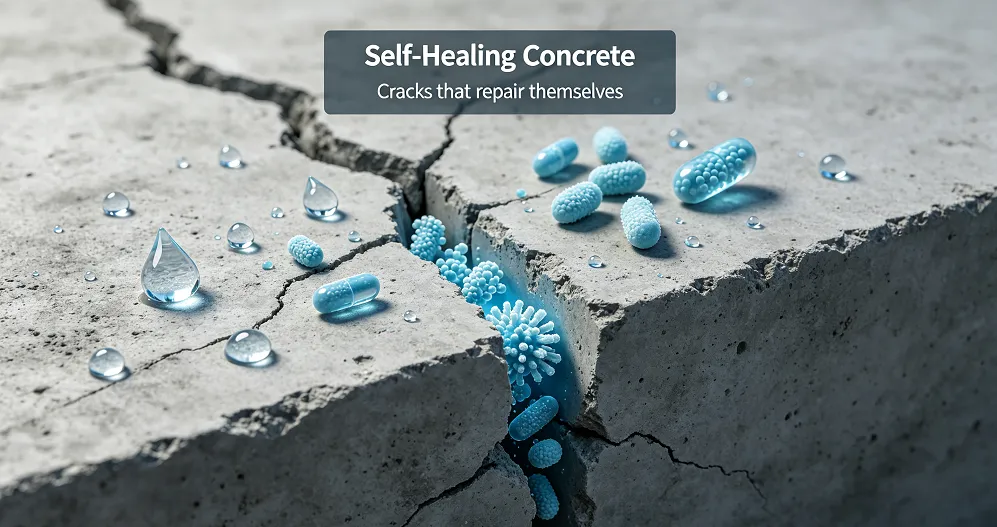
Self-Healing Concrete: Cracks That Repair Themselves
Cracks are the number one threat to concrete durability. Water, chlorides, and CO₂ penetrate through cracks, accelerating steel corrosion and structural deterioration. The traditional approach—periodic inspection and repair—is expensive and treats the symptom rather than the cause.
Self-healing concrete aims to let the structure repair its own cracks. Several technical pathways are currently being developed:
Microbially Induced Calcium Carbonate Precipitation (MICP): Specific Bacillus spores and nutrients are encapsulated in the concrete. When cracks appear and water seeps in, the bacteria are activated, inducing calcium carbonate precipitation through metabolic processes to seal the cracks. This technology can heal cracks up to approximately 1000 μm wide and is environmentally friendly, but maintaining long-term bacterial activity and scaling up production remain challenges.
Microcapsule Encapsulation Technology: Healing agents (epoxy resins, polyurethanes, sodium silicate, etc.) are encapsulated in microcapsules (tens to hundreds of micrometers in diameter) and dispersed throughout the concrete matrix. When cracks propagate, the capsules rupture, releasing the healing agent to fill the cracks and restore structural integrity. The response is fast, but the healing agent supply is limited—it’s a one-time repair.
Vascular Network Technology: Mimicking biological vascular systems, interconnected pipe networks are pre-embedded in the concrete. Healing agents can be replenished externally for multiple cycles of repair, covering larger crack widths. However, the network layout is complex and costly, and it has not yet been widely deployed.
Crystalline Admixtures: This is currently the most commercially mature approach. Reactive components in the admixture react with cement hydration products upon contact with water, forming insoluble crystalline substances (C-S-H gel and ettringite) that seal capillary pores and micro-cracks. It is simple to use and cost-effective, but the effective repair range is typically limited to cracks under 300 μm.
From a life-cycle perspective, the economic value of self-healing concrete lies in reduced inspection and maintenance frequency. For structures that are difficult to access for frequent repairs—bridges, tunnels, nuclear facilities—this “active defense” approach is particularly valuable.
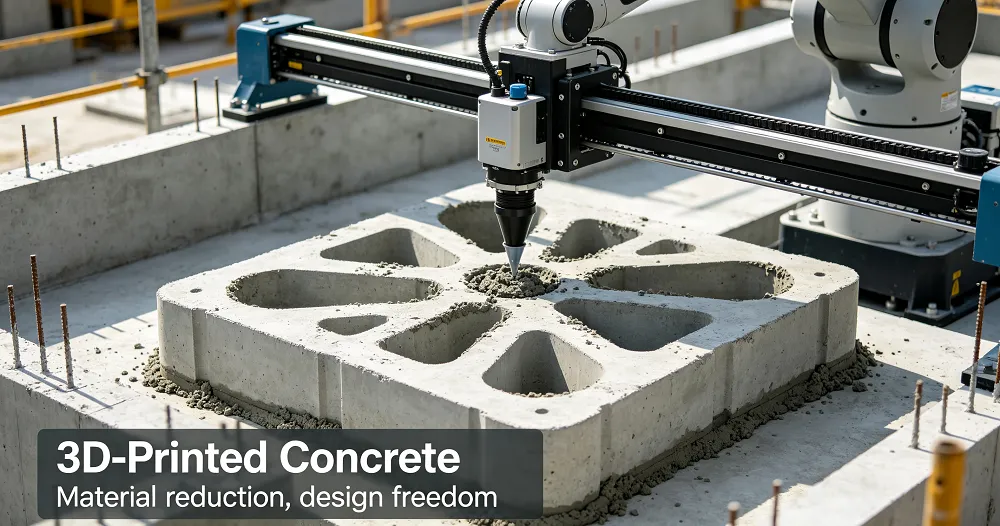
3D Concrete Printing: Material Reduction and Design Innovation
3D concrete printing no longer relies on traditional formwork. Instead, robots deposit material layer by layer, precisely placing concrete only where it’s needed. Compared to conventional casting, 3D printing significantly reduces material waste, eliminates formwork waste, and enables complex geometries that are difficult or impossible to achieve with traditional methods.
Material reduction is the most direct sustainability benefit. Traditional casting requires continuous filling of entire cross-sections, while 3D printing can leave voids where material is not needed—putting material exactly where it counts. Lightweight components not only reduce material consumption but also lower seismic load response. In seismic zones, a 10% weight reduction translates to a significant structural advantage.
Compression-dominant structural design is being integrated with 3D printing. By optimizing geometry so that structures primarily bear compressive rather than tensile forces, the need for traditional steel reinforcement can be greatly reduced or even eliminated. This draws on the structural logic of ancient Roman stone arch bridges—structures that stood for millennia without a single piece of rebar.
The EU’s CARBCOMN project goes a step further, using steel slag—an industrial waste product—as a binder instead of cement, curing it in a CO₂ environment to simultaneously harden the concrete and sequester carbon. The layer-by-layer nature of 3D printing also allows functional layers (insulation, sensing, etc.) to be integrated directly into the printing path.
Recent studies have also combined 3D printing with low-carbon supplementary cementitious materials. 3D-printed concrete incorporating 40% lithium slag as a supplementary cementitious material achieved a good balance of strength, constructability, and carbon reduction. The addition of PVA fibers effectively improved interlayer bond performance and crack resistance.
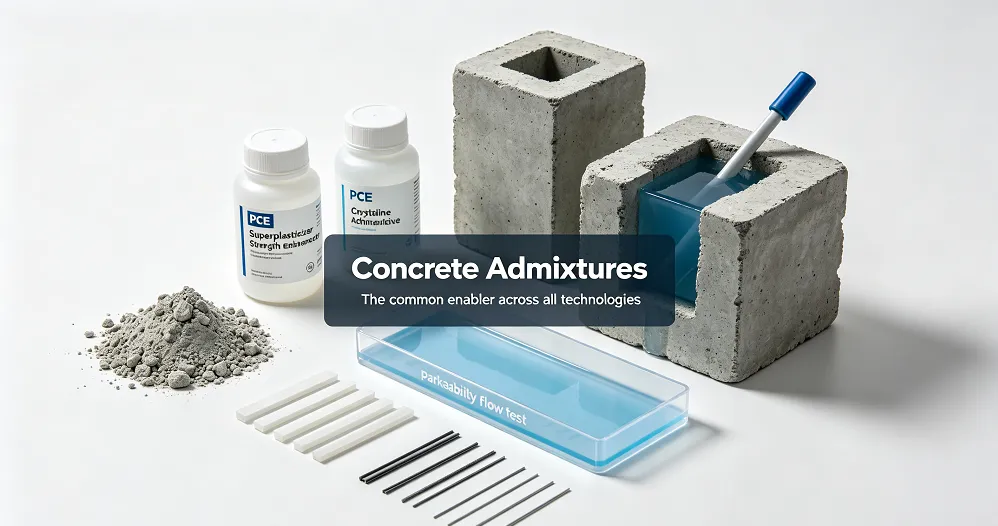
Admixtures: The Common Enabler Across All Technology Pathways
All four of the directions above depend on admixtures. Every pathway—whether biochar, graphene, self-healing, or 3D printing—relies on chemical additives to achieve its full potential.
Superplasticizers are essential for achieving workability and strength in low-carbon concrete. As supplementary cementitious material content increases, early strength development slows and workability declines. Polycarboxylate ether (PCE) superplasticizers lower the water-to-cement ratio, enabling low-clinker concrete to maintain pumpability and strength development. PCE offers water reduction rates of 25–35%, significantly higher than the 15–20% of traditional naphthalene-based superplasticizers. For the more complex cementitious systems of the future, PCEs with new functional groups—such as phosphate and silane groups—are being developed.
Strength enhancers directly accelerate cement hydration, compensating for the slower early strength gain of low-carbon formulations. Early-strength admixtures based on C-S-H seed crystals can increase 12-hour strength by over 40%, allowing low-carbon concrete to meet fast-track construction schedules.
Crystalline self-healing admixtures represent a leap in admixture functionality—from “performance enhancement” to “new capability.” They store a “repair capacity” within the concrete, activating automatically when cracks occur.
The future role of concrete admixtures will extend far beyond “improving workability.” They will need to provide customized solutions for different low-carbon binder systems: What kind of superplasticizer works for high-SCM blends? What dispersant works for biochar concrete? What rheology modifier works for 3D printing? These questions are redefining the direction of admixture R&D.
From Materials to Systems: How Five Trends Are Reshaping the Concrete Industry
The concrete industry is undergoing a transformation from “material” to “system.” Biochar turns it into a carbon sink; self-healing gives it immunity; 3D printing redefines how it’s built; and admixtures are the foundational support for all of these changes.
These five directions are not independent. They are converging. 3D-printed concrete requires specialized admixture systems. Self-healing capabilities can be achieved through admixtures. The dispersion of biochar and graphene also relies on admixtures. The competition in next-generation concrete will no longer be about individual materials—it will be about competing technology systems.
Supplier
RBOSCHCO brings years of experience in chemical materials and nanotechnology to deliver high-performance concrete and admixture solutions to customers worldwide. Our product portfolio covers everything from core additives to construction auxiliaries, including polycarboxylate superplasticizers (PCE) , naphthalene-based superplasticizers (SNF) , concrete foaming agents , and PVA fibers. These products are designed to help customers optimize mix designs, reduce carbon footprints, and maintain concrete workability and strength. We offer not only standard high-quality products but also customized solutions for specific project requirements. If you are looking for a reliable concrete admixture partner, please feel free to contact us.
RELATED POSTS

Cuprous telluride Cu₂Te shows great potential in the field of new materials and new energy

Why can chromium oxide be used in petrochemical industry
Top Ten Applications of Nano Colloidal Gold in Biomedicine

Chemical Name of Calcium Nitride Ca3N2

Discovery of high-entropy alloy: strength 2.5GPa at minus 258 ℃, plasticity 62%