Professional and high-quality metal alloys, ceramic products and concrete additives | RBOSCHCO

Lightweight concrete is quietly transitioning from a niche material to a mainstream choice in the construction industry. Building energy codes are becoming increasingly stringent. Prefabricated construction continues to expand its market presence. High-rise buildings demand ever-greater weight reduction. These trends are all moving in the same direction, and lightweight concrete stands out as the most suitable material to meet these combined demands.
A high-performance foaming agent is what makes lightweight concrete work. Without stable foam, the pore structure cannot be uniform. Without a uniform pore structure, you cannot achieve the thermal insulation, lightweight properties, or other characteristics that give lightweight concrete its value. The foaming agent is not merely an additive—it is the critical enabler of lightweight concrete’s core performance.
As the lightweight concrete market continues to grow, the demand for the foaming agents that enable its production is rising in tandem. The question is not whether the market will expand—it is already expanding. The question is which high-performance foaming agents are best positioned to capture this growth.
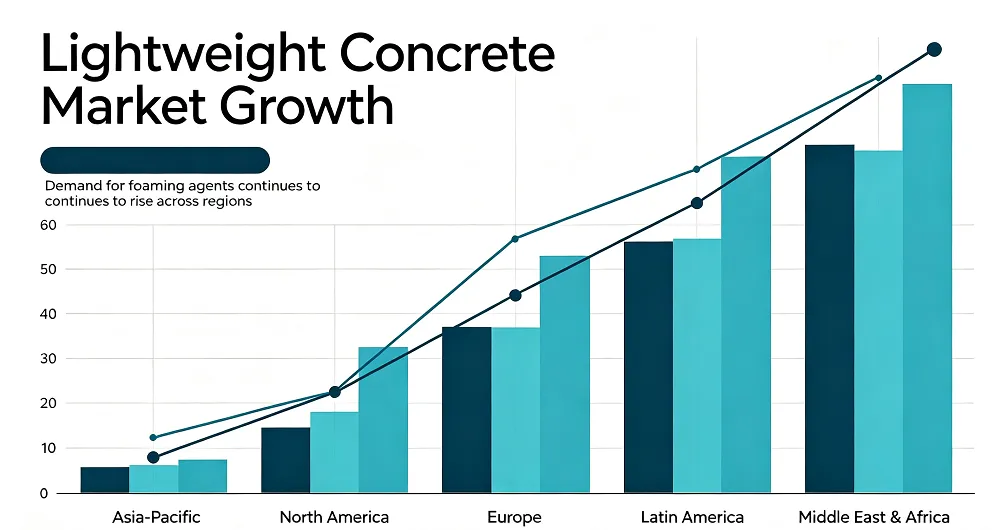
Lightweight Concrete Market Growth: The Numbers Tell a Clear Story
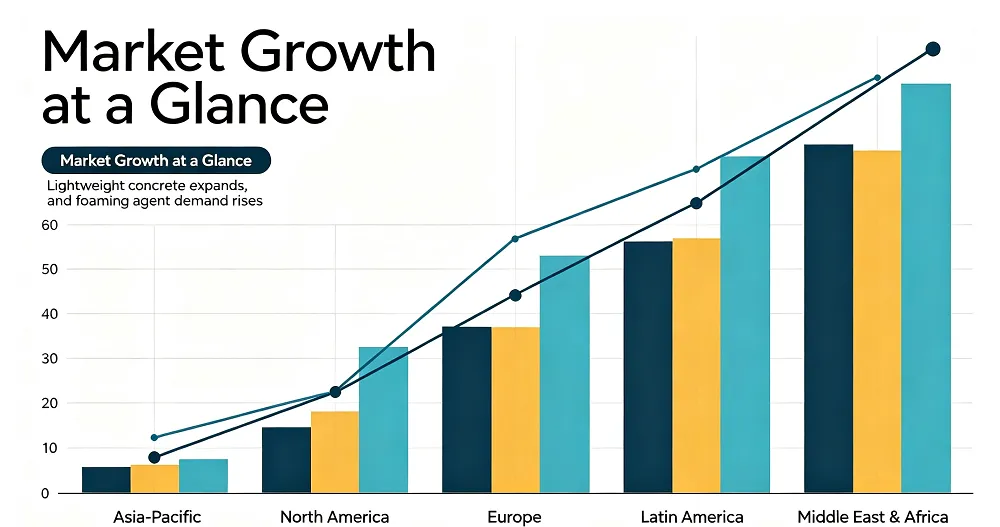
The global lightweight concrete market continues to expand across multiple segments. As a significant sub-segment, the foamed concrete market is projected to grow at a steady rate through the coming decade. The lightweight aggregate concrete market, which includes foamed concrete and cellular lightweight concrete, also demonstrates steady growth momentum.
The Asia-Pacific region accounts for a substantial share of global lightweight concrete consumption, driven by rapid development in key countries experiencing accelerated urbanization and infrastructure construction. North America and Europe follow closely.
Within this expanding lightweight concrete market, lightweight concrete blocks and panels—particularly those produced with high-performance foaming agents—are steadily gaining market share as builders seek materials that combine structural performance with thermal efficiency.
Core takeaway: The lightweight concrete market is growing across multiple segments simultaneously, making increased demand for foaming agents an inevitable outcome.
Two Key Drivers of the Lightweight Concrete Foaming Agent Market
The expansion of the foaming agent market is driven by two mutually reinforcing forces. Together, they are reshaping the construction materials landscape and creating sustained demand for advanced foaming solutions.
Driver 1: Lightweight Concrete Applications Are Broadening
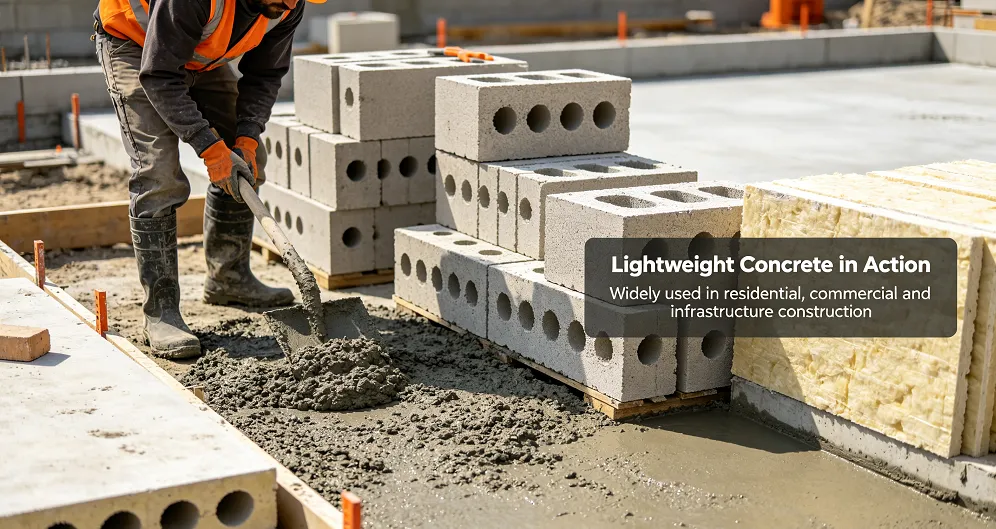
What was once primarily a material for blocks and wall panels has now evolved into a versatile solution used across a wide spectrum of construction and engineering scenarios. Today, lightweight concrete is being deployed in:
- Building insulation and thermal protection systems — exterior wall insulation, roof insulation, and floor heating systems all benefit from the excellent thermal performance of lightweight concrete, significantly reducing building energy consumption.
- Infrastructure backfill and void filling — lightweight concrete provides an ideal solution for filling voids behind retaining walls, bridge abutments, and underground utility trenches, reducing lateral pressure on structures while offering long-term stability.
- Bridge deck construction and tunnel linings — the reduced weight of lightweight concrete minimizes structural load on bridges and tunnels, while its thermal insulation properties help protect against freeze-thaw damage in cold climates.
- 3D concrete printing — the rheological properties of lightweight concrete, combined with its ability to maintain shape during extrusion, make it a promising material for additive manufacturing in construction, enabling complex geometries with reduced material usage.
- Prefabricated components and modular construction — lightweight concrete panels, blocks, and beams are easier to manufacture, transport, and install, accelerating construction timelines and reducing on-site labor requirements.
- Geotechnical engineering — applications such as cavity filling, pipeline abandonment, and slope stabilization benefit from the flowable nature of lightweight concrete, which can be pumped into difficult-to-access areas and provide long-term ground support.
Each application demands something slightly different from a foaming agent for lightweight concrete — some require ultra-fine bubbles to achieve high-density closed-cell structures for superior strength, others need extended stability under pressure during pumping over long distances, and still others require compatibility with specific binders or additives used in specialized formulations. This diversity of use cases is pushing the market toward more specialized, high-performance foaming agents that can be tailored to meet the precise requirements of each application.
The breadth of these applications also means that manufacturers cannot rely on a one-size-fits-all approach. Instead, they require foaming agents with consistent performance characteristics that can be adapted to different production conditions, curing environments, and performance targets. This is precisely where high-performance solutions like RBOSCHCO’s TR-B excel—offering the flexibility to perform reliably across a wide range of demanding applications.
Driver 2: Construction Industry Demand for Lightweight Materials Is Rising
Across the global construction industry, there is a clear and accelerating shift toward lighter, more efficient building materials. This shift is being driven by multiple factors that are transforming how buildings and infrastructure are designed, constructed, and operated.
- High-rise building construction — as urban populations continue to grow and land becomes increasingly scarce, cities are building taller than ever before. Every kilogram of structural weight saved translates directly into reduced foundation loads, lower material requirements for columns and shear walls, and significant cost savings in both materials and labor. Lightweight concrete enables architects and engineers to push the limits of building height while maintaining structural integrity and safety.
- Prefabricated components and modular construction — the construction industry is increasingly embracing off-site manufacturing as a means to improve quality control, reduce waste, and accelerate project delivery. Lightweight concrete components are inherently easier to handle, transport, and assemble on-site. This reduces the need for heavy lifting equipment, shortens crane cycles, and minimizes the risk of on-site accidents, making construction projects safer and more cost-effective.
- Green building standards and energy efficiency — building codes and sustainability certification programs such as LEED, BREEAM, and various national green building standards are becoming more stringent worldwide. Lightweight concrete’s inherent thermal insulation properties help buildings achieve lower energy consumption for heating and cooling, reducing operational carbon emissions over the building’s lifecycle. Additionally, the reduced material usage associated with lightweight concrete contributes to lower embodied carbon, aligning with the growing emphasis on whole-life carbon assessment.
- Logistics and transportation efficiency — the reduced weight of lightweight concrete components translates directly into lower transportation costs and reduced fuel consumption during delivery. For large-scale projects involving significant material volumes, these savings can be substantial and contribute to the overall economic viability of lightweight concrete solutions.
- Labor efficiency and construction speed — lighter materials mean less physical strain on workers, faster installation times, and reduced reliance on heavy machinery. In markets where skilled labor is in short supply, the ease of handling and installing lightweight concrete components offers a clear competitive advantage.
As prefabrication, modular construction methods, and green building practices become more prevalent across all regions, the need for stable, reliable foaming agent quality continues to grow. Builders and manufacturers are increasingly demanding foaming agents that can deliver consistent results batch after batch, ensuring that lightweight concrete components meet required specifications for density, strength, and thermal performance.
The demand for lightweight materials is no longer a passing trend — it represents a structural shift in how buildings are designed and constructed. This transformation creates a lasting and growing market for high-performance foaming agents that can enable the next generation of lightweight, energy-efficient, and sustainable building solutions.

From Ordinary Foaming Agents to High-Performance Foaming Agents
As lightweight concrete is applied to more demanding scenarios, the requirements for foaming agents continue to evolve.
Traditional foaming agents focused on a single objective: generating foam. The new generation of high-performance foaming agents, however, is evaluated against a different set of criteria—foam stability, closed-cell ratio, adaptability to different binders, and the compressive strength of the resulting concrete.
RBOSCHCO’s TR-B Protein Foaming Agent exemplifies this next-generation performance. As a hybrid formula that combines the performance of protein-based products with the versatility of synthetic alternatives, TR-B delivers exceptional foam stability and uniform pore structure. When diluted with water and processed through foam generation equipment, TR-B produces stable, fine bubbles that integrate seamlessly with cement and gypsum mortars to create lightweight insulating structural elements. It is suitable for a broad range of lightweight concrete applications, including CLC blocks, wallboards, insulation floors, and non-load-bearing panels.
Key performance advantages of this high-performance foaming agent include:
- Superior foam stability — foam remains intact for extended periods, ensuring consistent performance during mixing, pumping, and placement
- Adjustable foam and concrete density — supports a wide range of lightweight concrete formulations
- Excellent compatibility — works effectively with all types of cement
- Minimal volume loss — during mixing and pumping operations
- Environmentally safe — non-toxic, non-corrosive, non-combustible, and free of formaldehyde, ammonia, and heavy metals
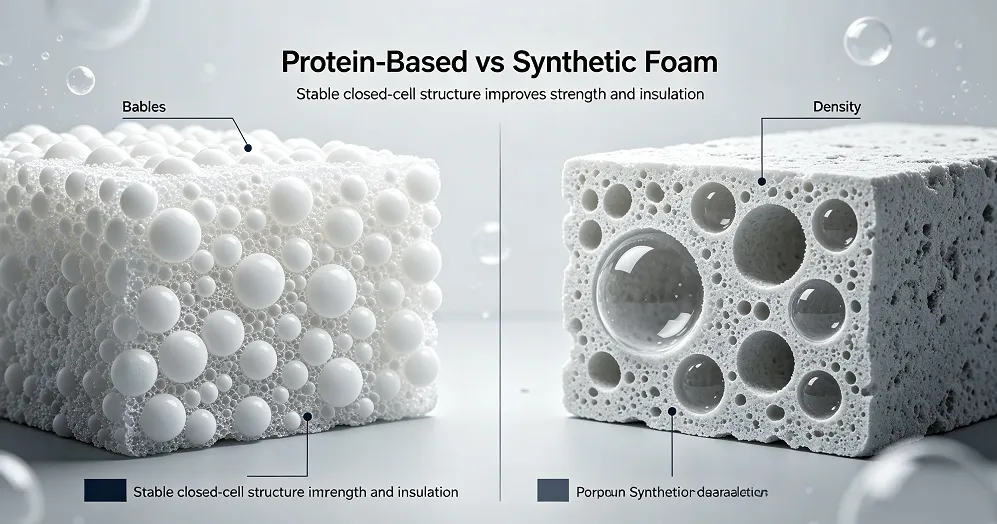
High-performance foaming agents like TR-B are designed to achieve superior closed-cell ratios, forming spherical thin-shell structures within the foamed concrete that significantly enhance mechanical strength and thermal insulation performance.
Research confirms that protein-based foaming agents produce smaller, more isolated spherical bubbles compared to synthetic alternatives, resulting in better mechanical properties and thermal resistance. This makes protein-based formulations particularly valuable in high-end applications where performance cannot be compromised.
The market is differentiating — and not all foaming agents will benefit equally from the growth of the lightweight concrete market.
Regional Landscape of the High-Performance Foaming Agent Market
| Region | Market Characteristics & Drivers | Growth Potential |
|---|---|---|
| Asia-Pacific | Largest consumer globally. Rapid urbanization, large-scale infrastructure investment, and government policies promoting green building materials. | Fastest-growing for foaming agents |
| North America | Significant market share. Geotechnical applications and green building certification programs driving demand for low-impact materials. | Steady growth for high-performance foaming agents |
| Europe | Strong market presence. Environmental regulations pushing transition to bio-based, low-VOC foaming agents. | Stable growth; bio-based foaming agent segment gaining share |
| Latin America | Infrastructure development gradually recovering, creating new opportunities. | Gradual growth |
| Middle East & Africa | Large-scale construction projects driving emerging demand. | Emerging market |
Seizing the Opportunity in the Lightweight Concrete Market
RBOSCHCO recognizes that the expansion of the lightweight concrete market is an undeniable trend, opening a significant and sustained window of opportunity for the foaming agent industry. As lightweight concrete continues to move from niche applications to mainstream construction practice across residential, commercial, and infrastructure sectors, the demand for reliable, high-performance foaming agents will only intensify. Market opportunities, however, will not be evenly distributed—they will belong to those who can deliver high-performance foaming agents with superior foam stability, higher closed-cell ratios, and better overall strength performance. Builders and manufacturers are no longer simply looking for any foaming agent; they are seeking solutions that can meet the increasingly stringent requirements of modern construction, from thermal efficiency to structural integrity to environmental compliance. With over 12 years of industry experience, a steadfast commitment to technological innovation, rigorous quality control from raw materials to finished products, and a deep understanding of evolving customer needs, RBOSCHCO is dedicated to being your most trusted material partner in this wave of growth. Whether your application involves building insulation, prefabricated components, infrastructure backfill, or CLC block production, RBOSCHCO’s TR-B Protein Foaming Agent is engineered to deliver the performance and consistency you can count on.
Supplier
RBOSCHCO is a trusted global chemical material supplier and manufacturer with over 12 years of experience in providing high-quality chemicals and nanomaterials. The company’s TR-B Protein Foaming Agent is specifically engineered for lightweight concrete production, offering reliable performance across a wide range of applications including building insulation, prefabricated components, infrastructure backfill, and CLC block production. RBOSCHCO maintains a professional technical department and quality control team, equipped with advanced testing facilities to ensure strict quality assurance from raw materials to finished products. Complete test reports and technical support are available upon request.
RELATED POSTS

Preparation and Application of Graphite

What Should You Consider When Choosing Protein-Based Foaming Agents or Synthetic Foaming Agents?
Rutile vs. Anatase Titanium Dioxide — Two Crystal Phases, Two Distinct Applications

Nanomaterials Uses

Ignite Unstoppable Growth: Nano Gold Colony Dominates the Future of Green Tech & Global Trade