Professional and high-quality metal alloys, ceramic products and concrete additives | RBOSCHCO

Abstract
O3-type layered oxide O3-Naₓ(FeᵧMn₁⁻ᵧ)O₂ has garnered significant attention as a promising cathode material for sodium-ion batteries (SIBs) due to its high specific capacity, low cost, and structural stability. This review systematically summarizes the crystal structure, element composition modulation strategies, synthesis process optimization, electrochemical performance, and challenges such as phase transitions, air instability, and large-scale production difficulties. Finally, future research directions are proposed.
1. Introduction
Sodium-ion batteries (SIBs) are considered a viable alternative to lithium-ion batteries (LIBs) in energy storage applications. The cathode material is a critical factor determining SIB performance. O3-type layered oxide O3-Naₓ(FeᵧMn₁⁻ᵧ)O₂, with tunable Fe/Mn ratios, exhibits excellent electrochemical properties and has become a research hotspot.
2. Material Characteristics
2.1 Crystal Structure
O3-Naₓ(FeᵧMn₁⁻ᵧ)O₂ belongs to the hexagonal crystal system (space group P6₃/mmc). Its layered structure alternates [MO₆] octahedral layers with Na⁺ ion layers, enabling reversible Na⁺ intercalation/deintercalation for high specific capacity and fast charging/discharging. However, the larger Na⁺ radius compared to Li⁺ results in longer diffusion paths, necessitating elemental doping to optimize ion transport.
2.2 Element Composition and Modulation
By adjusting the Fe/Mn ratio (y value), the electrochemical performance can be significantly optimized:
- Low y value (Mn-rich): Dominated by Mn³⁺/Mn⁴⁺ redox couples, offering a high voltage platform (~3.0 V vs. Na⁺/Na) and higher specific capacity. For example, at y=0.5, the material achieves 160 mAh/g at 0.1C.
- High y value (Fe-rich): Fe³⁺/Fe⁴⁺ redox couples contribute additional capacity but may reduce voltage platform and cycle stability. At y=0.7, the material retains only 60% capacity after 100 cycles, compared to 80% at y=0.5.
2.3 Physical Performance
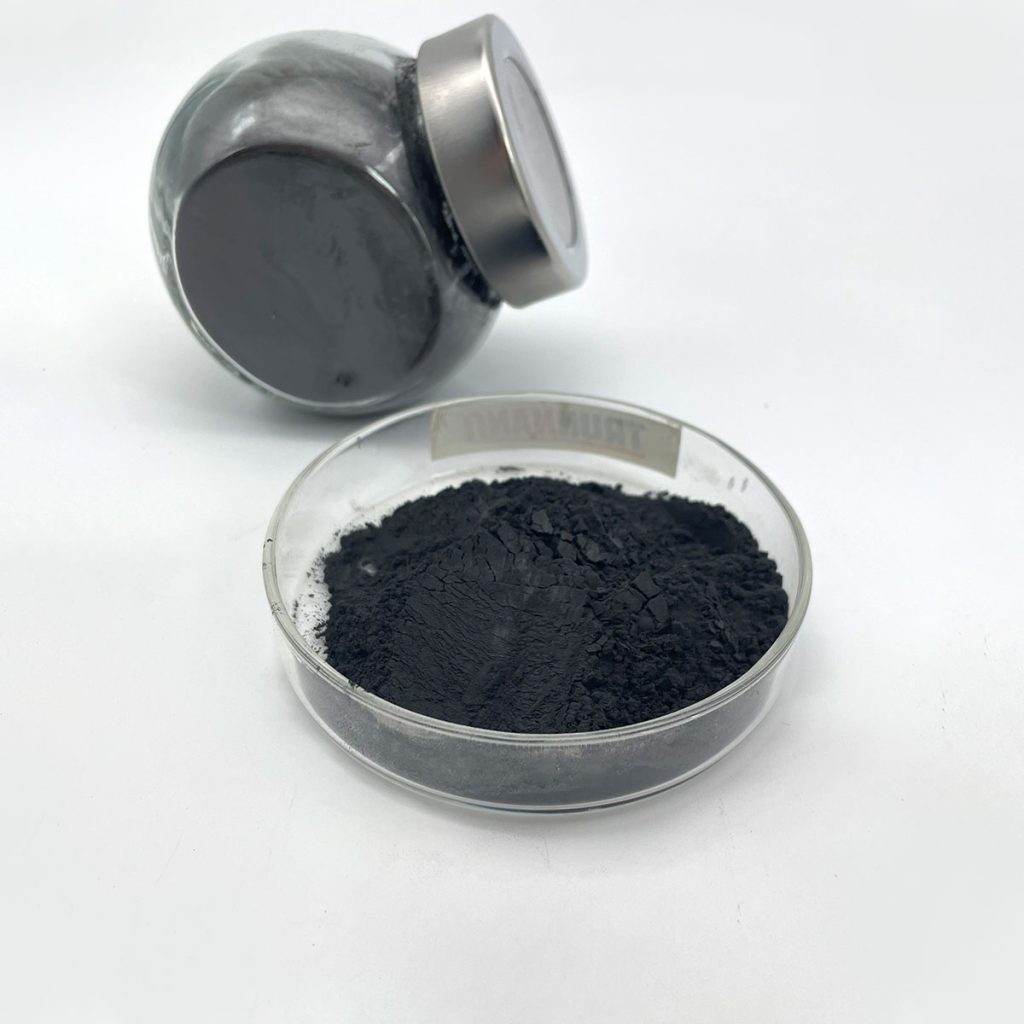
- Color: Deep gray or black, dependent on Fe/Mn ratio (darker for Mn-rich, lighter for Fe-rich).
- Tap Density: Influenced by particle morphology and size, directly affecting electrode compaction density and battery energy density. Co-precipitation methods yield higher tap densities.
- Dry Particle Size (D50): Typically controlled between 5–15 μm. Particles <5 μm complicate electrode processing, while particles>15 μm impede ion diffusion.
- Residual Alkali pH: Regulated via washing to avoid side reactions. Unwashed materials exhibit pH >10, while washed materials show pH 7–8.
3. Electrochemical Performance
3.1 Specific Capacity
- Theoretical Capacity: 120–150 mAh/g. Optimized y values and synthesis processes achieve 100–130 mAh/g (0.1C). Notably, y=0.38 yields 190 mAh/g at 0.1C.
- Voltage Platform:
- Mn-rich (y=0.5–0.7): Stable platform near 3.0 V.
- Fe-rich (y>0.7): Additional capacity in the 2.5–2.8 V range.
Fe/Mn Ratio Impact Comparison
| Characteristic | Mn-Rich (Low y) | Fe-Rich (High y) |
| Voltage platform | Higher (Mn³⁺/Mn⁴⁺ redox) | Lower (Fe³⁺/Fe⁴⁺ redox) |
| Specific capacity | Lower (Jahn-Teller effect) | Higher (more redox sites) |
| Structural stability | Poorer (Mn³⁺ distortion) | Better (Fe stabilization) |
| Cycle life | Shorter (structural stress) | Longer (phase transition suppression) |
| Synthesis difficulty | Higher (Mn valence control) | Lower (Fe easier to control) |
| Cost | Lower (abundant Mn) | Higher (Fe price volatility) |
3.2 Cycle Life
- Degradation Mechanisms: Structural distortion during Na⁺ extraction/insertion and Mn³⁺ disproportionation (3Mn³⁺ → 2Mn⁴⁺ + Mn²⁺).
- Stability: Mn-rich (y=0.5–0.7) retains >80% capacity after 100 cycles; Fe-rich materials require doping (e.g., Al³⁺, Ti⁴⁺) or carbon coating for improvement.
3.3 Coulombic Efficiency
- Initial Efficiency: 70–80%; >95% after 5–10 cycles.
- Key Factors: Residual alkali, SEI film formation, and side reactions. Optimized washing and surface coatings enhance efficiency.
3.4 Energy Density
- Practical Density: 120–150 Wh/kg (comparable to lithium iron phosphate batteries).
- Improvement Pathways: Phase transition suppression via doping (Al³⁺, Ti⁴⁺) or surface coatings.
4. Synthesis Processes
4.1 Synthetic Routes
- Solid-State Method: Traditional approach using Fe₂O₃, MnO₂, and Na₂CO₃. Low cost but poor uniformity (160 mAh/g at y=0.5).
- Sol-Gel Method: Produces uniform nanoparticles at a higher cost (170 mAh/g at y=0.5).
- Co-Precipitation: Industrial-scale method controlling pH/precursor concentration (190 mAh/g at y=0.38).
4.2 Sintering Parameters
- Temperature: 900–1000°C (optimal at 950°C; excessive heat causes Na loss/crystal distortion).
- Time: 6–12 hours (shorter times risk incomplete reactions; longer times increase energy consumption).
4.3 Post-Treatment
- Washing: Reduces residual alkali (pH 7–8 post-wash).
- Drying: Spray/vacuum drying controls moisture (<0.1%, e.g., 0.05% after spray drying).

5. Challenges and Solutions
5.1 Phase Transitions
- Fe-Rich Materials: Jahn-Teller distortion (Fe³⁺/Fe⁴⁺) induces lattice strain and accelerates degradation.
- Mn-Rich Materials: Mn³⁺ disproportionation destabilizes the layered structure.
- Structural Irreversibility: O3→O1 phase transition (6% volume contraction) causes microcracks and capacity fade.
5.2 Air Stability
- Moisture Sensitivity: O3 structure absorbs humidity, degrading performance. Mitigation strategies include Al₂O₃/carbon coatings or inert gas protection (carbon-coated materials degrade <5% after 24 hours of exposure).
5.3 Cost and Scalability
- Raw Material Costs: Mn/Fe are inexpensive, but purification increases costs (wet metallurgy reduces costs by 20%).
- Production Optimization: Continuous sintering furnaces improve efficiency by 50%.
6. Future Directions
- Element Doping/Coating: Multielement doping (e.g., Al³⁺ + Ti⁴⁺) and atomic layer deposition (ALD) for interface engineering.
- Industrialization: Develop scalable synthesis processes (e.g., promote co-precipitation adoption).
7. Conclusion
O3-Na(FeMn₁₋ᵧ)O₂ demonstrates significant potential as a low-cost, high-energy-density cathode material. Addressing phase transitions and air stability through doping, coatings, and process optimization will be critical for commercialization.
Tags: Sodium-ion battery, Layered oxide, O3-Na(FeMn)O₂, Cathode material, Electrochemical performance
RELATED POSTS
Performance comparison between silicon carbide ceramics and silicon nitride ceramics

Redefining Industrial Durability: The Dynamic Contrast Between Titanium Carbide and Tungsten Carbide in a High-Stakes Market
How to Improve Conductivity & Corrosion Resistance? Try Titanium Copper Clad Plate
Tungsten SilicidePowder: A High-Performance Conductive Porcelain Product for Advanced Electronic Devices and High-Temperature Applications

Understanding the Waterproofing Mechanism of Calcium Stearate Powder in Concrete: From Pore Structure to Hydrophobic Effect