Professional and high-quality metal alloys, ceramic products and concrete additives | RBOSCHCO

Lightweight concrete has become an increasingly important material in modern construction, offering reduced structural weight, improved thermal insulation, and better sound absorption compared to conventional concrete. At the heart of every lightweight concrete mix is the foaming agent — the additive that creates the air bubbles responsible for the material‘s low density and insulating properties. While synthetic foaming agents have long been available, protein-based foaming agents have gained a strong reputation for producing more stable, uniform foam that leads to better final product quality. TR-B Protein Foaming Agent is a hybrid formula that combines the performance advantages of protein-based chemistry with the processing agility of synthetic products, offering lightweight concrete producers a reliable solution for consistent, high-quality foam generation. This article explores why protein-based foaming agents are preferred for lightweight concrete applications, how they work, and what makes TR-B a standout choice for manufacturers of insulation blocks, wall panels, and other lightweight concrete products. Whether you are producing CLC blocks, insulating floor systems, or backfill materials, understanding the role of a protein-based foaming agent is essential to achieving consistent product quality and production efficiency.

What Is a Protein-Based Foaming Agent?
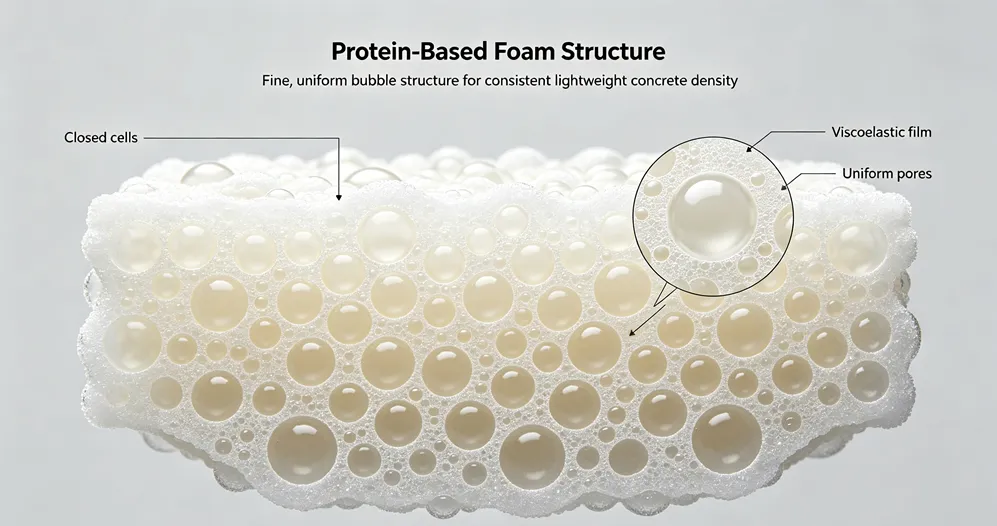
A protein-based foaming agent is a type of concrete admixture that uses hydrolyzed proteins as its primary foaming component. These proteins are typically derived from natural sources such as animal keratin, plant proteins, or other renewable materials. When diluted with water and processed through a foam generator, the protein molecules arrange themselves at the air-water interface, forming a strong, elastic film around each bubble.
This protein film is the key to the performance of protein-based foaming agents. Compared to synthetic surfactants, protein films are more resistant to drainage and rupture, meaning the foam remains stable for longer periods. This stability translates directly into better pore structure in the finished lightweight concrete, with more uniform bubble size distribution and a higher proportion of closed cells.
TR-B Protein Foaming Agent takes this concept further by using a hybrid formula that combines protein-based performance with the handling characteristics of synthetic products. The result is a protein-based foaming agent that delivers the foam stability and pore structure quality of protein chemistry while offering the ease of use and processing flexibility that modern lightweight concrete production requires. For manufacturers who have struggled with inconsistent foam quality from synthetic foaming agents, TR-B offers a reliable alternative that does not compromise on production efficiency.
How Protein-Based Foaming Agents Work
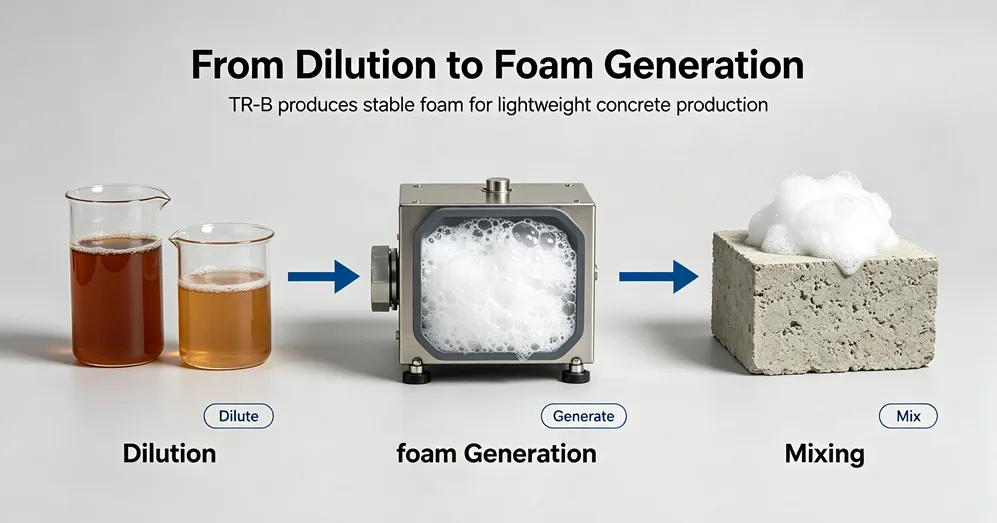
The working mechanism of a protein-based foaming agent involves several stages, from dilution through foam generation to final concrete formation. Understanding this mechanism helps explain why protein-based foaming agents outperform synthetic alternatives in many lightweight concrete applications.
When TR-B Protein Foaming Agent is diluted with water at the recommended ratio, the protein molecules disperse throughout the solution. The diluted solution is then passed through a foam generator, where compressed air is introduced to create bubbles. As the bubbles form, protein molecules migrate to the air-water interface and arrange themselves into a cohesive film.
This protein film has several important properties that distinguish it from synthetic surfactant films. First, it is viscoelastic, meaning it can stretch and deform without rupturing. This allows bubbles to withstand the mechanical stresses of mixing, pumping, and pouring without collapsing. Second, the protein film has a high surface charge, which creates electrostatic repulsion between bubbles and prevents them from coalescing. Third, the protein film is relatively impermeable to air, which slows the rate at which bubbles shrink or grow over time.
These properties together produce a foam that is stable, uniform, and capable of maintaining its structure throughout the concrete mixing and curing process. The resulting lightweight concrete has a consistent pore structure, which translates into predictable density, strength, and thermal performance. This is why protein-based foaming agents are often the preferred choice for applications where consistent density and thermal insulation are critical, such as insulation blocks, wall panels, and floor systems.
Key Advantages of Protein-Based Foaming Agents
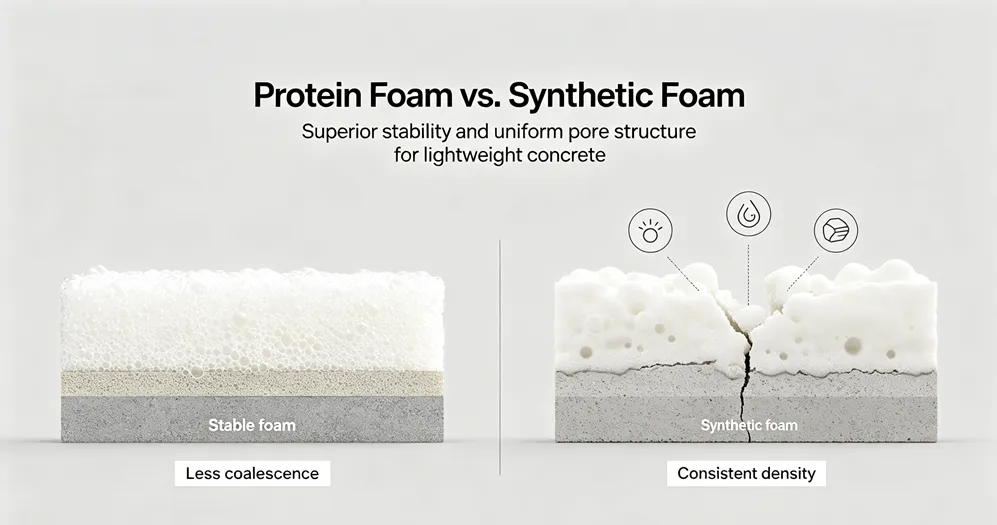
Protein-based foaming agents like TR-B offer several advantages over synthetic alternatives, particularly in applications where foam stability and pore structure quality are critical. These advantages are the result of the unique chemistry of protein films and their interaction with cementitious systems.
- Superior Foam Stability — Protein films are more resistant to drainage and rupture than synthetic surfactant films. The foam remains stable for extended periods, allowing enough time for the concrete to set without bubble collapse. This is especially important in large pours or in hot weather, where synthetic foams may break down before the concrete hardens. With TR-B, the stable foam remains upright for approximately 6 hours, providing ample working time.
- Uniform Pore Structure — The high surface charge of protein films prevents bubbles from coalescing, resulting in a narrow bubble size distribution. This uniform pore structure gives the lightweight concrete consistent density and predictable thermal insulation performance. For manufacturers producing insulation blocks or wall panels with strict density specifications, this uniformity is essential.
- High Closed-Cell Content — Protein-stabilized foams tend to produce a higher proportion of closed cells compared to synthetic foams. Closed cells are important for thermal insulation because they prevent air movement within the concrete, and they also reduce water absorption. This makes protein-based foaming agents particularly suitable for exterior insulation applications where moisture resistance is important.
- Reduced Volume Loss — TR-B Protein Foaming Agent is formulated to minimize volume loss during mixing and pumping. This means that the foam structure remains intact throughout the production process, ensuring that the final concrete achieves the target density. Concrete mixing time has no volume loss, and volume loss during pumping is minimized.
- Compatibility with All Cement Types — TR-B works effectively with all types of cement, including ordinary Portland cement, slag cement, fly ash cement, and gypsum-based systems. This versatility makes it suitable for a wide range of lightweight concrete formulations without requiring adjustments to the foaming agent.
- Environmental Safety — TR-B is based on natural protein sources and is non-toxic, non-corrosive, and non-combustible. It is free from formaldehyde, ammonia, heavy metals, and halogens, making it safe for workers and environmentally friendly. The product is based on nature, with no harmful effects on the environment.
- Antimicrobial Protection — TR-B contains an antimicrobial agent effective against mold in concrete, helping to maintain the quality and durability of the finished lightweight concrete product over time.
TR-B Protein Foaming Agent: Product Overview
TR-B Protein Foaming Agent is a brown liquid concentrate with a solid content of 40%. It is designed for dilution with water before use, typically at a ratio of 1:20 to 1:30, and is processed through a foam generator to produce foam for mixing with cement or gypsum mortar.
The recommended dosage of TR-B ranges from 0.75 to 1.25 kg per cubic meter of concrete, depending on the target density and application requirements. The product has a foaming multiple of ≥30, meaning that one liter of foaming agent solution produces at least 30 liters of foam. The bleeding rate is 27 ml, indicating good foam stability with minimal liquid drainage over time.
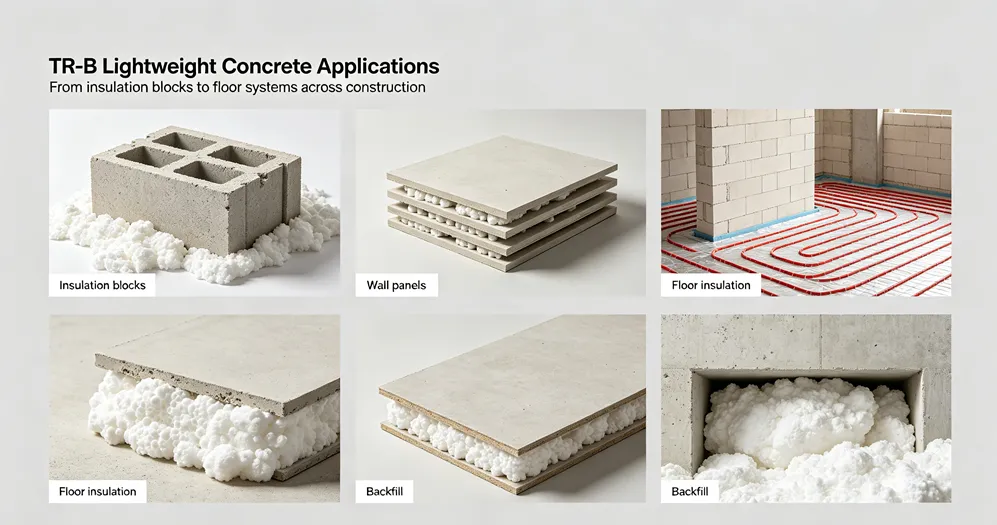
TR-B is suitable for a wide range of lightweight concrete applications, including:
- Lightweight insulation concrete production
- Insulation lightweight block, brick, and wallboard production
- Heat and sound insulation floor systems
- Non-load-bearing wall panels
- Cement or gypsum board manufacturing
- Soil filling to prevent landslides
- Underground drainage filling
- Deicing under bridges and roads
- Filling of tunnels and shafts
- Production of thermal insulation lightweight concrete with polystyrene foam particles
- Perlite cream mix
- Production of lightweight insulation floor and wall in steel structure systems
- Single-story building load-bearing walls
For storage, TR-B should be kept in a cool, dark place away from direct sunlight and extreme temperatures. The recommended storage temperature range is 5°C to 30°C. The product should be kept in sealed containers to prevent contamination and evaporation, and should be protected from strong acids, alkalis, and oxidizing agents. Proper storage ensures that the protein-based foaming agent retains its performance and shelf life.
How to Use TR-B Protein Foaming Agent
Using TR-B Protein Foaming Agent correctly is essential to achieving the desired foam quality and concrete performance. The following guidance covers the key steps in the process.
Dilution
TR-B should be diluted with water before use. The recommended dilution ratio is 1:20 to 1:30 (one part foaming agent to 20–30 parts water by volume). The diluted solution should be mixed thoroughly to ensure uniform distribution of the protein-based foaming agent.
Foam Generation
The diluted solution is passed through a foam generator, which introduces compressed air to create foam. The foam generator should be adjusted to produce a fine, uniform foam with the desired density. The foam density can be adjusted between 80 and 95 g/L, depending on the target concrete density.
Mixing with Cement or Gypsum
The generated foam is mixed with cement slurry or gypsum mortar to produce lightweight concrete. The foam should be added gradually while mixing to ensure even distribution throughout the mix. The concrete density can be adjusted between 115 kg/m³ and 1,600 kg/m³ by varying the amount of foam added.
Setting and Curing
TR-B reduces the setting time of concrete, allowing for faster demolding and increased production efficiency. At an air temperature of 25°C, the molding time is approximately 5 hours. The stable foam structure remains intact for about 6 hours, providing ample working time for placement and finishing.
Why Choose TR-B Protein Foaming Agent?
TR-B Protein Foaming Agent represents a balanced approach to lightweight concrete foaming. By combining protein-based foam stability with the processing advantages of a hybrid formula, TR-B delivers consistent performance across a wide range of applications and production conditions.
For manufacturers of lightweight concrete blocks, wall panels, and insulation materials, TR-B offers:
- Reliable Foam Stability — The protein-based film structure maintains bubble integrity throughout mixing, pumping, and placing, ensuring consistent density in the finished product.
- Uniform Pore Structure — The narrow bubble size distribution produces lightweight concrete with predictable thermal and mechanical properties.
- Broad Application Coverage — From insulation blocks to floor systems to backfill applications, TR-B is suitable for a wide range of lightweight concrete products.
- Environmental Safety — The natural protein base and absence of harmful substances make TR-B a safe choice for workers and the environment.
- Production Efficiency — Reduced setting time and minimal volume loss contribute to higher productivity and lower waste.
Supplier
RBOSCHCO is a trusted global chemical material supplier and manufacturer with over 12 years of experience in providing high-quality chemicals and nanomaterials, including boride powder, nitride powder, graphite powder, sulfide powder, and 3D printing powder. The company has a professional technical department and quality supervision department, a well-equipped laboratory with advanced testing equipment, and a dedicated after-sales customer service center. RBOSCHCO supplies TR-B Protein Foaming Agent worldwide, suitable for lightweight insulation concrete, insulation blocks, wall panels, floor systems, and backfill applications. The company offers comprehensive technical support, from product selection to application guidance. If you are looking for a high-quality protein-based foaming agent for lightweight concrete production, please feel free to contact us.
RELATED POSTS

Aluminum Nitride (AlN) Powder: The Advanced Ceramic Material Driving Next-Generation Thermal Management Solutions
Silicon Nitride Bonded Silicon Carbide: High-Performance Ceramic Solutions for Advanced Industrial Applications

Adjustable Temperature Soldering Iron Heater: The Ultimate Guide to Precision, Efficiency, and Durability

Silicon Carbide Ceramic:The Superhero Material Shaping Modern Industry

Redefining Industrial Durability: The Dynamic Contrast Between Titanium Carbide and Tungsten Carbide in a High-Stakes Market