Professional and high-quality metal alloys, ceramic products and concrete additives | RBOSCHCO

Description of Silicon carbide (SiC) ceramics
Silicon carbide (SiC) ceramics have the top spot in the field of high-temperature structural ceramics because of their lower thermal expansion coefficient, their high thermal conductivity, remarkable hardness, and their excellent chemical and thermal stability. They are extensively used in nuclear energy, aerospace, military, and semiconductor sectors.
Due to SiC’s strong covalent bonds as well as its small diffusion coefficients, the process of achieving total densification for SiC ceramics poses a number of challenges. Thus, various sintering techniques are being developed specifically for SiC ceramics, which include reaction sintering, pressureless solid-state sintering, pressureless liquid-phase hot-press sintering, and recrystallization sintering. Each of these techniques for sintering has its own advantages and produces SiC ceramics that vary in the microstructure, properties, and domains in which they can be used. Do you know the different kinds of ceramics made from silicon carbide?
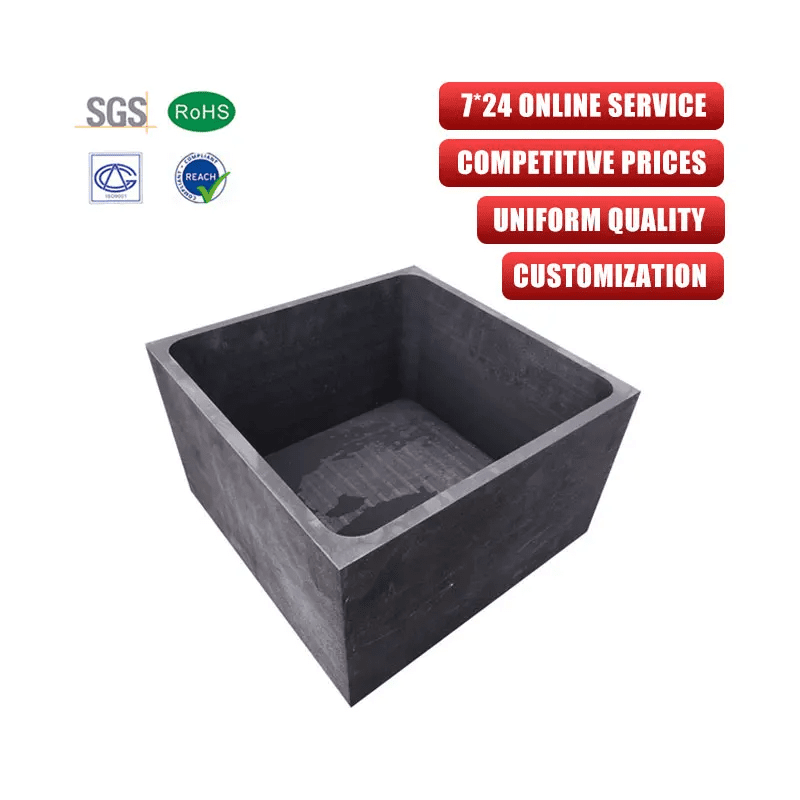
Silicon carbide (SiC) ceramics
Pressureless Sintered SiC Ceramics (S-SiC)
Pressureless sintering is considered to be the most effective method of sintering SiC. This method allows for different forming techniques, provides lower costs for production, and does not impose any limitations on the shape or size. It is the most popular and easily achievable method of batch processing.
Pressureless Sintering is the process of adding boron and carbon to b-SiC that contains trace oxygen, and then sintering under an inert atmosphere at around 2000°C to produce a sintering body that has 98 per cent theoretical density. This technique generally uses two strategies: solid-phase or liquid-phase sintering. In both, unpressed solid-phase sintered silicon carbide displays excellent density and purity and distinctive properties like extraordinary thermal conductivity and high-temperature strength. This makes it easier to process into complex, large-scale ceramic parts.
In real-world applications, the sintering that is not press-pressed of SiC provides simple operation and affordable costs, making it ideal for the production of ceramic parts with various forms. SiC is widely used in corrosion-resistant and wear-resistant products like sealing rings and sliding bearings. Furthermore, due to its superior hardness, low density, favourable ballistic properties, its superior energy absorption after fragmentation and the cost-effectiveness of sintered, unpressed SiC ceramics, they are widely used to make ballistic armour. They include protection systems for vessels and vehicles, as well as security solutions for safes used by civilians and armoured cash vehicles, as a ballistic armour product that has superior multi-impact resistance, and overall protection that is superior to traditional silica carbide-based ceramics. When used in light circular ceramic armour, its breaking point is greater than 65 tonnes, providing better protection than cylindrical ceramic armour that is made from traditional silica carbide-based ceramics.
Reaction-Sintered SiC Ceramics (RB-SiC)
Reaction-sintered SiC is an extremely attractive structural ceramic that has exceptional mechanical properties that include excellent durability, corrosion resistance and resistance to oxidation. It also has the lowest sintering temperatures as well as lower costs for sintering and the distinct capability of close-net-shape sintering. The process of reaction sintering is simple; the green body is created by mixing a carbon source and SiC powder. In the presence of high-temperature capillary action, silica molten flows through the green body’s porous surface and reacts with the internal carbon source, forming the b-SiC stage. The b-SiC phase is tightly bound to the original a-SiC, and the remaining voids are filled with liquid silicon, which results in an intense sintering process of the ceramic material. The process results in a shrinkage of the dimensional size when sintering, while also achieving close-net-shape-forming, allowing the creation of complicated geometries when required. This is why it has a wide range of applications in the manufacturing of diverse ceramic materials.
The most common applications are furniture for high-temperature kilns and radiator tubes, heat exchangers, and desulphurization nozzles. Additionally, due to the low temperature expansion, its high elastic modulus and near-net-shape ability to sinter, reaction-sintered carbide is now a great material for the production of space mirrors. Furthermore, as wafer sizes and heat treatment temperatures increase, the reaction-sintered silicon carbide material is gradually substituting quartz glass. Making use of high-purity silicon carbide and high-purity silicon permits the creation of high-purity silicon carbide products that have partially silicon phases. They are used extensively in support fixtures used to manufacture electron tubes and semiconductor wafers.
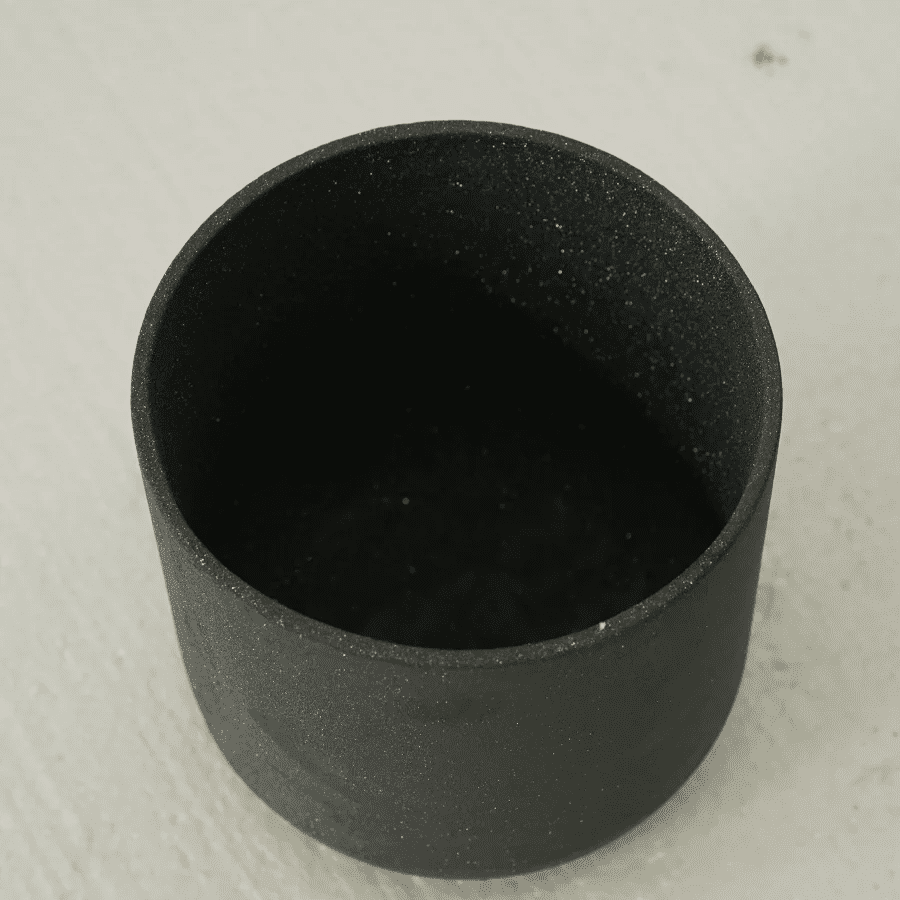
Recrystallised silicon carbide crucible
Hot-Press Sintering of Silicon Carbide Ceramics (HP-SiC)
Hot-press sintering is a process in which the material is subjected to simultaneous sintering as well as forming under high temperatures and pressure. The dry silicon carbide powder gets compressed into graphite moulds with high strength that are kept at a constant pressure as it heats, thereby being able to form and sinter simultaneously.
Since heating and pressurisation take place simultaneously, the powder stays in a thermoplastic state, making it easier for particle contact diffusion along with mass transfer. This allows the creation of silicon carbide products with fine grain sizes, high relative density, and superior mechanical properties at lower temperatures for sintering and shorter sintering times. In addition, the hot-press sintered SiC ceramics can reach complete densification and can be compared to a completely sintered state.
In terms of applications, HP-SiC was initially used as body armour for US personnel on helicopters throughout the Vietnam War in the 1960s. However, technological advancements have seen the premium market for ultra-high-performance armour ceramics dominated by hot-pressed boron carbide, which now represents the pinnacle of armour technology with high added value. In the case of these ceramic materials, the importance of control over composition quality, purity, and densification is far greater than the costs. In addition, HP-SiC finds applications in parts that resist wear as well as those in the nuclear sector.
Recrystallized SiC Ceramics (R-SiC)
Recrystallization sintering has attracted a lot of attention because of its need for no help in sintering. This is the most widely used method for making ultra-pure, huge-scale SiC ceramic bits. The process of making resin-sintered SiC ceramics (R-SiC) is like this: Fine and coarse SiC powders of different particle sizes are blended into particular proportions. Green bodies are created through processes like the slip casting process, compress moulding or extrusion. These green bodies are later fired at extremely high temperatures (2200-2450 degrees Celsius) under protection from inert air. The fine particles eventually disappear in the phase of vapour, and condense near the points of contact with coarse particles, creating R-SiC ceramics.
It is formed at high temperatures. R-SiC is a material with a hardness comparable to that of diamond. It has many of the exceptional properties of SiC, including its durability at high temperatures, a robust resistance to corrosion, a high oxidation resistance and a high temperature shock resistance. This makes it an ideal material for furniture that is heated to high temperatures and heat exchangers, as well as combustion nozzles. In military and aerospace applications, recrystallised silicon carbide is utilised to create parts for aerospace vehicles, such as tail fins, engines and fuselages. Its superior mechanics, resistance to corrosion and impact resiliency significantly enhance efficiency and longevity of service.
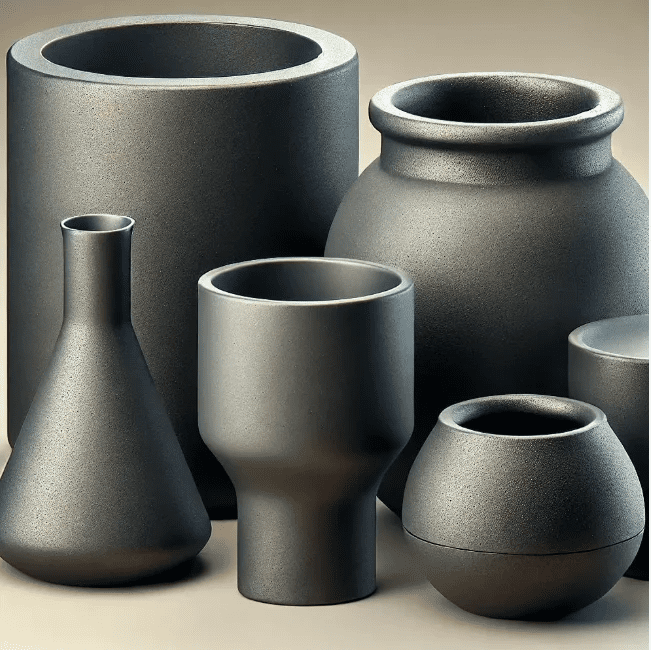
Silicon carbide crucible
Silicon-Infiltrated SiC Ceramics (SiSiC)
As opposed to sintering methods such as the hot press and unpress, silicon infiltration is the most appropriate to be used in industries. SiC production. Its advantages include shorter time to sinter, lower temperatures of sintering, full densification, and little deformation during the sintering process. SiC is composed of a SiC-based matrix, which is infiltrated with an Si phase. Different methods of infiltration yield different properties and uses.
Liquid Infiltration: Silicon carbide is mixed with carbon and pressed into shape. Carbon substrates that are porous can be made through casting, additive manufacturing, or extrusion. Molten silicon is absorbed into the green body. When sintering, silicon reacts with carbon and produces additional silicon carbide, filling pores, enhancing the density and tensile strength. Therefore, this technique is sometimes referred to as reaction-sintered carbide.
Gas infiltration. The vapour of silicon or the reactive gases that contain carbon and silicon permeate carbon-based substances or even silicon carbide blanks, followed by high-temperature reactions or deposition. While costly, this process provides superior ceramic density and uniformity of the free silicon.
In the real world, the very low porosity SiSiC ceramics, which are achieved by silicon permeation, guarantee an airtightness that is unmatched. Additionally, silicon doping enhances the amount of charge-free carriers (electrons, which are also called holes) inside the material, which results in less electrical resistance than silicon carbide. This feature helps to dissipate static electricity that is generated by components. The manufacturing process and the characteristics are especially beneficial for the production of huge, intricate parts or hollow structures. This leads to its widespread use for semiconductor equipment and related applications.
Furthermore, it is equipped with the benefit of having a large elastic modulus. This enables it to take on massive loads without causing significant deformation when subjected to the conditions of microgravity and stresses in the space environment, making sure the accuracy and strength of space-based equipment. Additionally, its exceptional watertightness and airtightness, together with its high strength, exceptional durability, rigidity and extremely light weight, make silicon carbide the top high-performance material for the aerospace industry.
Supplier for Silicon carbide (SiC) ceramics
RBOSCHCO is a trusted global chemical material supplier & manufacturer with over 12 years experience in providing super high-quality chemicals and Nanomaterials. The company export to many countries, such as USA, Canada, Europe, UAE, South Africa,Tanzania,Kenya,Egypt,Nigeria,Cameroon,Uganda,Turkey,Mexico,Azerbaijan,Belgium,Cyprus,Czech Republic, Brazil, Chile, Argentina, Dubai, Japan, Korea, Vietnam, Thailand, Malaysia, Indonesia, Australia,Germany, France, Italy, Portugal etc. As a leading nanotechnology development manufacturer, RBOSCHCO dominates the market. Our professional work team provides perfect solutions to help improve the efficiency of various industries, create value, and easily cope with various challenges. If you are looking for XXX, please feel free to contact us!
RELATED POSTS
Transform Your Market with Unmatched Boron Nitride Porcelain Solutions: The Pinnacle of Thermal Development
Production of Graphene Powder
The Next Profit Margin in The Alumina Industry-Red Mud
Surpassing Graphene? Molybdenum Disulfide Powder, With Its Unique Band Structure, Is Opening Up A New Track In The Field Of Optoelectronics
What is Boron Carbide B4C?
