Professional and high-quality metal alloys, ceramic products and concrete additives | RBOSCHCO

1. Overview and Crystal Structure of Boron Nitride Ceramics
Boron nitride has various crystal structures, among which the most representative are hexagonal boron nitride (h-BN) similar to graphite structure and cubic boron nitride (c-BN) similar to diamond structure. Hexagonal boron nitride ceramic products are the focus of this article’s discussion. Their crystal structure is layered, with strong covalent bonds within each layer and weak van der Waals force connections between layers. This structure endows them with a unique combination of properties: excellent processability, high-temperature lubricity, anisotropic thermal conductivity, and excellent dielectric properties. Cubic boron nitride is known for its extraordinary hardness and is mainly used as a superhard abrasive and tool coating. The preparation of its ceramic body usually requires extremely high pressure and temperature.
2. The main production process of boron nitride ceramic products
The preparation process of boron nitride ceramics varies depending on their product form (such as bulk, coating, composite materials) and performance requirements, but the core process revolves around powder synthesis, forming, and densification.
2.1 Powder synthesis: the source of performance
High quality BN powder is the foundation for preparing high-performance ceramics. The main synthesis methods include:
Boric acid urea method: Using boric acid and urea as raw materials, h-BN is generated through high-temperature nitriding reaction. This method has mature technology and can prepare high-purity and fine-grained powders, making it one of the most commonly used methods in industry. By controlling the process parameters, the crystallinity, particle size, and morphology of the powder can be adjusted.
Borax ammonium chloride method: utilizing the reaction between borax and ammonium chloride. The cost is relatively low, but there may be residual chloride ions in the product, which require subsequent purification treatment.
Chemical Vapor Deposition (CVD): High purity, dense, and structurally controllable BN coatings or films can be obtained by reactive deposition of precursor gases containing boron and nitrogen (such as BCl∝ and NH3) on a high-temperature substrate. This method has complex equipment and high cost, and is suitable for special needs.
High temperature and high pressure method: specifically used for synthesizing c-BN powder, usually transformed from h-BN phase under conditions of several GPa pressure and thousands of degrees Celsius.
2.2. Forming process: endowing the initial form
Select the forming method based on the product shape and subsequent process:
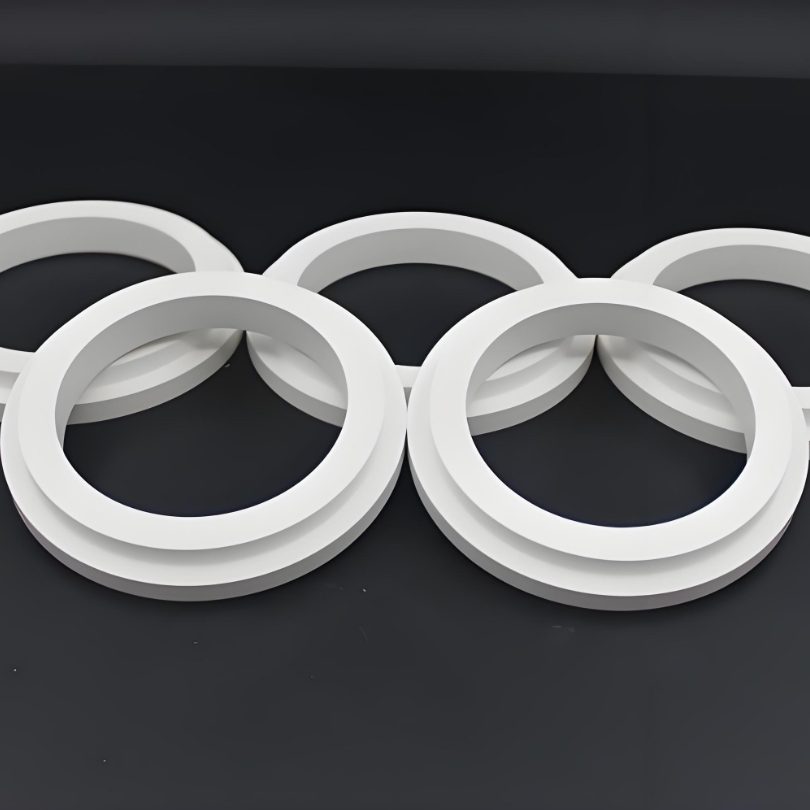
Compression molding: Mix BN powder with a small amount of temporary binder and apply unidirectional or bidirectional pressure in the mold. Suitable for producing simple shaped plates, crucibles, rings, etc. To improve density uniformity, pre pressing granulation process is often used.
Isostatic pressure forming: Load the powder into an elastic mold and apply isotropic pressure through a liquid medium. The preferred method for preparing high-performance BN products is to produce billets with more complex shapes and more uniform density distribution.
Grouting forming: Disperse BN powder in water to make a slurry, and inject it into a porous gypsum mold for forming. Suitable for producing thin-walled, hollow or large-sized special-shaped parts.
Casting forming: Used for preparing BN ceramic thin films or thin substrates, the process is similar to electronic ceramic casting forming.

2.3. Sintering and hot pressing densification: the key to achieving performance
Due to the strong covalent bonds and layered structure of h-BN, its diffusion coefficient is extremely low, and pure h-BN is almost impossible to sinter and compact at normal pressure. Therefore, hot pressing sintering is the most important and effective process for preparing high-density h-BN bulk ceramics.
Process: Fill BN powder into a high-temperature resistant mold (usually a graphite mold), and apply high temperature (1700-2200 ° C) and uniaxial high pressure (10-50 MPa) in a protective atmosphere (such as nitrogen, argon) or vacuum. Under the combined action of heat and force, particles undergo plastic flow, rearrangement, and grain growth, thereby achieving densification.
Sintering aids: In order to reduce the hot pressing temperature or pressure, a small amount of sintering aids (such as B₂O3, Al₂O3, SiO₂, or certain borates) may sometimes be added. However, additives may introduce impurities that affect the high-temperature purity and dielectric properties of BN ceramics, and should be used with caution.
Other densification techniques, including hot isostatic pressing (HIP) and ultra-high pressure sintering, are mainly used to prepare high-density or c-BN ceramic bodies, with extremely high equipment requirements and costs.
2.4. Post processing and application processing
The h-BN ceramics after hot pressing have excellent mechanical machinability and can be processed by ordinary hard alloy or diamond tools for turning, milling, drilling, planing, etc., easily obtaining high-precision complex shapes, which is a unique advantage that the vast majority of engineering ceramics do not possess. For certain applications, coating, metallization, or composite treatment with other materials can also be performed.
3. Comparison of advantages and disadvantages of boron nitride ceramics
Comparing h-BN ceramics with common high-temperature ceramics, thermally conductive ceramics, and machinable ceramics, its characteristic spectrum is extremely distinct.
3.1 Core advantages
Excellent high-temperature stability and oxidation resistance: It can be used at temperatures above 2800 ° C in inert or reducing atmospheres. In air, the starting temperature for oxidation resistance is about 900 ° C (higher than graphite), and the formation of B ₂ O3 glass film after oxidation can temporarily provide protection and slow down further oxidation.
Unique combination of thermal conductivity and electrical insulation: h-BN has high thermal conductivity along the hexagonal plane (up to 400 W/(m · K) level, comparable to or even higher than stainless steel), and is also an excellent insulator (room temperature resistivity>10 ¹⁴Ω· cm). This characteristic makes it an ideal heat dissipation and insulation material for high-frequency, high-power electronic devices and semiconductor processing equipment.
Excellent lubricity and low friction coefficient: Its layered structure is similar to graphite, giving it the characteristics of a solid lubricant. The friction coefficient is as low as 0.2-0.4, and it can still maintain lubrication under high temperature and high vacuum, solving the problem of lubrication failure of graphite in vacuum.
Excellent machinability: As mentioned earlier, its reputation as “ceramic steel” comes from this, which can produce precision parts at low cost, greatly reducing the manufacturing difficulty and cost of ceramic components.
Excellent chemical inertness: It has strong corrosion resistance to most molten metals (such as aluminum, magnesium, copper, molten steel), glass melts, acidic slag, etc., does not wet, and is an ideal material for crucibles, containers, and separation rings.
Good dielectric properties: low dielectric constant (~4), small loss tangent, and stable with frequency and temperature changes, suitable for high-frequency and microwave window materials.
Neutron absorption capacity: The B isotope has a high absorption cross-section for thermal neutrons, making BN suitable for neutron shielding and control materials in the nuclear industry.
3.2. Main disadvantages and challenges
Relatively low mechanical strength: Due to its layered structure and weak interlayer bonding, h-BN ceramics have much lower room temperature bending strength and fracture toughness than structural ceramics such as alumina, silicon nitride, and silicon carbide, and are not suitable for structural components that can withstand high mechanical loads.
Significant anisotropy: h-BN ceramics formed by hot pressing exhibit significant anisotropy in thermal conductivity, thermal expansion coefficient, mechanical properties, etc. (perpendicular to the pressure direction vs. parallel to the pressure direction), and directional effects need to be considered in design and use.
Limited high-temperature oxidation resistance: Although superior to graphite, oxidation will still intensify when used in air at temperatures above 1000 ° C for a long time, limiting its exposed application in high-temperature oxidation environments and usually requiring protective coatings.
High cost: The synthesis of high-quality BN powder and the necessary hot pressing sintering process result in significantly higher production costs than ordinary oxide ceramics (such as alumina) and also higher than some carbide ceramics.
Difficult to achieve near net forming of complex shapes: The hot pressing process itself is more suitable for producing simple shaped blanks such as plates, rods, and rings. The manufacturing of complex three-dimensional shapes heavily relies on subsequent mechanical processing, which may lead to material waste and increased costs.
Moisture absorption: BN powder and porous BN products have a certain degree of moisture absorption, which may affect certain electrical properties and applications. Storage and pretreatment should be taken into account.
4. Conclusion and Prospect
Boron nitride ceramics, especially hexagonal boron nitride ceramics, have established a stable application position in high-end fields such as semiconductor manufacturing, metallurgy, aerospace, nuclear power, and electronic communication due to their unique combination of high temperature stability, thermal conductivity and insulation, self-lubricating properties, and excellent processability.
However, its inherent defects such as low mechanical strength, anisotropy, and insufficient high-temperature oxidation resistance also define its application boundaries. Future development will focus on: 1) Composite materialization: preparing BN based composite materials by introducing fibers, whiskers, or second phase particles (such as SiC, AlN), significantly improving mechanical strength and thermal shock resistance while retaining their advantages; 2) Coating technology: Developing more effective anti-oxidation and anti-corrosion coatings to extend their service life in extreme environments; 3) Advanced Forming Technology: Exploring new technologies such as additive manufacturing (3D printing) to achieve near net forming of complex shaped BN ceramic parts and reduce processing losses; 4) Low cost process: Optimize powder synthesis and sintering processes, reduce production costs, and explore broader markets.
In summary, boron nitride ceramics are a special ceramic material with strong functional orientation. When selecting materials, engineers must fully balance their unparalleled comprehensive functional advantages with compromises in mechanical performance. With the continuous breakthroughs in material design and preparation technology, boron nitride ceramics will play a more critical role in more cutting-edge technologies and industrial fields.
Supplier
RBOSCHCO is a trusted global Boron Nitride Ceramic Parts supplier & manufacturer with over 12 years experience in providing super high-quality chemicals and Nanomaterials. The company export to many countries, such as USA, Canada, Europe, UAE, South Africa,Tanzania,Kenya,Egypt,Nigeria,Cameroon,Uganda,Turkey,Mexico,Azerbaijan,Belgium,Cyprus,Czech Republic, Brazil, Chile, Argentina, Dubai, Japan, Korea, Vietnam, Thailand, Malaysia, Indonesia, Australia,Germany, France, Italy, Portugal etc. As a leading nanotechnology development manufacturer, RBOSCHCO dominates the market. Our professional work team provides perfect solutions to help improve the efficiency of various industries, create value, and easily cope with various challenges. If you are looking for Boron Nitride Ceramic Parts, please feel free to contact us.
RELATED POSTS
What is Boron Carbide Powder B4C
Green nickel oxide shows great potential in the field of new battery materials
What is the function of tungsten powder
What is Aluminum Diboride AlB2 Powder
Unleashing the Potential of Single and Multi-Layer Graphene Powder: Pioneering Innovations and Applications
