Professional and high-quality metal alloys, ceramic products and concrete additives | RBOSCHCO

Nano manganese tetroxide (Mn₃O₄) has emerged as a superior alternative to nano manganese oxide (MnO) for lithium-ion battery anode applications, offering distinct advantages in air stability, cycling performance, and practical manufacturability. With global demand increasing for high-energy-density batteries in electric vehicles, portable electronics, and renewable energy storage, the selection of appropriate anode materials has become increasingly critical. While MnO offers a higher theoretical capacity of approximately 680 mAh/g, it suffers from significant practical limitations including poor air stability, severe volume expansion during cycling, and low electrical conductivity. In contrast, Mn₃O₄ features a spinel-type crystal structure with divalent (Mn²⁺) and trivalent (Mn³⁺) manganese ions distributed at two distinct lattice sites, delivering superior stability and reliable long-term performance. When engineered at the nanoscale, Mn₃O₄ exhibits high specific surface area, abundant active sites, and shortened ion diffusion paths, effectively overcoming the kinetic limitations of bulk materials. As a next-generation anode material, Mn₃O₄ is driving innovation in battery technology while offering manufacturers a more practical and stable alternative to MnO.
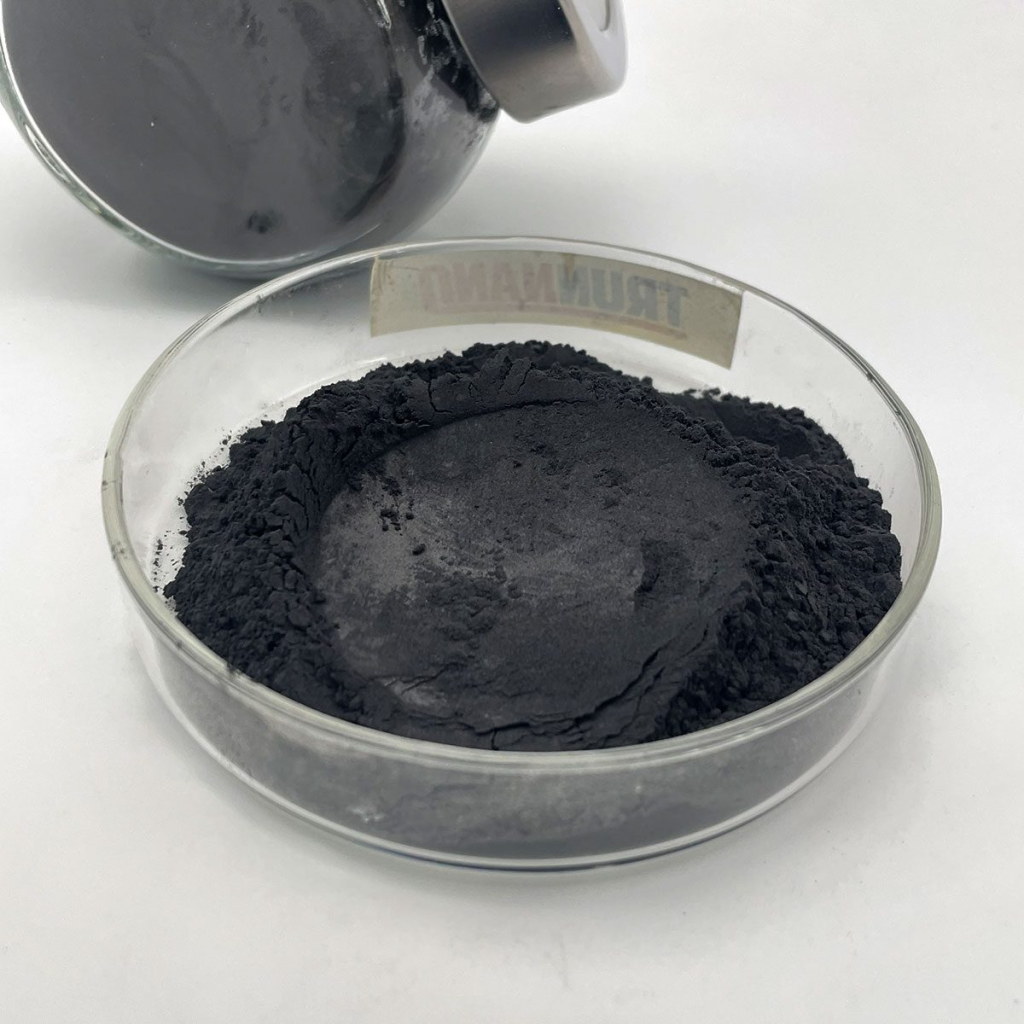
Crystal Structure and Electrochemical Mechanism: Understanding the Differences
Nano manganese oxide (MnO) adopts a cubic rock salt crystal structure, which, while providing high theoretical capacity, suffers from inherent structural instability during electrochemical cycling. The rock salt structure offers less resistance to volume changes, contributing to the severe expansion and contraction that plagues MnO anodes during charge/discharge cycles.
Nano manganese tetroxide (Mn₃O₄), in contrast, features a spinel-type crystal structure where Mn²⁺ ions occupy tetrahedral sites and Mn³⁺ ions occupy octahedral sites. This unique structural arrangement, featuring tightly combined octahedral and tetrahedral sites with cubic close packing of oxide anions, minimizes repulsion between like charges, resulting in a thermodynamically stable structure. The spinel structure provides good structural integrity during charge/discharge cycling, minimizing volume changes and enhancing cycle life.
The lithium storage mechanism for both materials involves conversion reactions, where manganese oxides are reduced to metallic manganese with the formation of Li₂O. This mechanism enables reversible Li⁺ intercalation and deintercalation, contributing to the exceptional capacities of these materials. However, the superior structural stability of Mn₃O₄’s spinel framework provides a critical advantage in maintaining electrode integrity over extended cycling.
Theoretical Capacity vs. Practical Performance: The Real-World Trade-Off
Theoretical capacity comparison – MnO offers a higher theoretical capacity of approximately 680 mAh/g, nearly double that of conventional graphite anodes (372 mAh/g). Mn₃O₄ provides a slightly lower theoretical capacity of approximately 480 mAh/g for lithium storage. From a purely capacity perspective, MnO appears to be the superior choice.
Practical performance considerations – However, theoretical capacity does not tell the whole story. In practical applications, MnO faces significant challenges that severely limit its real-world performance:
- Poor air stability – MnO is susceptible to oxidation in air, forming Mn₃O₄ or MnO₂, requiring storage under inert atmosphere protection. This adds significant handling, storage, and manufacturing complexity and cost.
- Severe volume expansion – MnO suffers from significant volume expansion during charge/discharge cycling, leading to capacity fade and structural degradation.
- Low electrical conductivity – Poor electrical conductivity requires extensive carbon compositing to achieve acceptable rate performance.
- High contact resistance – The combination of volume changes and poor conductivity results in high contact resistance during cycling.
Mn₃O₄’s practical advantages – The spinel structure of Mn₃O₄ provides several real-world benefits that make it more attractive for commercial battery manufacturing:
- Superior air stability – Mn₃O₄ is considerably more stable in air compared to MnO, with strong resistance to oxidation, ensuring reliable long-term performance without requiring inert atmosphere handling.
- Better cycling stability – The spinel structure provides greater structural integrity during charge/discharge, delivering stable reversible capacity over extended cycling.
- Enhanced conductivity – Better electrical conductivity compared to MnO, reducing the need for extensive carbon compositing.
- Excellent dispersibility – Low tap density and clean, impurity-free particle surfaces facilitate easy dispersion in both aqueous and organic solvent systems.

Air Stability: A Critical Differentiator
MnO’s air stability problem – One of the most significant limitations of MnO is its susceptibility to oxidation in air. The material readily forms higher manganese oxides such as Mn₃O₄ or MnO₂ upon exposure to ambient conditions. This instability has several engineering consequences:
- Requires storage under inert atmosphere (argon or nitrogen) to prevent oxidation
- Demands careful handling during manufacturing to avoid performance degradation
- Adds significant cost and complexity to supply chain management
- Limits shelf life and long-term storage capabilities
Mn₃O₄’s air stability advantage – In contrast, Mn₃O₄ is considerably more stable in air compared to MnO, with strong resistance to oxidation. This stability enables:
- Simplified handling and storage without inert atmosphere requirements
- Extended shelf life of up to 24 months under recommended storage conditions
- Consistent electrochemical performance without oxidation-related degradation
- Reduced manufacturing complexity and cost
Practical impact – For battery manufacturers, the air stability advantage of Mn₃O₄ translates directly to lower production costs, simpler quality control, and more reliable supply chain management. The ability to handle and store the material in ambient conditions without performance degradation is a significant operational advantage.
Cycling Stability and Volume Expansion
Volume expansion challenges – During lithium insertion and extraction, both MnO and Mn₃O₄ undergo conversion reactions that involve significant structural reorganization. However, the extent and impact of volume changes differ substantially between the two materials.
MnO’s volume expansion problem – MnO experiences severe volume expansion during charge/discharge cycling, which leads to:
- Particle cracking and pulverization
- Loss of electrical contact within the electrode
- Rapid capacity fade over cycling
- Structural degradation of the electrode
Mn₃O₄’s structural stability – The spinel structure of Mn₃O₄ provides better resistance to volume changes during cycling. This structural integrity translates to:
- Superior cycling stability with stable reversible capacity maintained over extended cycling
- Better particle integrity during repeated charge/discharge
- More consistent electrochemical performance
- Longer cycle life
Cycling performance – While MnO may offer higher theoretical capacity, the rapid capacity fade due to structural degradation means that practical capacity over long-term cycling is often significantly lower. Mn₃O₄’s superior structural stability ensures more consistent performance over the lifetime of the battery.Cycling performance – While MnO may offer higher theoretical capacity, the rapid capacity fade due to structural degradation means that practical capacity over long-term cycling is often significantly lower. Mn₃O₄’s superior structural stability ensures more consistent performance over the lifetime of the battery.

Processing, Handling, and Manufacturing Advantages
MnO’s handling challenges – The poor air stability of MnO creates significant manufacturing challenges:
- Requires inert atmosphere (argon or nitrogen) during storage and processing
- Demands specialized handling equipment and procedures
- Increases manufacturing complexity and cost
- Risks of oxidation-induced performance degradation during production
Mn₃O₄’s processing advantages – The superior air stability of Mn₃O₄ offers clear manufacturing benefits:
- No inert atmosphere required for handling and storage
- Compatible with standard manufacturing equipment and procedures
- Reduced manufacturing complexity and cost
- Consistent product quality without oxidation risks
Composite compatibility – Both materials can be combined with carbon materials such as porous carbon, graphene, and carbon nanotubes to enhance performance. However, Mn₃O₄ requires less extensive carbon compositing due to its better intrinsic conductivity, further simplifying manufacturing.
Applications and End-Use Versatility
MnO applications – Nano manganese oxide offers promise in several energy storage applications:
- Lithium-ion battery anodes – High theoretical capacity of ~680 mAh/g, often requiring extensive carbon compositing
- Supercapacitor electrodes – High specific surface area for charge storage
- Lithium manganese oxide synthesis – Precursor for spinel cathode materials
- Lithium-sulfur batteries – Composite modification of sulfur cathodes
Mn₃O₄ applications – Nano manganese tetroxide offers even greater versatility across multiple battery chemistries:
- Lithium-ion battery anodes – High theoretical capacity with excellent cycling stability, superior air stability, and practical manufacturability
- Sodium-ion battery anodes – Leveraging spinel structure for sodium storage
- Zinc-ion battery cathodes – Excellent cycling stability for aqueous systems
- Supercapacitor electrodes – High pseudocapacitive performance
- Cathode precursor – High-purity manganese source for spinel LiMn₂O₄ synthesis
- Cathode additive – Nano-scale particles enhance electrode reaction activity

Making the Right Choice: Selection Guide
When selecting between nano manganese tetroxide (Mn₃O₄) and nano manganese oxide (MnO) for energy storage applications, consider the following trade-offs:
| Decision Factor | Mn₃O₄ | MnO |
|---|---|---|
| Theoretical capacity | ~480 mAh/g | ~680 mAh/g |
| Air stability | Excellent — stable in air, no inert atmosphere required | Poor — oxidizes in air, requires inert atmosphere storage |
| Cycling stability | Superior — spinel structure maintains integrity | Limited — severe volume expansion causes capacity fade |
| Electrical conductivity | Better — reduced need for carbon compositing | Poor — requires extensive carbon compositing |
| Manufacturing complexity | Low — standard handling and processing | High — inert atmosphere required |
| Volume expansion | Moderate — spinel structure provides stability | Severe — structural degradation during cycling |
| Applications | LIB anodes, SIB anodes, ZIB cathodes, supercapacitors, cathode precursor | LIB anodes, supercapacitors, cathode precursor |
For applications where long-term cycling stability, air stability, and manufacturing simplicity are priorities, Mn₃O₄ is the superior choice. For applications prioritizing maximum theoretical capacity and where the handling challenges of MnO can be managed, MnO remains an option—but at the cost of significantly higher manufacturing complexity and potentially lower real-world performance.
Supplier
RBOSCHCO is a trusted global supplier and manufacturer of high-performance battery materials, including nano manganese tetroxide (Mn₃O₄) and nano manganese oxide (MnO), with over 12 years of experience in providing super high-quality chemicals and nanomaterials. The company exports to many countries, such as USA, Canada, Europe, UAE, South Africa, Tanzania, Kenya, Egypt, Nigeria, Cameroon, Uganda, Turkey, Mexico, Azerbaijan, Belgium, Cyprus, Czech Republic, Brazil, Chile, Argentina, Dubai, Japan, Korea, Vietnam, Thailand, Malaysia, Indonesia, Australia, Germany, France, Italy, Portugal, and more. As a leading nanotechnology development manufacturer, TRUNNANO dominates the market. Our professional work team provides perfect solutions to help improve the efficiency of various industries, create value, and easily cope with various challenges. If you are looking for high-quality manganese oxide materials for battery applications, please feel free to contact us.
RELATED POSTS
TRGY-3 Silicon Anode Material: Advanced Battery Anode Powder for EV Manufacturers
Silicon Nitride Ceramic: The Advanced Material Revolutionizing Aerospace and High-Speed Mechanical Components

A Comprehensive Comparison Of Silica Powders: Vapor Phase Method Vs. Precipitation Method

Transforming Global Industries: The Unseen Power of Boron Carbide in a Shifting Profession Landscape
Metal vs. Ceramic Ball Bearings: A Performance and Cost Comparison