Professional and high-quality metal alloys, ceramic products and concrete additives | RBOSCHCO

Lithium battery safety remains one of the most critical challenges facing the energy storage industry. As batteries are pushed to higher energy densities and faster charging rates, the risk of thermal runaway and internal short circuits increases. Battery manufacturers are constantly seeking materials that can enhance safety without compromising performance. Nano Aluminum Oxide (Al₂O₃) has emerged as a key material in this effort, playing a dual role that spans from the separator to the cathode. In separator coatings, Nano Aluminum Oxide provides a thermally resistant and electrically insulating barrier that reduces the risk of short circuits. In cathode materials, it enhances structural stability, suppresses oxygen generation, and protects active materials from electrolyte degradation. This dual functionality makes Nano Aluminum Oxide one of the most versatile safety-enhancing materials in modern lithium battery design. This article explores how Nano Aluminum Oxide is reshaping lithium battery safety across separator and cathode applications, and why it has become an essential material for battery manufacturers worldwide. Whether you are developing next-generation electric vehicle batteries, consumer electronics, or grid-scale energy storage systems, understanding the role of Nano Aluminum Oxide is essential to achieving the safety and performance targets that modern applications demand.
What Is Nano Aluminum Oxide?
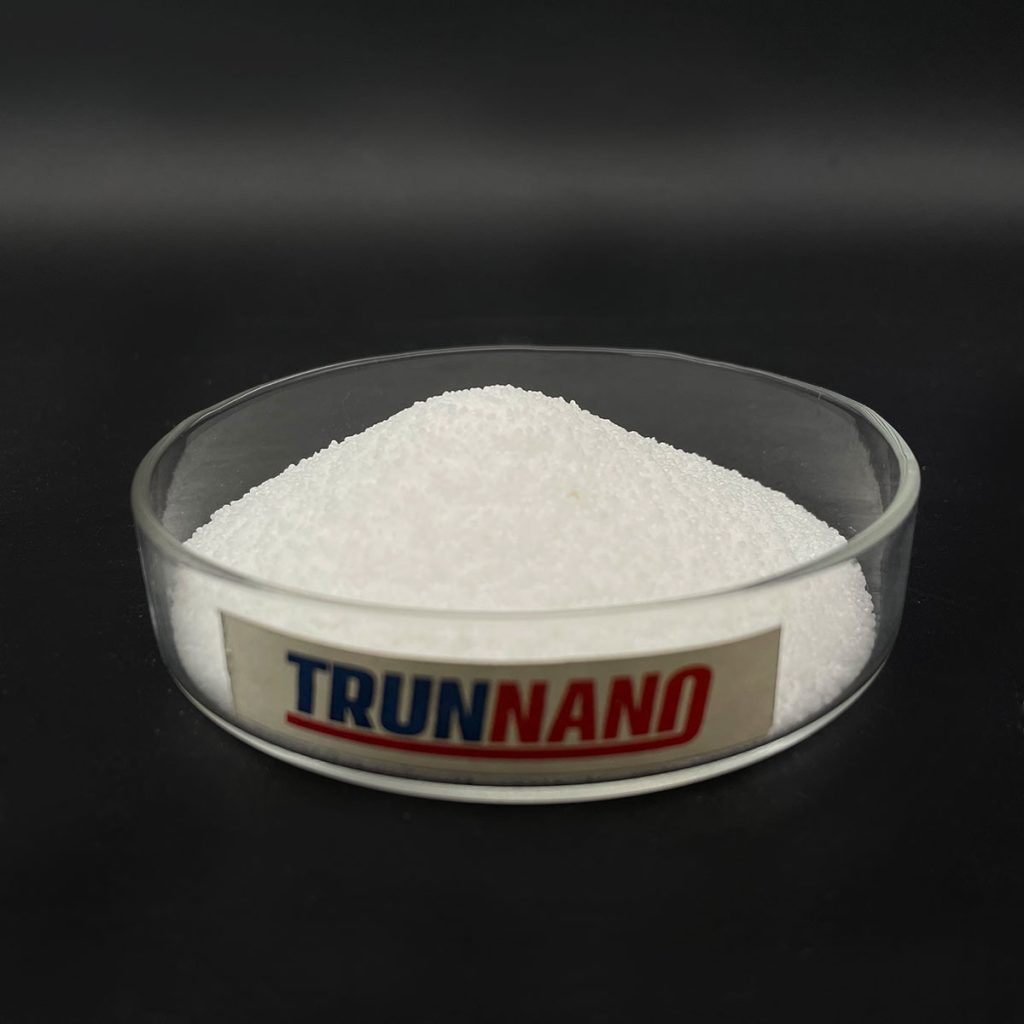
Nano Aluminum Oxide (Al₂O₃) for lithium batteries is a high-performance nanopowder engineered specifically for battery and battery material applications. Utilizing advanced nano-processing technology, the product features uniform and fine particle size, exceptionally high purity, and superior surface properties. These characteristics are essential for battery applications, where even trace impurities can significantly affect electrochemical performance and safety.
The material is widely used in lithium batteries, alkaline batteries, solar cells, and other energy storage systems to enhance energy density, improve safety performance, and support energy-saving and environmentally friendly initiatives. Its high purity and uniform particle size distribution ensure consistent performance in demanding battery applications, where reliability and repeatability are critical.
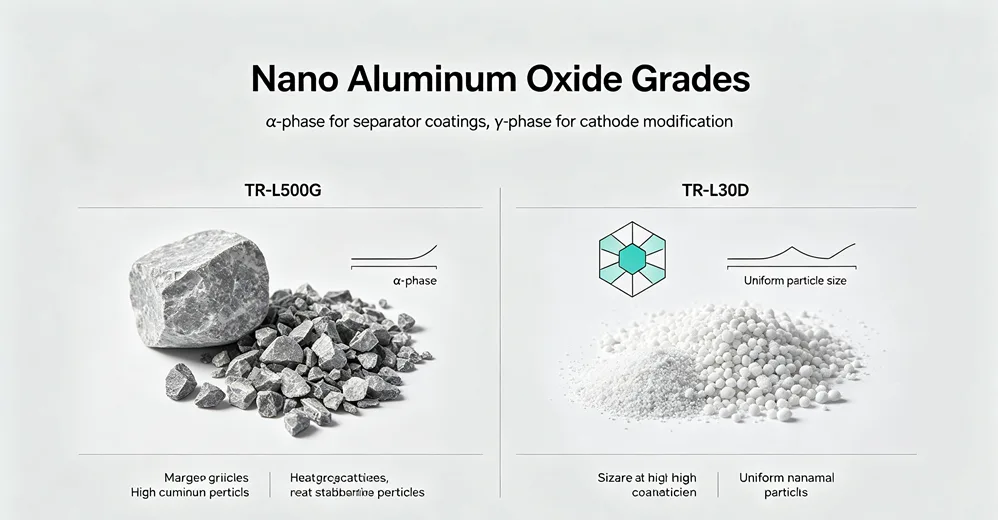
Nano Aluminum Oxide is available in two primary grades. The first is an α-phase alumina with a larger particle size and ultra-high purity, primarily used for separator coatings. The second is a γ-phase nano alumina with a smaller particle size and higher surface area, designed for cathode material doping and additive applications. Both grades are produced under strict quality control to ensure minimal impurities and consistent performance.
The α-phase product is characterized by its high crystallinity and thermal stability, making it ideal for separator coatings where dimensional stability at elevated temperatures is essential. The γ-phase product, with its higher surface area and smaller particle size, is optimized for chemical interaction with cathode materials, enabling more effective doping and coating.
How Nano Aluminum Oxide Enhances Battery Safety
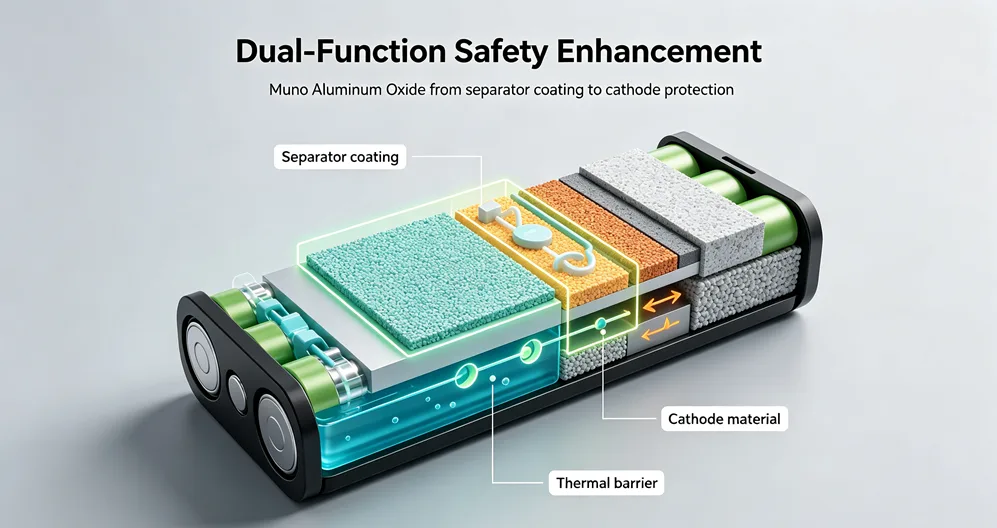
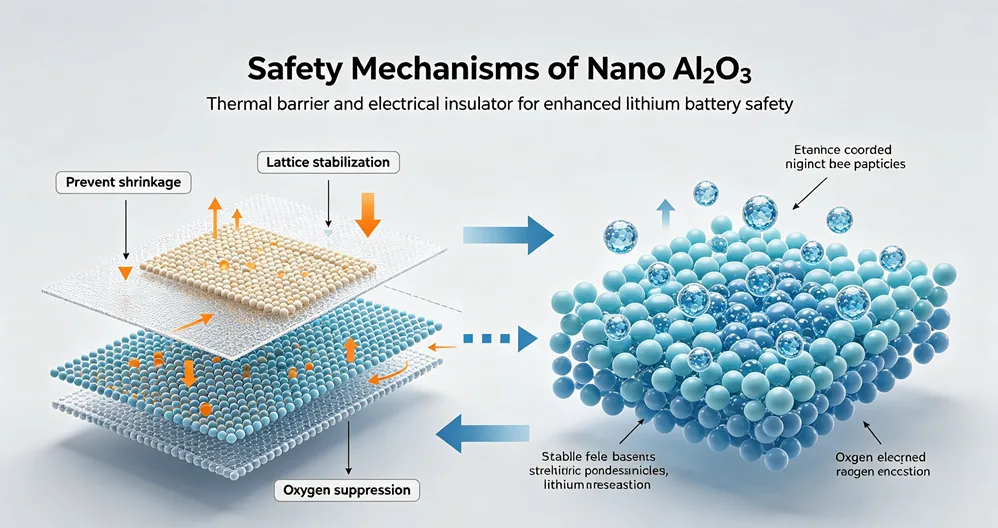
The safety benefits of Nano Aluminum Oxide arise from its unique combination of thermal insulation and electrical insulation properties. When used as an electrode or separator coating, it effectively isolates heat and prevents short circuits, significantly improving battery safety. These properties are critical because lithium batteries operate under conditions where even minor defects can escalate into major safety incidents.
Separator Coating: The First Line of Defense
In lithium batteries, the separator is a critical component that prevents direct contact between the anode and cathode while allowing lithium ions to pass through. However, conventional polyolefin separators can shrink or melt at elevated temperatures, leading to internal short circuits and thermal runaway. Once thermal runaway begins, it can propagate rapidly, leading to fire or explosion.
Coating the separator with Nano Aluminum Oxide creates a thermally resistant and electrically insulating layer that maintains separation even at high temperatures. The ceramic coating provides dimensional stability, preventing the separator from shrinking and reducing the risk of short circuits. This is particularly important in high-energy-density batteries where the margin for safety is narrower.
The ceramic coating also improves the mechanical strength of the separator, making it more resistant to puncture and damage during battery assembly and operation. This added robustness contributes to overall battery reliability and longevity.
Cathode Protection: Enhancing Structural Stability
Nano Aluminum Oxide also plays a critical role in cathode materials. Doping aluminum ions into lithium cobalt oxide (LiCoO₂) forms a solid solution that stabilizes the crystal lattice, boosting rate performance and cycle life. The introduction of aluminum ions raises the battery’s operating voltage while contributing to safer operation.
Coating LiCoO₂ with Nano Aluminum Oxide provides superior surface protection. The coating improves thermal stability, overcharge resistance, and cycling performance. It suppresses oxygen generation and inhibits the decomposition of LiPF₆, while also preventing direct contact between the cathode material and the electrolyte, thereby reducing electrochemical capacity loss.
When applied to modified spinel lithium manganese oxide (LiMn₂O₄) materials, Nano Aluminum Oxide helps produce batteries with larger reversible capacity. This makes it a valuable material for a wide range of cathode chemistries, including those used in electric vehicles, consumer electronics, and grid storage systems.
Key Applications of Nano Aluminum Oxide in Lithium Batteries
Nano Aluminum Oxide is used in multiple battery components, each contributing to overall safety and performance. Understanding these applications helps battery manufacturers select the right grade and optimize its use.
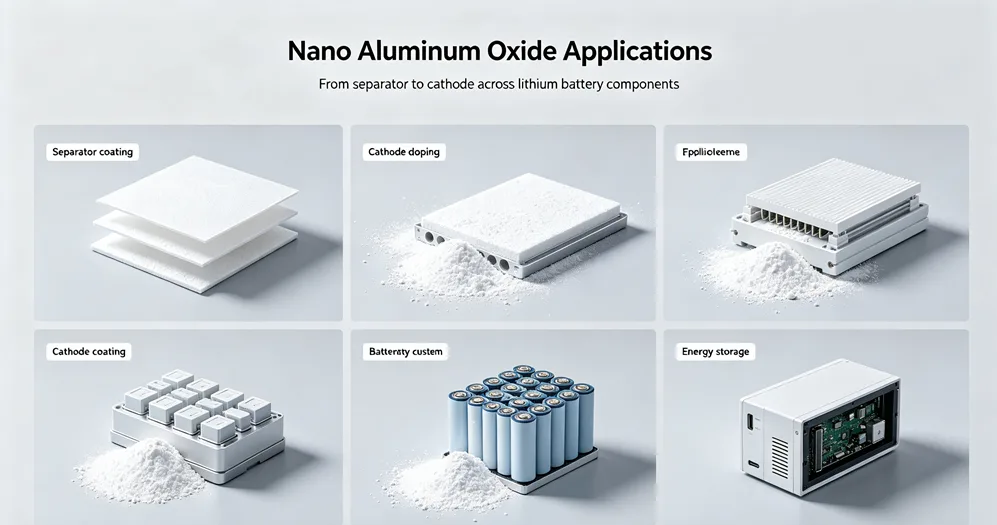
- Separator Coatings — Provides a thermally resistant and electrically insulating layer for improved safety. The ceramic coating prevents separator shrinkage and reduces the risk of internal short circuits. This is the most widely adopted application of Nano Aluminum Oxide in lithium batteries.
- Cathode Material Doping — Enhances the crystal structure of lithium cobalt oxide and other cathode materials for better cycle stability and high-rate performance. Aluminum ion doping stabilizes the lattice and improves structural integrity, enabling longer battery life and more reliable operation.
- Cathode Material Coating — Protects active materials from electrolyte degradation, increases thermal stability, and extends battery life. The coating suppresses oxygen generation and inhibits electrolyte decomposition, which are key factors in battery safety and longevity.
- Voltage Enhancement — Increases battery operating voltage while maintaining safety. The introduction of aluminum ions raises the voltage without compromising stability, enabling higher energy density without sacrificing safety.
- Spinel Lithium Manganese Oxide Modification — Boosts reversible capacity in modified cathode systems. Nano Aluminum Oxide helps produce batteries with larger reversible capacity and improved cycling performance.
- Beyond Lithium-Ion — In addition to lithium-ion batteries, Nano Aluminum Oxide is also suitable for alkaline batteries, solar cells, and other advanced energy storage systems where enhanced safety and stability are required.
Why Nano Aluminum Oxide Is Reshaping Battery Safety
The dual functionality of Nano Aluminum Oxide — providing safety enhancement at both the separator and the cathode — makes it a uniquely valuable material for battery manufacturers. Few other materials can deliver both thermal insulation and structural stabilization across multiple battery components.
As batteries continue to evolve toward higher energy densities, faster charging rates, and longer cycle lives, the demand for safety-enhancing materials like Nano Aluminum Oxide will only grow. Battery manufacturers are increasingly recognizing that safety cannot be an afterthought — it must be engineered into every component from the start. Nano Aluminum Oxide enables this approach by providing reliable, consistent performance in separator coatings, cathode doping, and cathode coating applications.
With its high purity, uniform particle size, and excellent thermal and electrical insulation properties, Nano Aluminum Oxide is well-positioned to remain a key material in the ongoing effort to make lithium batteries safer, more reliable, and more durable. For battery manufacturers seeking to improve safety without compromising performance, Nano Aluminum Oxide offers a proven, versatile solution.
Whether you are developing next-generation electric vehicle batteries, consumer electronics, or grid-scale energy storage systems, Nano Aluminum Oxide provides the safety and performance characteristics that modern applications demand. Its dual role from separator to cathode makes it an essential material in the lithium battery supply chain.
Supplier
RBOSCHCO is a trusted global chemical material supplier and manufacturer with over 12 years of experience in providing high-quality chemicals and nanomaterials, including boride powder, nitride powder, graphite powder, sulfide powder, and 3D printing powder. The company has a professional technical department and quality supervision department, a well-equipped laboratory with advanced testing equipment, and a dedicated after-sales customer service center. RBOSCHCO supplies Nano Aluminum Oxide worldwide, suitable for lithium battery separator coatings, cathode material doping, cathode material coating, and other energy storage applications. The company offers comprehensive technical support, from product selection to application guidance. If you are looking for high-quality Nano Aluminum Oxide for lithium battery materials, please feel free to contact us.
RELATED POSTS

Silicon Oxide Powder

Copper Bus bars: Understanding Global Market Trends and Future Growth Leads

Properties and Applications of Aluminum Nitride
Unlocking Crop Potential: The Role of Potassium Silicate in Modern Agriculture
How Does Spherical Aluminum Nitride Improve The Heat Dissipation Performance Of Electronic Product Packaging By Greater Than 50%?