Professional and high-quality metal alloys, ceramic products and concrete additives | RBOSCHCO

Spec sheets look impressive. Two hundred hours in, it cracks. Not because the material is bad — but because processing defects and failure triggers were never considered. As a core part of our Advanced Ceramics section, this guide walks through nine commonly used ceramic crucible materials from a real-world engineering perspective, covering how they are processed, how they fail in service, and how long they last. Our goal is to help you avoid the mistakes others have already made.
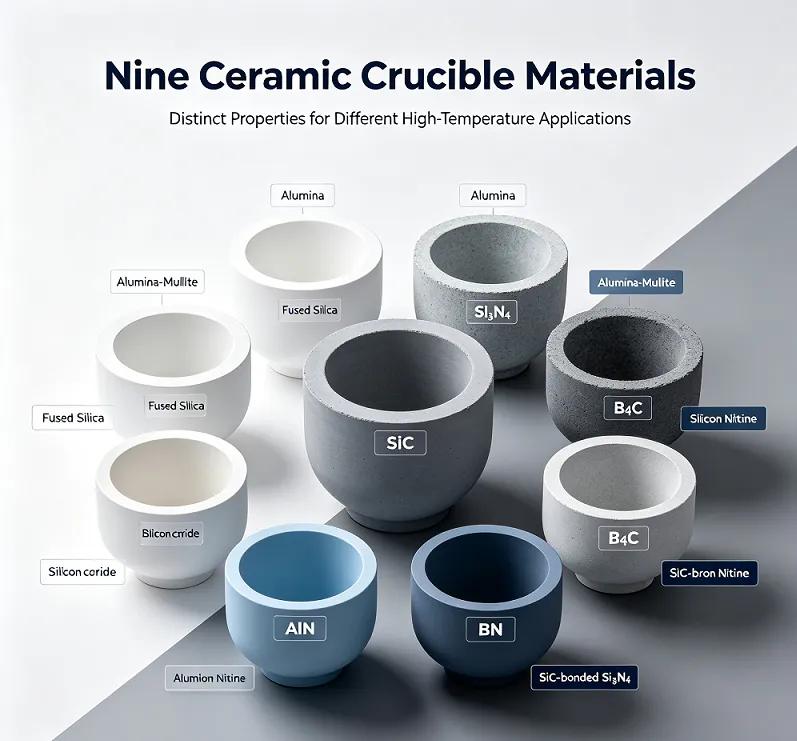
Ceramic Crucible Processability: Can You Actually Make the Shape You Need?
The first question in crucible selection is not about temperature ratings or theoretical longevity — it is about whether the material can be formed into the shape and precision you actually need. Many promising materials fall at this hurdle. Either they cannot be fabricated at all, or the cost of doing so is prohibitive.
Alumina (Al₂O₃) is the industry workhorse. It can be formed by slip casting, dry pressing, or isostatic pressing, and the manufacturing processes are mature and well understood. Large crucibles are prone to warping, but with proper design and controlled sintering profiles, alumina performs reliably across most industrial applications. Dimensional accuracy can be held within ±0.5%. In terms of raw material quality, alumina purity should be no less than 95% — higher purity directly improves chemical stability and thermal shock resistance at elevated temperatures. Excessive alkali oxide impurities in the raw material can react with the melt at high temperatures, significantly shortening crucible life.
Alumina-Mullite is a close relative of alumina, primarily formed by casting, and is well suited for large crucibles. Its weakness lies in shrinkage control during sintering — parts from the same firing run can show noticeable dimensional variations across different sections, with accuracy typically around ±1%. If tight dimensional tolerances are not a primary concern, it is an excellent alternative to alumina. Mullite offers slightly better thermal shock resistance than pure alumina, which is a notable advantage in large-scale applications.
Fused Silica (Quartz) is melted and then machined to shape. Quartz is relatively easy to machine and can achieve good precision. The problem, however, is that prolonged use above 1450°C causes devitrification — the amorphous glass structure gradually transforms into crystalline phases, becoming brittle and losing its thermal stability. Quartz crucibles excel in purity and thermal shock resistance, making them ideal for low-temperature applications where cleanliness is critical, but their upper temperature limit remains a hard constraint.
Silicon Nitride (Si₃N₄) and Silicon Carbide (SiC) are both difficult to process, though for different reasons. Silicon nitride requires gas pressure sintering or reaction sintering — processes that demand expensive high-temperature, high-pressure equipment with narrow operating windows. Silicon carbide, on the other hand, is so hard that machining costs are prohibitive — the tooling wear alone makes precision shaping expensive. Recrystallized SiC can achieve ±0.5% accuracy, but that precision comes at a high cost. SiC offers excellent thermal conductivity and wear resistance that are irreplaceable in certain extreme applications, but you must budget accordingly for its fabrication.
Boron Carbide (B₄C) is the most challenging of all. Sintering temperatures exceed 2200°C, which alone rules out most manufacturing facilities. Parts are limited in size, and achievable precision is relatively poor. Outside of truly extreme conditions, few engineers choose it. B₄C offers exceptional hardness and wear resistance, but its processing difficulty and intrinsic brittleness make it uncompetitive for most conventional applications.
Aluminum Nitride (AlN) is formed by hot pressing or tape casting, achieving precision as tight as 0.01 mm — exceptionally high for ceramics. The trade-off is its extreme sensitivity to moisture — even modest humidity causes surface hydrolysis and powdering. Storage and processing require strictly dry conditions, which has discouraged many potential users. AlN’s high thermal conductivity is its biggest selling point, offering unique value in precision sintering processes that demand rapid, uniform heat transfer.
Boron Nitride (BN) is the outlier — it is soft, easy to machine, and capable of high precision. But softness means low strength. A slight knock during handling can chip an edge, and excessive force during installation can cause fracture. BN’s non-stick properties make it highly desirable for optical glass and precious metal melting, but its low strength and oxidation sensitivity severely limit its operating envelope.
SiC-bonded Silicon Nitride is a composite material formed by reaction sintering. Processing difficulty is moderate, and it is suitable for large components. However, large parts are constrained by equipment chamber size, and internal uniformity remains a persistent challenge — batch-to-batch quality can vary significantly. The rationale behind this composite is to balance the high strength of SiC with the thermal shock resistance of Si₃N₄, but the phase interface introduces additional failure risks.
Summary: If you need a mature, stable material for modest sizes, alumina is your safest choice. If your precision requirements are extremely high, AlN can deliver — provided you can maintain a dry environment. For large sizes, alumina-mullite or SiC-bonded silicon nitride are worth considering, but you must accept compromises in precision and consistency. And if budget is no object and your conditions are exceptionally harsh, boron carbide is an option — provided you can find a supplier capable of producing it reliably.
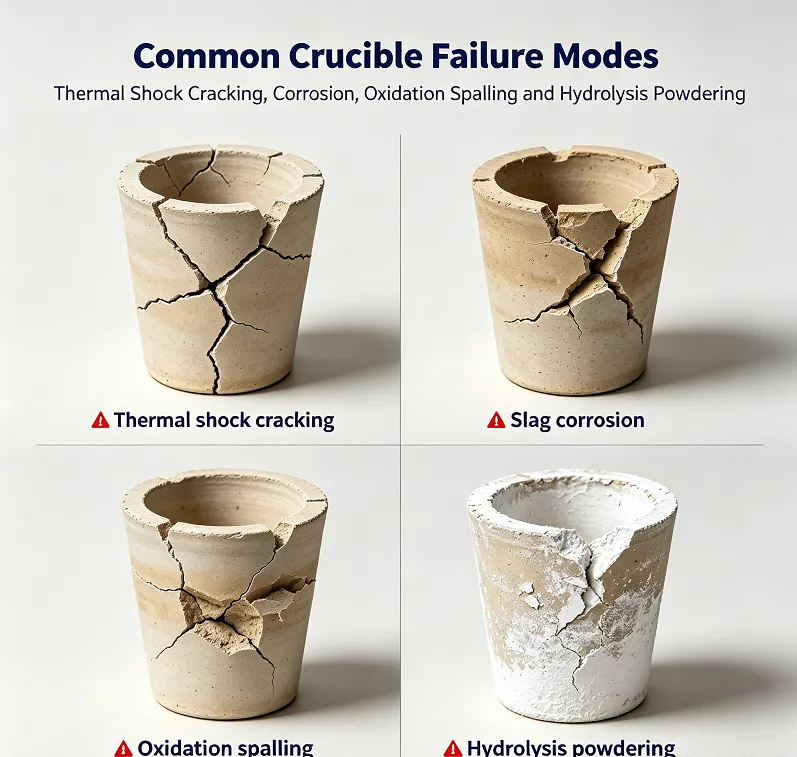
Ceramic Crucible Failure Modes: How Does Each Material Actually Fail in Service?
Spec sheets tell you how a material performs under ideal conditions. They don’t tell you how it dies in your furnace. Below are the two most common failure modes for each crucible material — all drawn from real service experience.
Alumina & Alumina-Mullite — The most frequent failure is thermal shock cracking. Rapid heating or cooling generates internal stresses that the material cannot relieve quickly enough — and the crucible cracks. Uneven wall thickness, particularly at the transition between the bottom and side walls, concentrates stress and makes cracking more likely. This is why crucible design standards emphasize uniform wall thickness — the greater the thickness variation, the higher the thermal stress concentration and the greater the cracking risk. Additionally, if the melt contains alkaline slag, it gradually penetrates and corrodes the alumina surface, layer by layer, thinning the wall over time until it can no longer withstand the load. Unlike thermal shock cracking, which occurs suddenly, this corrosion is a slow accumulation process — operators often discover significant wall thinning only during routine inspections.
Fused Silica (Quartz) — 1450°C is the dividing line for quartz crucibles. Extended exposure above this temperature causes devitrification — the transparent glassy phase transforms into a cloudy crystalline structure, dramatically increasing brittleness. Once devitrification begins, it is irreversible — the crucible structure deteriorates continuously with no remediation possible. Another common failure mode is alkali contamination — sodium, potassium, and other alkali metals react with silica, causing localized softening and deformation that quickly renders the crucible unusable. Quartz is far more sensitive to alkaline substances than any other ceramic material — this is a fundamental chemical limitation that no process improvement can overcome.
Silicon Carbide (SiC) — At high temperatures, SiC forms a protective silicon dioxide (SiO₂) layer on its surface. This sounds beneficial, but the layer spalls off during repeated thermal cycling — each cycle removes a little more material, and over time the wall thickness gradually diminishes. Oxidation loss accelerates significantly above 1200°C — the higher the temperature, the faster the oxidation. Strong oxidizing acids or caustic alkalis accelerate corrosion even further. SiC failure is typically a slow, predictable process — gradual wall thinning until the crucible can no longer hold the melt — rather than sudden fracture. This failure pattern has an advantage: it is predictable and monitorable. Regular wall thickness measurements provide a reasonable estimate of remaining life, enabling scheduled replacement and avoiding unplanned downtime.
Silicon Nitride (Si₃N₄) — Silicon nitride failures are often linked to processing. Surface microcracks left from machining grow under thermal stress over time, eventually developing into through-wall cracks. Pre-service surface inspection is therefore critical — visible machining marks and grinding lines are potential crack initiation sites that should not be ignored. Additionally, once the protective oxide layer on the surface is breached, the exposed substrate oxidizes rapidly in air, and strength drops sharply. Oxidation becomes particularly pronounced above 1300°C, making atmosphere control an essential consideration.
Aluminum Nitride (AlN) — AlN has a unique failure mode — hydrolysis powdering. It is extremely sensitive to moisture; even moderately humid air triggers surface reactions that form powder, layer by layer. Proper storage is a major issue — sealed, moisture-proof containers are mandatory. Many first-time users underestimate the severity of this problem — a crucible that leaves the factory in perfect condition can develop a visible powder layer after just two weeks in a damp warehouse, essentially ruining it. Above 1200°C in air, oxidation adds a second failure mechanism. AlN failures are typically the result of problems in both storage and service.
Boron Nitride (BN) — BN’s weakness is straightforward — low mechanical strength. A minor impact during handling can chip an edge; slightly excessive force during installation can cause fracture. It is so soft that even a fingernail can leave a mark — making it extremely fragile when handled alongside metal or ceramic tools. Oxidation begins above 900°C in air and proceeds at a notable rate, so BN must be used exclusively under protective atmospheres — nitrogen or argon, without interruption. If the protective atmosphere fails, BN oxidizes at a visibly rapid pace — the white surface darkens, and the structure becomes loose and flaky.
Boron Carbide (B₄C) — Boron carbide is a classic example of a material with outstanding properties but extreme manufacturing difficulty. Its greatest vulnerability is not service-related — it is defects introduced during manufacturing. Sintering above 2200°C with an exceptionally narrow process window makes internal porosity or microcracks difficult to avoid entirely. These inherent defects grow progressively during service, eventually leading to sudden fracture. In addition, while B₄C is extremely hard, it is also highly brittle — even modest impact can cause shattering. Many engineers mistakenly equate hardness with strength — but boron carbide’s flexural strength is actually modest, and hardness alone does not guarantee structural integrity.
SiC-bonded Silicon Nitride — Composite materials come with composite problems — the interface between phases is often the weakest link. During thermal cycling, SiC and Si₃N₄ have different coefficients of thermal expansion, and the interface experiences repeated stress over time, eventually leading to delamination. This type of failure is harder to detect than other modes — it often goes unnoticed until the crucible wall shows visible layering or spalling. Additionally, internal uniformity in large parts is difficult to achieve — density and performance can vary across different sections of the same crucible, posing significant challenges in large-scale industrial operations. For oversized composite crucibles, non-destructive testing before use is strongly recommended to confirm the absence of internal defects.
Ceramic Crucible Service Life: Maintenance Guidelines to Maximize Performance
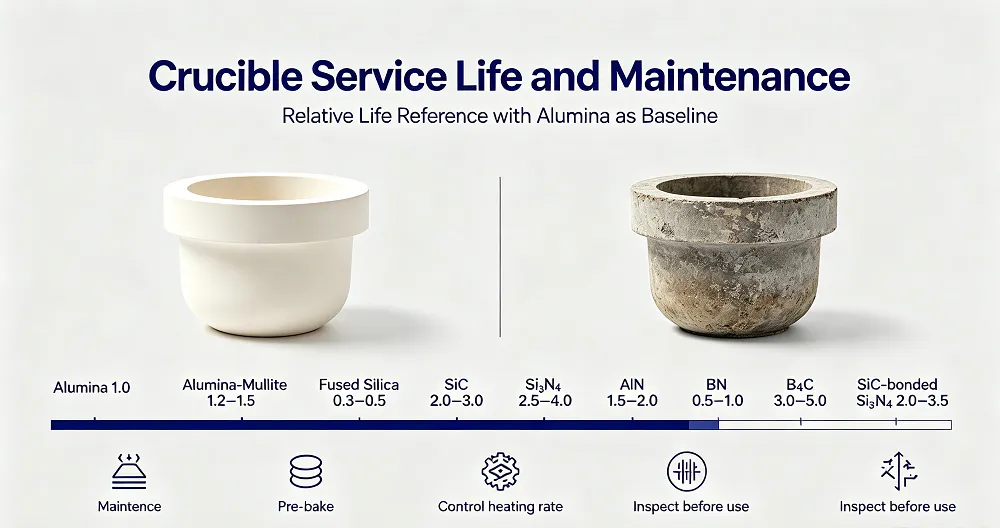
There are no absolute numbers when it comes to service life. What we can provide is a relative reference — with alumina set as the baseline at 1.0 under identical operating conditions, other materials can be compared on this scale.
| Alumina | 1.0 (baseline) | Avoid thermal shock; ramp slowly. Pre-bake with step annealing |
| Alumina-Mullite | 1.2 – 1.5 | Better thermal shock resistance; still control heating/cooling rates |
| Fused Silica (Quartz) | 0.3 – 0.5 (at high T) | Strictly keep < 1450°C; avoid contact with alkaline substances |
| Silicon Carbide | 2.0 – 3.0 | Prevent spalling of surface oxide layer; limit acid/alkali exposure |
| Silicon Nitride | 2.5 – 4.0 | Inspect for surface defects before use; avoid impact loading |
| Aluminum Nitride | 1.5 – 2.0 | Store in moisture-proof sealed containers; pre-bake before use |
| Boron Nitride | 0.5 – 1.0 (in air) | Protective atmosphere mandatory; handle with extreme care |
| Boron Carbide | 3.0 – 5.0 | Manufacturing quality is decisive — choose suppliers with proven sintering processes |
| SiC-bonded Si₃N₄ | 2.0 – 3.5 | NDT recommended for large parts; inspect internal uniformity |
Alumina serves as the baseline and performs stably under normal conditions. The core maintenance rule is simple: avoid rapid heating and cooling — slower ramps mean longer life. Before first use, a step-annealing process is recommended — hold at 500°C for 30 minutes, then raise to 800°C for one hour, followed by natural cooling. This helps relieve residual stresses from processing. In practice, heating rates within 200°C per hour and cooling rates within 300°C per hour are good general guidelines for extending alumina crucible life.
Alumina-Mullite offers a moderate improvement over alumina, with roughly 1.2 to 1.5 times the service life thanks to better thermal shock resistance. Design should emphasize uniform wall thickness to minimize thermal stress concentrations. For large mullite crucibles, structural optimization is essential — the larger the transition radius between bottom and side walls, the more effectively thermal stress is dissipated.
Quartz has relatively short service life at high temperatures — only 0.3 to 0.5 times that of alumina. The key is keeping the temperature below 1450°C and strictly avoiding contact with alkaline substances. Many quartz crucible failures are not caused by temperature alone — they result from the combined effect of temperature and alkaline contamination, which accelerates degradation dramatically. Below 1400°C, quartz performs quite well — but as the temperature approaches its upper limit, service life drops sharply.
Silicon Carbide achieves 2 to 3 times the life of alumina — provided the oxide layer on the surface is protected from repeated spalling. If the melt contains acids or alkalis, regular wall thickness monitoring is recommended, with replacement scheduled once significant thinning is observed. SiC’s life advantage is most pronounced in continuous high-temperature operations — the more stable the temperature and the fewer the thermal cycles, the greater the benefit.
Silicon Nitride is among the top performers, with 2.5 to 4 times the life of alumina. Before first use, carefully inspect surfaces for visible machining marks or cracks — these are potential crack initiation sites under thermal stress. Avoid mechanical impact during service. Si₃N₄ has higher fracture toughness than SiC, giving it better resistance to crack propagation — which is one reason for its longer service life.
Aluminum Nitride offers about 1.5 to 2 times the life of alumina — but its weakness is storage, not high-temperature performance. Strict moisture-proof storage is non-negotiable, and pre-baking at 100 to 150°C for at least two hours is recommended to remove adsorbed moisture before placing it in the furnace. Many AlN failures trace back to improper storage — a problem that is entirely avoidable through good management.
Boron Nitride offers only 0.5 to 1.0 times the life of alumina in oxidizing atmospheres — a protective atmosphere is not a recommendation but a requirement. Without it, BN should not be used at all. With it, its non-stick properties become a major advantage. BN’s operating window is narrow, but within that window, it has almost no substitute — optical glass melting and precious metal processing both demand non-reactivity.
Boron Carbide offers the greatest life potential — 3 to 5 times that of alumina — provided the manufacturing process is defect-free. When selecting a supplier, do not focus solely on price; sintering process maturity is the decisive factor. B₄C is among the most expensive of the nine materials, but if you are processing ultra-hard melts and cannot afford frequent shutdowns, the investment is entirely justified.
SiC-bonded Silicon Nitride offers approximately 2 to 3.5 times the life of alumina. For large parts, non-destructive testing before use is recommended to confirm internal uniformity. For oversized composite crucibles, internal uniformity is a key procurement metric — requesting density test reports from the supplier is a reasonable practice.
Closing Thoughts – Selecting the Right Ceramic Crucible Starts with Understanding Failure Modes
No crucible lasts forever. The key is understanding how yours will fail — so you can plan for it.
Each of the nine materials has its own character. Alumina is the dependable generalist — it won’t surprise you, but it won’t excel in extremes either. SiC and Si₃N₄ are the long-haul performers — they cost more upfront but pay off over time. AlN is the precision specialist — but only if you can keep it dry. BN is the niche player — irreplaceable in its narrow lane, useless outside it. B₄C is the overachiever — extraordinary potential, but manufacturing quality is everything. Quartz is the low-temperature purist — excellent below 1450°C, dangerous above it. Mullite and SiC-bonded Si₃N₄ are the compromisers — they balance trade-offs for large-scale applications.
Quick Selection Guide:
- Routine metal melting, general heat treatment → Alumina or Alumina-Mullite. Mature, reliable, cost-effective.
- High temperature (>1500°C), long service life desired → SiC or Si₃N₄. 2–4× the life of alumina. Higher upfront cost but lower cost per operating hour.
- Precision sintering, high thermal conductivity needed → AlN. But a dry storage environment is essential.
- Specialized melting under protective atmosphere → BN. Easy to machine, non-stick — but handle with care.
- Ultra-high temperature, ultra-hard melts → B₄C. Longest life — but ensure your supplier has mature sintering capability.
- Large crucibles, moderate-to-high temperatures → SiC-bonded Si₃N₄. Balances the strengths of both materials — but pay close attention to quality consistency in large parts.
- Low temperature (<1450°C), high purity requirements → Quartz. Cost-effective — but keep it away from alkaline materials.
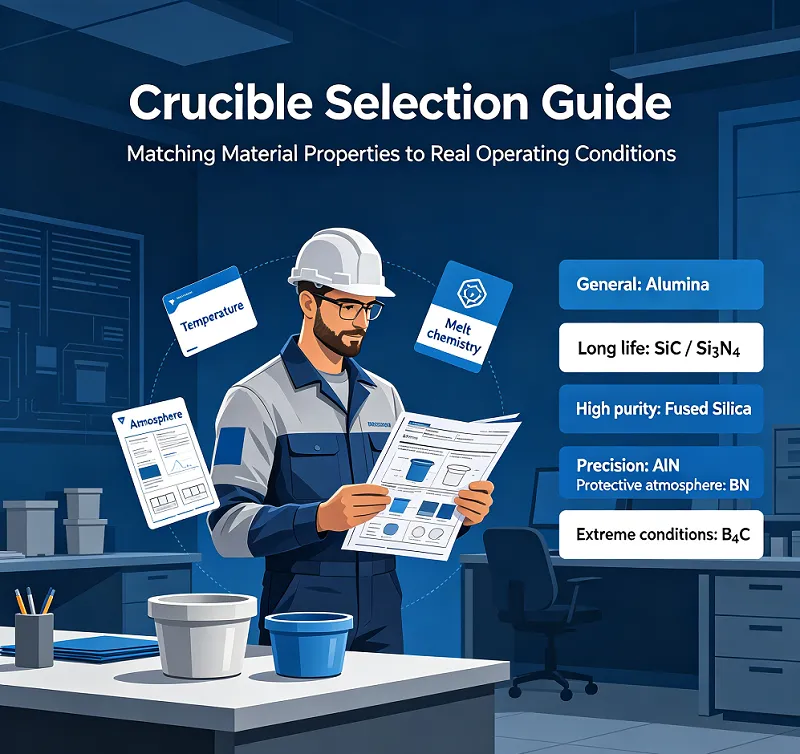
When selecting a crucible, always start with three factors: operating temperature, atmosphere, and melt chemistry. Once these are clearly defined, compare them against each material’s strengths and weaknesses. There is no universally “best” crucible — the key is matching material properties to your real operating conditions, not chasing impressive spec-sheet numbers.
For more selection guides, failure analyses, and maintenance insights on ceramic crucibles, refractories, and precision ceramic components, stay tuned to our Advanced Ceramics section.
If you are still torn between two materials, feel free to reach out with your actual operating conditions — temperature, atmosphere, and melt chemistry. No sales pitch, just engineering advice to help you make the right call.
Supplier
The global market for advanced ceramic crucibles continues to grow, driven primarily by the semiconductor and new energy sectors. RBOSCHCO (Luoyang Tongrun Info Technology Co., Ltd.), established in 2014 and headquartered in Luoyang High-Tech Development Zone, China, is a national high-tech enterprise specializing in advanced ceramics and nanomaterials with over a decade of experience. The company holds 27 patents and 11 trademarks, with core expertise spanning oxide, carbide, and nitride nanopowders — controlling purity and microstructure from the source to finished components. RBOSCHCO serves global customers across semiconductors, metallurgy, new energy, and chemical processing, offering a full range of crucible materials including alumina, silicon carbide, silicon nitride, aluminum nitride, boron nitride, boron carbide, fused silica, mullite, and SiC-bonded silicon nitride. The company accepts credit cards, T/T, West Union, and PayPal, and ships overseas via FedEx, DHL, air, or sea with professional packaging. If you are looking for high-quality ceramic crucibles, please get in touch with us and send an inquiry — our technical team is ready to assist with material selection and application support.
RELATED POSTS
Nano Manganese Tetroxide (Mn₃O₄): Superior Air Stability and Cycling Performance Beyond MnO for Advanced Battery Anodes
Silicon Carbide: The Advanced Ceramic Material Powering the Future of EVs and Semiconductor Technology

P2-Naₓ(FeᵧMn₁⁻ʸ)O₂: A Promising Cathode Material for Sodium-Ion Batteries
High-Temperature Resistant Tungsten Boride Powder: Superior for Extreme Environments

Redefining Industrial Durability: The Dynamic Contrast Between Titanium Carbide and Tungsten Carbide in a High-Stakes Market