Professional and high-quality metal alloys, ceramic products and concrete additives | RBOSCHCO

12Supplier
1. Introduction to Aluminum Nitride Ceramics
1.1 What Is Aluminum Nitride (AlN) Ceramic?
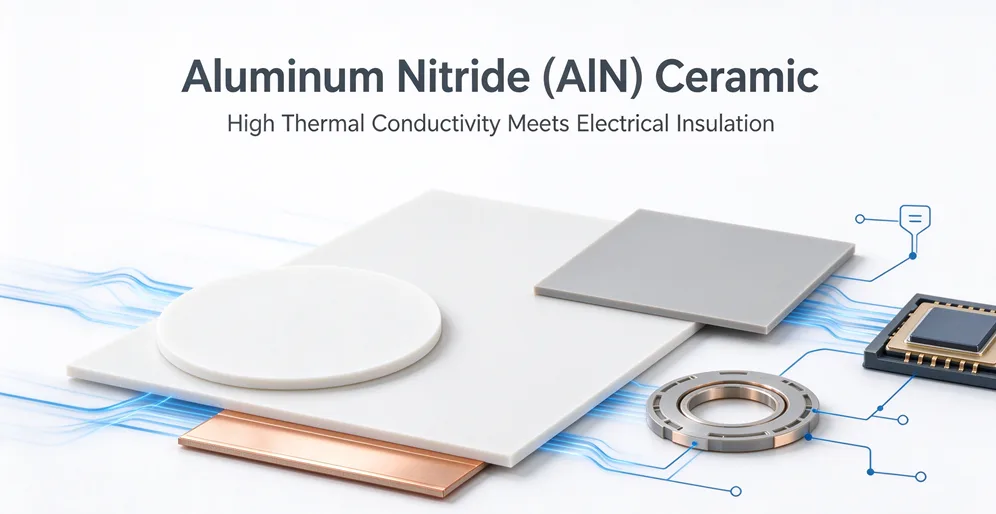
Aluminum Nitride (AlN) Ceramic is an advanced ceramic material that combines exceptionally high thermal conductivity with excellent electrical insulation. This unique combination makes it one of the most sought-after materials for thermal management in power electronics, semiconductor devices, and high-power LED systems .
The theoretical thermal conductivity of AlN ceramics can reach 320 W/(m·K), and practical products typically achieve 170–220 W/(m·K) depending on purity and processing . At the same time, AlN maintains a volume resistivity exceeding 10¹⁴ Ω·cm, ensuring reliable electrical isolation even under high-voltage conditions .
1.2 Why Power Devices Need AlN
Modern power electronics—IGBT modules, GaN devices, SiC converters, and high-power LEDs—generate enormous heat during operation. If this heat is not efficiently dissipated, device performance degrades, reliability suffers, and service life shortens. The challenge is that many high-thermal-conductivity materials, such as copper and aluminum, are electrically conductive. Using them as heat spreaders requires additional insulation layers, which add thermal resistance and complexity.
Aluminum Nitride (AlN) Ceramic eliminates this trade-off. It provides high thermal conductivity and electrical insulation in a single material, simplifying thermal design and improving overall system reliability .
1.3 Why Aluminum Nitride (AlN) Ceramic Stands Out
Among high-thermal-conductivity ceramics, Aluminum Nitride (AlN) Ceramic offers a distinctive balance of properties. Its thermal expansion coefficient (approximately 4.5–5.0 ppm/°C) closely matches that of silicon, minimizing thermal stress at the chip-ceramic interface . This thermal matching is critical for long-term reliability in semiconductor packaging.
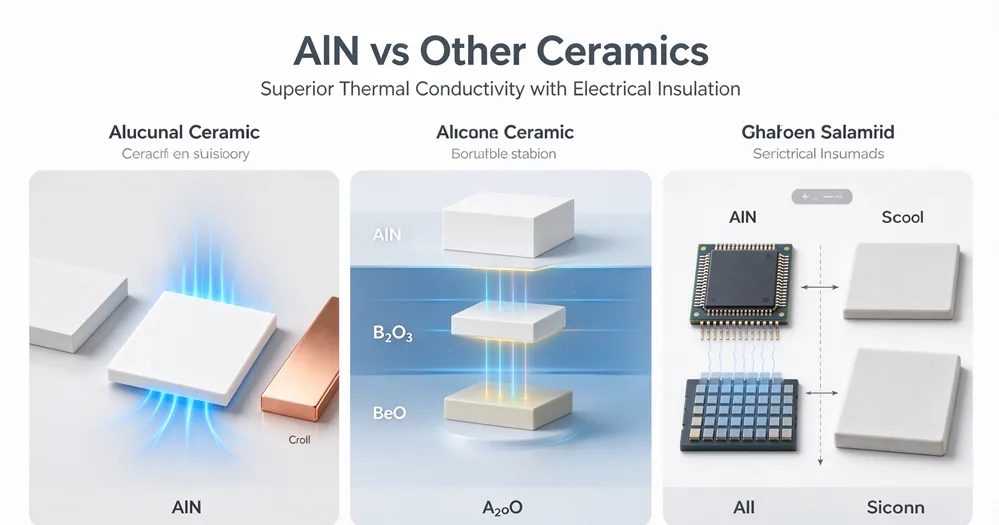
Compared to alumina (Al₂O₃), AlN offers roughly 5–10 times higher thermal conductivity. Compared to beryllium oxide (BeO), AlN is non-toxic, addressing a major safety concern associated with BeO dust . These advantages make AlN the preferred choice for demanding thermal management applications.
2. Understanding the Basics of Aluminum Nitride Ceramic
2.1 Chemical Composition and Crystal Structure
Aluminum Nitride (AlN) Ceramic is a covalent-bond compound with a hexagonal wurtzite crystal structure . The strong covalent bonding gives AlN its high melting point (approximately 2200°C stability) and excellent chemical stability .
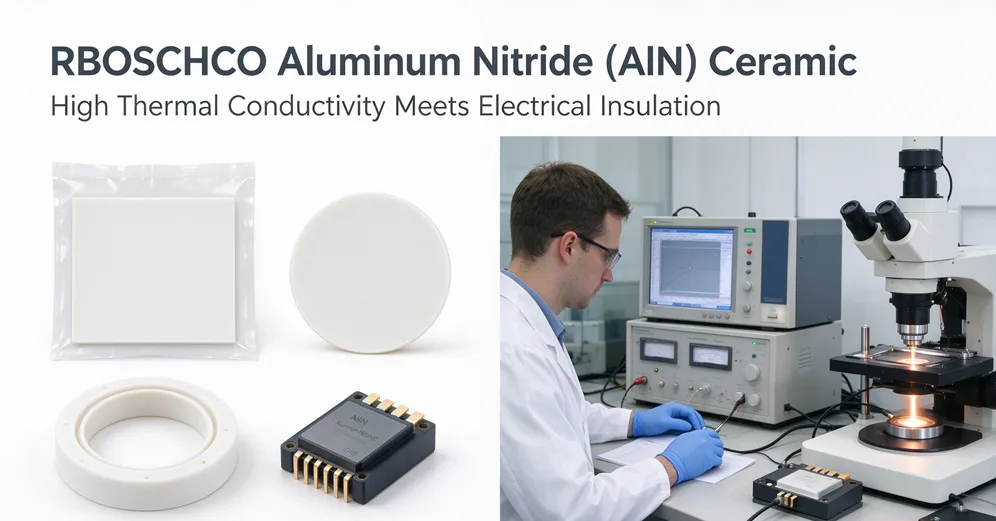
The material is typically white or off-white in color and can be produced in various forms, including substrates, plates, rings, rods, and custom shapes . High-purity grades (>99%) are available for demanding semiconductor and electronic applications.
2.2 Key Properties of Aluminum Nitride (AlN) Ceramic
Aluminum Nitride (AlN) Ceramic offers a combination of properties that make it suitable for power device thermal management.
- High thermal conductivity: 170–220 W/(m·K) for typical products, with theoretical values up to 320 W/(m·K) .
- Excellent electrical insulation: Volume resistivity >10¹⁴ Ω·cm, dielectric strength >20 kV/mm .
- Thermal expansion matching: CTE of approximately 4.5–5.0 ppm/°C, close to silicon .
- Chemical stability: Resistant to acids, alkalis, and molten metals .
- High mechanical strength: Bending strength of 350–450 MPa .
- Wide operating temperature range: -269°C to +1000°C .
2.3 Comparison with Other Thermal Management Materials
| Property | AlN Ceramic | Al₂O₃ Ceramic | BeO Ceramic | Copper |
|---|---|---|---|---|
| Thermal Conductivity (W/m·K) | 170–220 | 20–30 | 200–250 | ~400 |
| Electrical Insulation | Excellent | Excellent | Excellent | Conductive |
| CTE (ppm/°C) | ~4.5–5.0 | ~7–8 | ~7–8 | ~17 |
| Toxicity | Non-toxic | Non-toxic | Toxic (dust) | Non-toxic |
| Thermal Matching to Si | Excellent | Moderate | Moderate | Poor |
The comparison highlights why Aluminum Nitride (AlN) Ceramic is preferred for power electronics. It offers high thermal conductivity without the toxicity concerns of BeO and without the thermal mismatch issues of copper or alumina .
3. Why Power Devices Demand High Thermal Conductivity and Electrical Insulation
3.1 The Heat Problem in Power Electronics
Power devices generate heat as a byproduct of operation. In IGBT modules, for example, switching losses and conduction losses produce significant heat that must be removed to maintain junction temperatures within safe limits. As device power densities increase, the thermal management challenge intensifies .
Traditional solutions use alumina (Al₂O₃) substrates, which provide electrical insulation but have relatively low thermal conductivity (20–30 W/m·K). This limits heat dissipation and constrains device performance. Aluminum Nitride (AlN) Ceramic offers a direct replacement with 5–10 times higher thermal conductivity, enabling more efficient heat removal .
3.2 The Insulation Requirement
Power devices operate at high voltages, often hundreds or thousands of volts. The substrate or heat spreader must provide reliable electrical isolation to prevent short circuits and ensure safety. Conductive materials like copper require additional insulation layers, which add thermal resistance and manufacturing complexity.
Aluminum Nitride (AlN) Ceramic provides intrinsic electrical insulation. Its dielectric strength exceeds 20 kV/mm, and its volume resistivity exceeds 10¹⁴ Ω·cm, ensuring reliable isolation even under high-voltage stress . This eliminates the need for separate insulation layers, simplifying design and improving thermal performance.
3.3 The Thermal Expansion Challenge
When materials with different thermal expansion coefficients are bonded together, temperature changes create thermal stress. Over repeated thermal cycles, this stress can cause cracking, delamination, or failure. The thermal expansion of Aluminum Nitride (AlN) Ceramic (approximately 4.5–5.0 ppm/°C) is close to that of silicon (approximately 4.0 ppm/°C), minimizing thermal stress at the chip-ceramic interface .
This thermal matching is a key advantage for semiconductor packaging, where long-term reliability is essential. Alumina, with a CTE of 7–8 ppm/°C, creates higher thermal stress and may limit cycle life in demanding applications.
4. How Aluminum Nitride Ceramic Solves Thermal Management Challenges
4.1 High Thermal Conductivity for Efficient Heat Dissipation
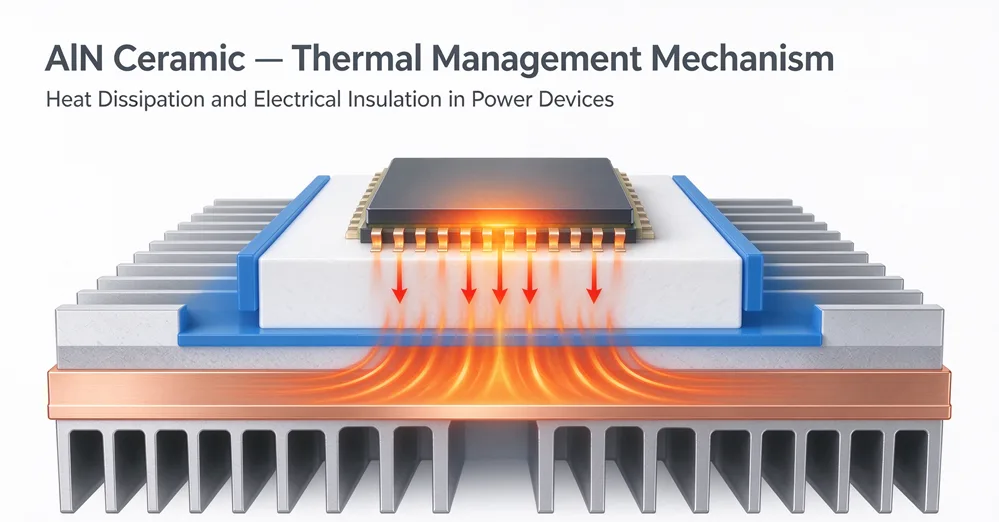
The thermal conductivity of Aluminum Nitride (AlN) Ceramic (170–220 W/m·K) enables rapid heat transfer from the device to the heat sink. In IGBT modules, AlN substrates have been shown to reduce thermal resistance by a factor of more than three compared to alumina substrates . This improvement directly translates into lower junction temperatures, higher power handling capability, and longer device life.
4.2 Electrical Insulation for Safety and Reliability
The high volume resistivity and dielectric strength of Aluminum Nitride (AlN) Ceramic ensure reliable electrical isolation. This is critical for high-voltage power devices, where even small leakage currents can cause problems. AlN substrates have been used successfully in IGBT modules and other power electronics applications, meeting stringent insulation requirements .
4.3 Thermal Matching for Long-Term Reliability
The close thermal expansion match between Aluminum Nitride (AlN) Ceramic and silicon reduces thermal stress at the interface. This improves reliability under thermal cycling, a critical requirement for automotive and industrial power electronics. Temperature cycling tests of AlN substrates and modules show reliability similar to alumina, fulfilling industry requirements .
4.4 Design Flexibility Through Customizable Forms
Aluminum Nitride (AlN) Ceramic is available in a wide range of forms, including plates, rings, rods, and custom shapes . This flexibility allows designers to optimize thermal management for specific device geometries. AlN can also be metallized for direct bonding to copper, enabling DBC (Direct Bonded Copper) substrates for power modules.
5. Key Technical Specifications of Aluminum Nitride Ceramic
6. Matching Aluminum Nitride Ceramic to Your Power Device Application
6.1 IGBT Modules
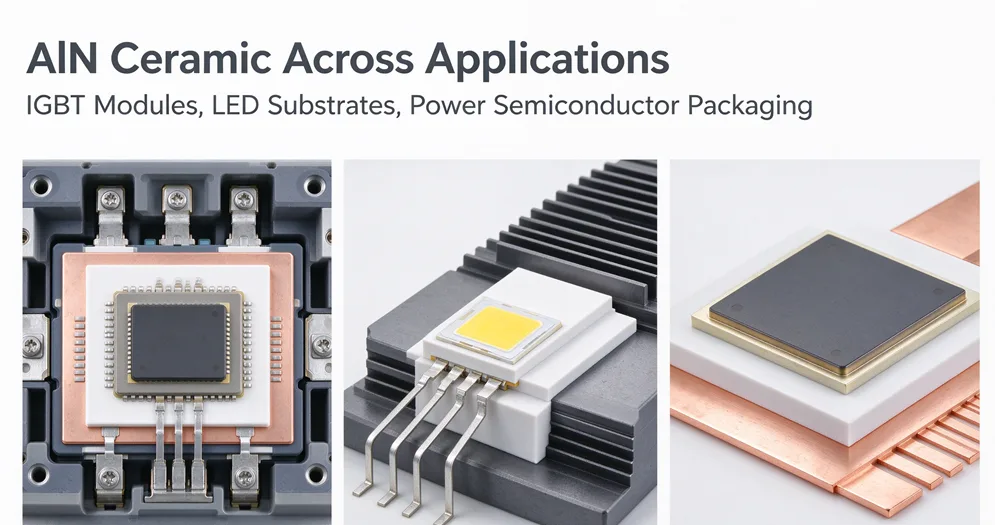
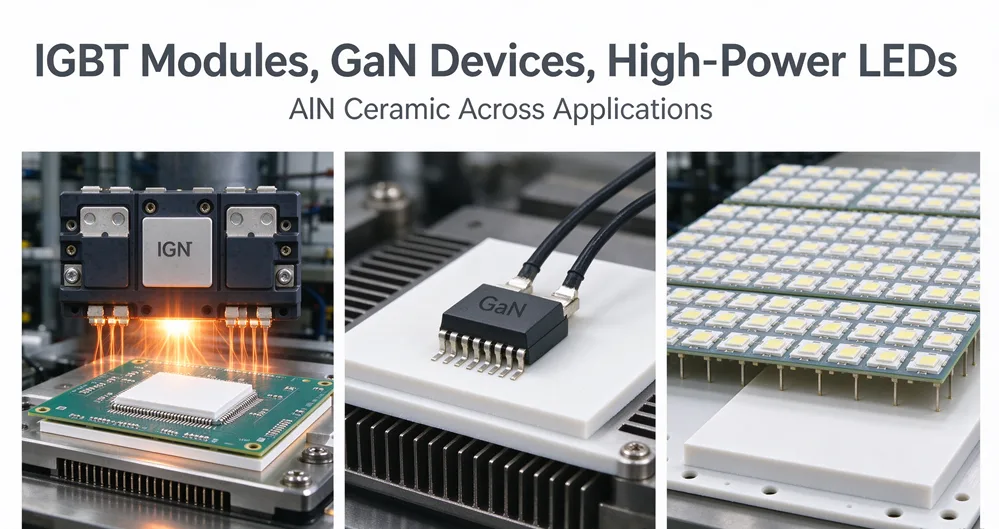
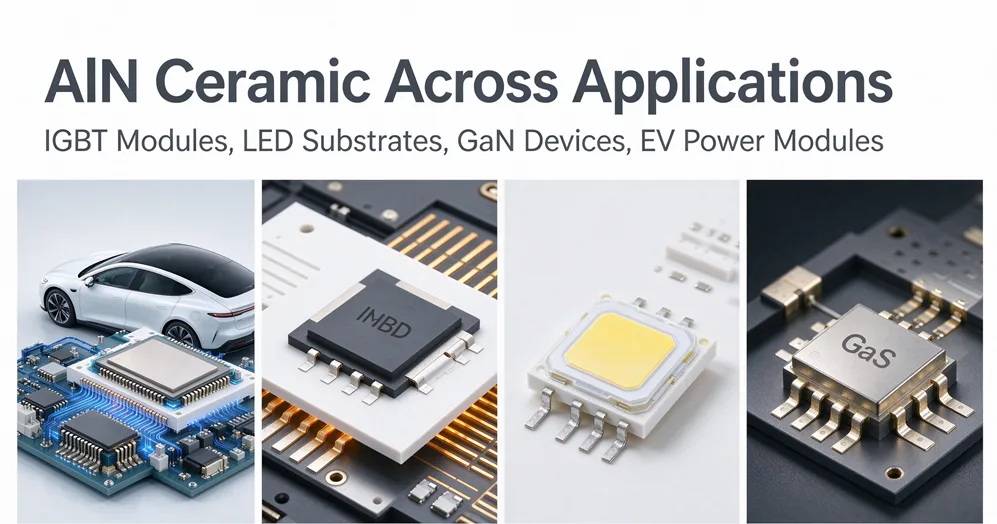
Aluminum Nitride (AlN) Ceramic is widely used as a substrate material in IGBT modules. Its high thermal conductivity and electrical insulation enable efficient heat dissipation while maintaining isolation between the high-voltage and low-voltage sides. AlN substrates reduce thermal resistance compared to alumina, improving module performance and reliability .
6.2 High-Power LEDs
For high-power LED packaging, Aluminum Nitride (AlN) Ceramic substrates provide efficient heat dissipation, maintaining LED junction temperatures within safe limits. This improves luminous efficiency, extends lifetime, and reduces color shift .
6.3 GaN and SiC Power Devices
Wide-bandgap semiconductors like GaN and SiC operate at higher temperatures and power densities than silicon devices. Aluminum Nitride (AlN) Ceramic provides the thermal management and insulation these devices require. AlN coatings have been shown to reduce thermal resistance by up to 25% under forced convection in GaN LED systems .
6.4 Automotive Power Electronics
In electric vehicles, power electronics such as motor controllers and DC-DC converters must operate reliably under harsh conditions. Aluminum Nitride (AlN) Ceramic substrates and heat spreaders provide the thermal performance and reliability needed for these demanding applications .
6.5 RF and Microwave Devices
The low dielectric constant and low dielectric loss of Aluminum Nitride (AlN) Ceramic make it suitable for RF and microwave applications, where signal integrity is critical. AlN substrates are used in high-frequency power amplifiers and radar systems.
7. Common Misconceptions About Aluminum Nitride Ceramics
7.1 “AlN Is Too Expensive for Most Applications”
While Aluminum Nitride (AlN) Ceramic costs more than alumina, its superior thermal conductivity enables smaller, lighter, and more efficient thermal management systems. The total cost of ownership often favors AlN in high-power applications where performance and reliability are critical.
7.2 “AlN Is Difficult to Process”
Aluminum Nitride (AlN) Ceramic does require careful processing due to its covalent bonding and sensitivity to moisture during powder handling. However, advances in sintering aids, powder synthesis, and densification techniques have made AlN processing more accessible. Pressureless sintering and tape casting are now established industrial processes for AlN .
7.3 “AlN Is Only for Semiconductor Applications”
While Aluminum Nitride (AlN) Ceramic is widely used in semiconductors, it is also suitable for power electronics, LED packaging, automotive components, and RF devices. Its versatility is one of its key advantages.
7.4 “AlN Is Toxic Like BeO”
Unlike beryllium oxide (BeO), Aluminum Nitride (AlN) Ceramic is non-toxic. This is a significant advantage for manufacturing safety and environmental compliance .
7.5 “AlN Has Poor Mechanical Strength”
Aluminum Nitride (AlN) Ceramic offers bending strength of 350–450 MPa, which is adequate for most substrate and packaging applications. While it is a brittle ceramic, careful design and handling ensure reliable performance .
8. Quick Evaluation Checklist
Before selecting Aluminum Nitride (AlN) Ceramic for your power device application, verify the following key parameters:
- Thermal conductivity requirement (170–220 W/m·K typical)
- Electrical insulation requirement (volume resistivity, dielectric strength)
- Thermal expansion matching to semiconductor material
- Operating temperature range
- Mechanical strength and hardness requirements
- Form factor (plate, ring, rod, custom shape)
- Metallization requirements for bonding
- Purity level (>99% for demanding applications)
- Supplier quality and technical support
9. Real-World Application Scenarios
9.1 IGBT Module Substrate
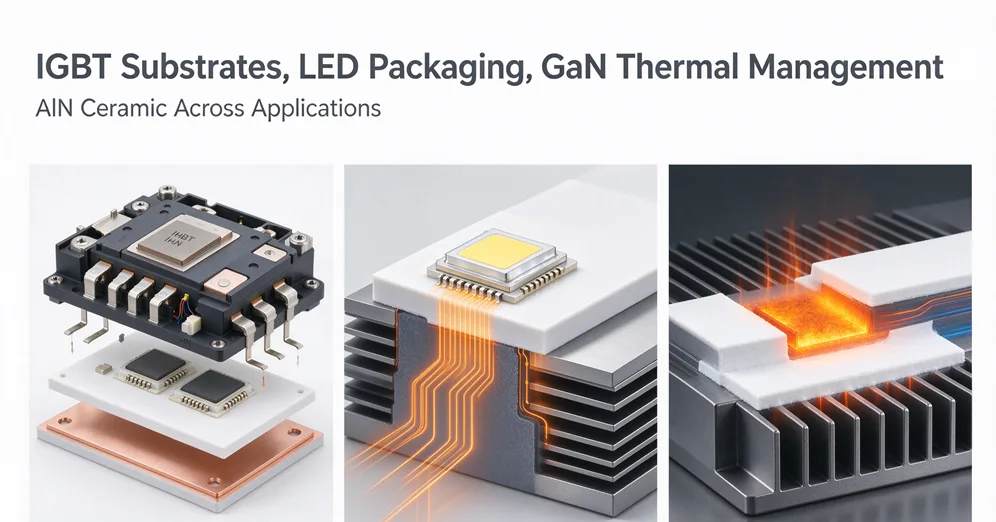
An IGBT module manufacturer replaced alumina substrates with Aluminum Nitride (AlN) Ceramic substrates. The thermal resistance of the module was reduced by a factor of more than three, enabling higher power density and improved reliability .
9.2 High-Power LED Packaging
A high-power LED manufacturer used Aluminum Nitride (AlN) Ceramic substrates for thermal management. The high thermal conductivity of AlN enabled efficient heat dissipation, maintaining LED junction temperatures within safe limits and extending LED lifetime .
9.3 GaN Device Thermal Management
A GaN power device developer applied Aluminum Nitride (AlN) Ceramic coatings to heat sink surfaces. The AlN coating improved heat spreading and reduced thermal resistance by up to 25% under forced convection, demonstrating its effectiveness as a passive cooling solution .
10. Frequently Asked Questions (FAQs)
Q1: What is the thermal conductivity of Aluminum Nitride (AlN) Ceramic?
Aluminum Nitride (AlN) Ceramic typically has a thermal conductivity of 170–220 W/(m·K) for commercial products, with theoretical values reaching 320 W/(m·K) .
Q2: Is AlN Ceramic electrically insulating?
Yes. Aluminum Nitride (AlN) Ceramic has a volume resistivity exceeding 10¹⁴ Ω·cm and a dielectric strength greater than 20 kV/mm, making it an excellent electrical insulator .
Q3: How does AlN compare to alumina (Al₂O₃) for power electronics?
Aluminum Nitride (AlN) Ceramic offers 5–10 times higher thermal conductivity than alumina, enabling more efficient heat dissipation. AlN also has a thermal expansion coefficient closer to silicon, reducing thermal stress. Alumina is more cost-effective but limited in high-power applications .
Q4: Is AlN toxic like beryllium oxide (BeO)?
No. Unlike BeO, Aluminum Nitride (AlN) Ceramic is non-toxic, making it safer to manufacture and handle .
Q5: What forms is AlN Ceramic available in?
Aluminum Nitride (AlN) Ceramic is available in various forms, including plates, rings, rods, and custom shapes. These can be metallized for bonding to copper in DBC substrates .
Q6: Can AlN Ceramic be used in high-temperature applications?
Yes. Aluminum Nitride (AlN) Ceramic can operate at temperatures from -269°C to +1000°C, making it suitable for a wide range of high-temperature applications .
Q7: What is the dielectric strength of AlN Ceramic?
Aluminum Nitride (AlN) Ceramic has a dielectric strength greater than 20 kV/mm, providing reliable electrical insulation for high-voltage power devices .
Q8: Why is thermal expansion matching important for power devices?
Thermal expansion mismatch between the substrate and the semiconductor chip creates thermal stress during temperature cycling. Aluminum Nitride (AlN) Ceramic has a CTE close to silicon, minimizing this stress and improving long-term reliability .
11. What Aluminum Nitride Ceramic Means for Power Electronics
Aluminum Nitride (AlN) Ceramic represents a critical material for the next generation of power electronics. Its combination of high thermal conductivity and excellent electrical insulation enables efficient heat dissipation without compromising safety or reliability.
As power devices continue to push the limits of power density and operating temperature, the demand for materials that can handle these extreme conditions will only grow. Aluminum Nitride (AlN) Ceramic is well-positioned to meet this demand, offering a proven solution for thermal management in IGBT modules, high-power LEDs, GaN devices, and automotive power electronics.
RBOSCHCO offers Aluminum Nitride (AlN) Ceramic with high purity and consistent quality. For power device thermal management applications, Aluminum Nitride (AlN) Ceramic is a proven choice.
Supplier
RBOSCHCO is a trusted global chemical material supplier and manufacturer with over 12 years of experience in providing high-quality chemicals and nanomaterials, including boride powder, nitride powder, graphite powder, sulfide powder, and 3D printing powder. The company has a professional technical department and quality supervision department, a well-equipped laboratory with advanced testing equipment, and a dedicated after-sales customer service center. RBOSCHCO supplies Aluminum Nitride (AlN) Ceramic worldwide, suitable for IGBT modules, high-power LEDs, GaN devices, and automotive power electronics. The company offers comprehensive technical support, from product selection to application guidance. If you are looking for high-quality Aluminum Nitride (AlN) Ceramic for power device thermal management, please feel free to contact us.
RELATED POSTS

Superman in ceramics——Carbide ceramics

Tungsten Boride
Tin Telluride SnTe Powder: A New Star Material in the Optoelectronic Field
AlN vs. BeO Ceramics: The Alternative for Thermal Management
Global Market Trends Forming the Future of Steel Clad Plate–Opportunities for Customers and Vendors Worldwide
