Professional and high-quality metal alloys, ceramic products and concrete additives | RBOSCHCO

1. Introduction to Crucible Selection for Battery Material Synthesis
1.1 What Is a Boron Nitride Crucible?
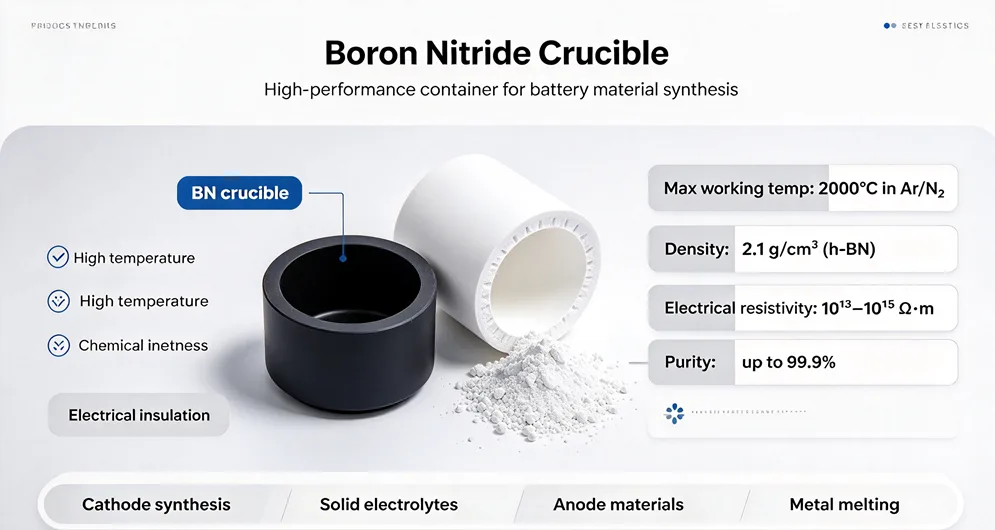
Boron Nitride Crucible is a high-performance crucible made of boron nitride as the main raw material. Boron Nitride Crucible has the advantages of high-temperature resistance, good thermal stability, strong chemical stability, and good insulation performance. It can maintain good shape and performance under high-temperature environments and is not easy to corrode and oxidize. It can be used in melting metals, growing crystals, and other fields to provide stable and reliable containers for related processes, which can help to improve product quality and production efficiency.
1.2 Why Crucible Selection Matters in Battery Material Synthesis
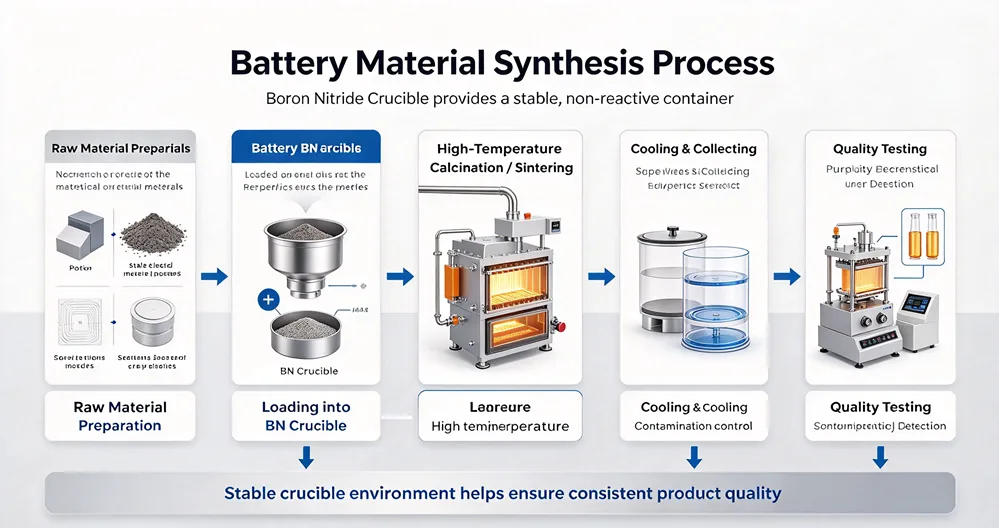
Battery material synthesis involves high-temperature processes such as calcination, sintering, and melting. The crucible used in these processes must withstand extreme temperatures, resist chemical attack from reactive materials, and avoid contaminating the battery material. Even trace amounts of impurity can degrade electrochemical performance, reduce cycle life, and compromise safety.
Traditional crucible materials such as alumina, quartz, and graphite each have limitations. Alumina can react with certain battery materials at high temperatures. Quartz can devitrify and contaminate the product. Graphite can introduce carbon impurities and is not suitable for oxidizing atmospheres. Boron Nitride Crucible addresses these limitations with a combination of high-temperature stability, chemical inertness, and electrical insulation.
1.3 Why Boron Nitride Crucible Stands Out
Among high-temperature crucible materials, Boron Nitride Crucible offers a unique combination of properties. It can withstand temperatures up to 2800°C, has thermal conductivity close to that of aluminum, and is highly resistant to molten metals, glass, and many acid and alkali solutions. It is also electrically insulating, which prevents current leakage and short circuits in electrical heating systems.
For battery material synthesis, these properties translate into higher product purity, longer crucible life, and more reliable process performance. Boron Nitride Crucible is particularly valuable for synthesizing cathode materials, solid electrolytes, and other advanced battery components where contamination must be avoided.
2. Understanding the Basics of Boron Nitride Crucible
2.1 Chemical Composition and Structure
Boron Nitride Crucible is composed primarily of boron nitride (BN), a compound with a layered crystal structure similar to graphite. The molecular weight of BN is 24.82 g/mol. The material is available in two main forms: hexagonal boron nitride (h-BN) and cubic boron nitride (c-BN).
Hexagonal boron nitride (h-BN) is the form used in most crucible applications. It has a density of 2.1 g/cm³, is insoluble in water, and has a refractive index of 1.8. Cubic boron nitride (c-BN) has a density of 3.45 g/cm³ and a refractive index of 2.1, but it is less commonly used in crucibles due to its higher cost and different properties.
2.2 Key Properties of Boron Nitride Crucible
Boron Nitride Crucible offers a combination of properties that make it suitable for battery material synthesis.
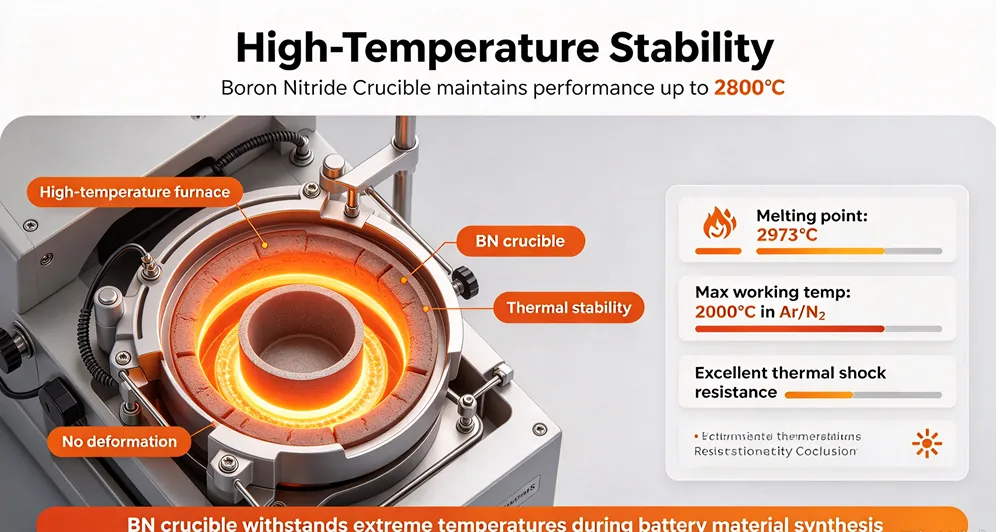
- Excellent high-temperature resistance: Can maintain stability at temperatures up to 2800°C, with a melting point of 2973°C.
- High thermal conductivity: Thermal conductivity close to that of metallic aluminum, enabling rapid and uniform heat conduction and avoiding local overheating.
- Excellent chemical stability: Highly resistant to molten metals, glass, and many acid and alkali solutions. Stable in vacuum, inert gas, or reducing atmosphere environments.
- Good electrical insulation: Effectively isolates electric current and avoids potential problems caused by electrical conduction. Electrical resistivity of 10¹³–10¹⁵ Ω·m.
- High mechanical strength and thermal shock resistance: Maintains structural integrity even after frequent and drastic temperature changes.
- Max working temperature: 2000°C under Ar/N₂; 1800°C under vacuum; 900°C under air.
2.3 Comparison with Other Crucible Materials
| Property | Boron Nitride Crucible | Alumina Crucible | Quartz Crucible | Graphite Crucible |
|---|---|---|---|---|
| Maximum Working Temperature | 2000°C (Ar/N₂) | 1700°C | 1200°C | 2500°C (inert) |
| Chemical Inertness | Excellent | Good | Good | Good (inert) |
| Electrical Insulation | Excellent | Excellent | Excellent | Conductive |
| Thermal Shock Resistance | Excellent | Good | Poor | Excellent |
| Contamination Risk | Very Low | Low | Moderate | Moderate (carbon) |
| Cost | High | Low | Moderate | Low |
The comparison shows that Boron Nitride Crucible offers the best combination of high-temperature capability, chemical inertness, and electrical insulation. While graphite crucibles can withstand higher temperatures in inert atmospheres, they are electrically conductive and can introduce carbon contamination. Alumina crucibles are cheaper but have lower maximum working temperature and can react with certain battery materials.

3. Why Battery Material Synthesis Demands Specialized Crucibles
3.1 High-Temperature Processing
Battery material synthesis often involves high-temperature processes. Cathode materials such as lithium cobalt oxide (LCO), lithium nickel manganese cobalt oxide (NCM), and lithium iron phosphate (LFP) are typically synthesized at temperatures ranging from 700°C to 1000°C. Solid electrolytes may require even higher temperatures. The crucible must withstand these temperatures without softening, deforming, or reacting with the battery material.
3.2 Chemical Reactivity
Battery materials are chemically reactive, especially at high temperatures. Lithium compounds can react with many crucible materials, leading to contamination and degradation of electrochemical performance. The crucible must be chemically inert to the battery material and resistant to attack from molten salts, oxides, and other reactive species.
3.3 Contamination Control
Even trace amounts of impurity can significantly affect battery performance. Metal contamination can increase self-discharge, reduce cycle life, and compromise safety. The crucible must be made from high-purity materials and must not introduce contaminants during processing. Boron Nitride Crucible is available in high-purity grades (up to 99.9%) to meet these requirements.
3.4 Thermal Shock Resistance
Battery material synthesis often involves rapid heating and cooling cycles. The crucible must withstand these thermal cycles without cracking or degrading. Boron Nitride Crucible has excellent thermal shock resistance due to its low thermal expansion and high thermal conductivity.
3.5 Electrical Insulation
In some battery material synthesis processes, the crucible is heated by induction or resistance heating. The crucible must be electrically insulating to prevent current leakage and short circuits. Boron Nitride Crucible has high electrical resistivity (10¹³–10¹⁵ Ω·m), making it suitable for these applications.
4. How Boron Nitride Crucible Meets Battery Material Requirements
4.1 High-Temperature Stability
Boron Nitride Crucible can maintain stability at temperatures up to 2800°C, far exceeding the temperatures required for most battery material synthesis. The crucible does not soften, deform, or react with the battery material, ensuring consistent process performance and product quality.
4.2 Chemical Inertness
Boron Nitride Crucible is highly resistant to molten metals, glass, and many acid and alkali solutions. It is stable in vacuum, inert gas, or reducing atmosphere environments, with corrosion resistance far exceeding that of common crucibles. This makes it suitable for synthesizing a wide range of battery materials, including cathode materials, anode materials, and solid electrolytes.
4.3 Contamination Prevention
Boron Nitride Crucible is available in high-purity grades with low impurity precipitation. This effectively avoids contamination of semiconductor materials and battery materials, ensuring the purity and performance of the final product. The crucible is particularly valuable for synthesizing high-purity battery materials where even trace contamination can degrade performance.
4.4 Thermal Shock Resistance
Boron Nitride Crucible has excellent thermal shock resistance, maintaining structural integrity even after frequent and drastic temperature changes. This is important for battery material synthesis processes that involve rapid heating and cooling cycles.
4.5 Electrical Insulation
Boron Nitride Crucible has high electrical resistivity (10¹³–10¹⁵ Ω·m), effectively isolating electric current and avoiding potential problems caused by electrical conduction. This makes it suitable for use in electrical heating systems and other applications where electrical insulation is required.
5. Key Technical Specifications of Boron Nitride Crucible
| Property | Specification |
|---|---|
| Compound Formula | BN |
| Molecular Weight | 24.82 g/mol |
| Appearance | Black or white solid |
| Melting Point | 2973 °C |
| Density | 2.1 g/cm³ (h-BN); 3.45 g/cm³ (c-BN) |
| Solubility in H₂O | Insoluble |
| Refractive Index | 1.8 (h-BN); 2.1 (c-BN) |
| Electrical Resistivity | 10¹³ – 10¹⁵ Ω·m |
| Max. Working Temperature | 2000°C (under Ar/N₂); 1800°C (under vacuum); 900°C (under air) |
| Thermal Conductivity | Close to metallic aluminum |
| Chemical Resistance | Resistant to molten metals, glass, acids, and alkalis |
| Thermal Shock Resistance | Excellent |
| Purity | Up to 99.9% |
6. Matching Boron Nitride Crucible to Your Battery Application
6.1 Cathode Material Synthesis
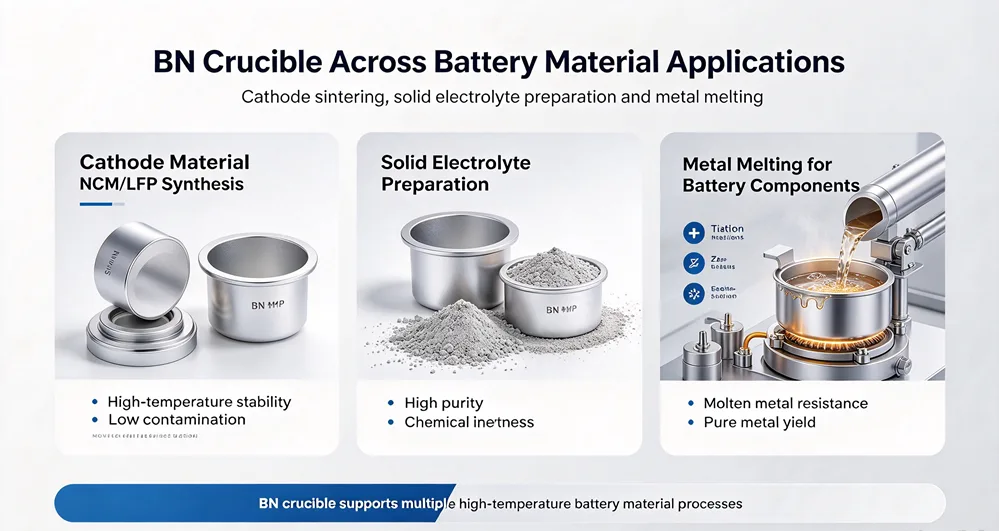
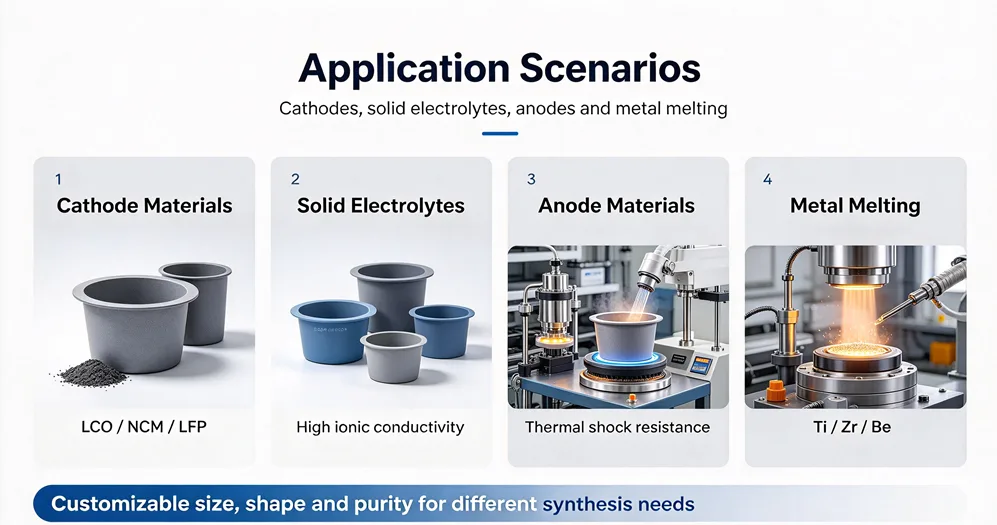
Boron Nitride Crucible is suitable for synthesizing cathode materials such as LCO, NCM, and LFP. The crucible’s high-temperature stability and chemical inertness prevent contamination and ensure consistent product quality. The crucible can withstand the high temperatures required for cathode material calcination and sintering.
6.2 Solid Electrolyte Preparation
Boron Nitride Crucible is used for preparing solid electrolytes, which often require high-temperature processing and are sensitive to contamination. The crucible’s high purity and chemical inertness make it ideal for these applications.
6.3 Anode Material Synthesis
Boron Nitride Crucible is used for synthesizing anode materials such as silicon-based anodes and hard carbon. The crucible’s thermal shock resistance and chemical inertness ensure reliable performance during high-temperature processing.
6.4 Metal Melting for Battery Components
Boron Nitride Crucible is used for melting high-melting-point metals and active metals, such as titanium, zirconium, and beryllium, which are used in battery components. The crucible can withstand high temperatures and does not react with the metal, preventing contamination and ensuring metal purity.
6.5 Semiconductor Material Preparation
Boron Nitride Crucible is used in the growth of compound semiconductor crystals such as Gallium Arsenide and Indium Phosphide. The crucible’s high purity and low impurity precipitation characteristics ensure the purity and performance of the crystals.
7. Common Misconceptions About Boron Nitride Crucible
7.1 “Boron Nitride Crucible Is Only for Semiconductor Applications”
While Boron Nitride Crucible is widely used in semiconductor manufacturing, it is also suitable for battery material synthesis, metal melting, optical material preparation, and ceramic sintering. Its versatility is one of its key advantages.
7.2 “Boron Nitride Crucible Is Too Expensive”
While Boron Nitride Crucible has a higher initial cost than some conventional crucibles, its longer service life and higher product purity can reduce total cost of ownership. For battery material synthesis, where contamination can ruin an entire batch, the cost premium is often justified.
7.3 “Boron Nitride Crucible Cannot Be Used in Air”
Boron Nitride Crucible can be used in air up to 900°C. Above this temperature, oxidation becomes significant. For higher-temperature applications, an inert or vacuum atmosphere is required.
7.4 “Boron Nitride Crucible Is Difficult to Clean”
Boron Nitride Crucible can be cleaned using etching cleaning (hydrofluoric acid solution followed by ammonia-hydrogen peroxide mixture), physical sanding (P600-P1000 sandpaper), and drying treatment (methanol rinse and low-temperature drying). Proper cleaning can extend the service life of the crucible.
7.5 “Boron Nitride Crucible Is Not Customizable”
Boron Nitride Crucible can be customized in terms of size (e.g., diameter 50-300mm), shape (e.g., cylindrical, square), purity (95%-99.9%), and coating (e.g., silicon carbide coating to enhance wear resistance). Customization allows the crucible to be optimized for specific battery material synthesis processes.
8. Quick Evaluation Checklist
Before selecting Boron Nitride Crucible for your battery material synthesis application, verify the following key parameters:
- Maximum working temperature required
- Atmosphere (air, inert, vacuum, reducing)
- Chemical compatibility with the battery material
- Purity requirements (impurity levels)
- Thermal shock resistance requirements
- Electrical insulation requirements
- Crucible size and shape requirements
- Cleaning and maintenance requirements
- Service life expectations
- Supplier quality and technical support
9. Real-World Application Scenarios
9.1 Cathode Material Synthesis for Lithium-Ion Batteries
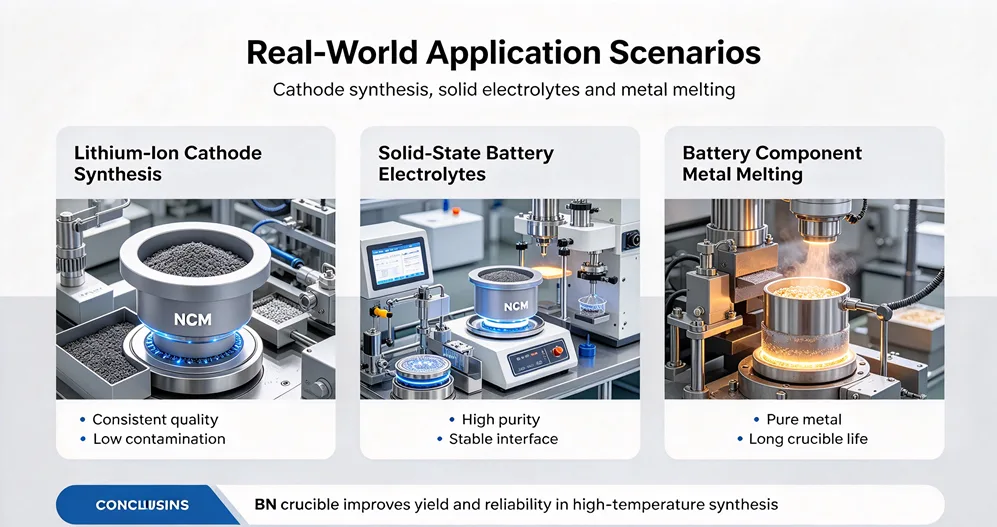
A battery material manufacturer used Boron Nitride Crucible for synthesizing NCM cathode materials. The crucible’s high-temperature stability and chemical inertness prevented contamination and ensured consistent product quality. The crucible withstood the high temperatures required for calcination and sintering without degradation.
9.2 Solid Electrolyte Preparation for Solid-State Batteries
A solid-state battery developer used Boron Nitride Crucible for preparing solid electrolytes. The crucible’s high purity and chemical inertness ensured that the solid electrolyte was free from contamination, which is critical for achieving high ionic conductivity and stable performance.
9.3 Metal Melting for Battery Components
A battery component manufacturer used Boron Nitride Crucible for melting titanium and zirconium, which are used in battery current collectors and other components. The crucible did not react with the molten metal, preventing contamination and ensuring metal purity.
10. Frequently Asked Questions (FAQs)
Q1: Why does boron nitride crucible flash off in electron beam evaporation?
The high insulating property of Boron Nitride Crucible leads to charge accumulation after electron beam bombardment and produces a homogeneous repulsion effect. It can be mitigated by controlling the power, the current rising speed, or choosing a low voltage electron gun.
Q2: How to clean and maintain the boron nitride crucible?
Cleaning steps include etching cleaning (hydrofluoric acid solution 1:10-12 to soften surface impurities, then ammonia-hydrogen peroxide mixture 1-3:1:5 to further remove deep energy level impurities), physical sanding (P600-P1000 sandpaper to remove faults and scratches), and drying treatment (methanol rinse and low-temperature drying at ≤120°C). Maintenance points include avoiding mechanical collision, storing in a dry environment, and checking regularly for cracks or wear.
Q3: How long is the service life of boron nitride crucible?
In the semiconductor field, Boron Nitride Crucible can be reused more than 15 times after professional cleaning. In metal melting, the service life depends on the corrosiveness and temperature of the melt, generally 50-100 times. Pyrolytic Boron Nitride (PBN) crucibles can be used more than 200 times due to their dense structure.
Q4: What is the price range of Boron Nitride Crucible?
Prices vary by purity, size, and process. Ordinary hexagonal boron nitride crucible (e.g., 20ml) costs about $200-500 per unit. Pyrolytic boron nitride (PBN) crucibles (e.g., 135mm) cost thousands of dollars. Customized products (e.g., large size, special shapes) cost even more.
Q5: Can we customize boron nitride crucible?
Yes. Common customization parameters include size (e.g., diameter 50-300mm), shape (e.g., cylindrical, square), purity (95%-99.9%), and coating (e.g., silicon carbide coating to enhance wear resistance).
Q6: What is the maximum working temperature of Boron Nitride Crucible?
Boron Nitride Crucible can operate at temperatures up to 2000°C under Ar/N₂, 1800°C under vacuum, and 900°C under air. The maximum working temperature depends on the atmosphere and the specific grade of the crucible.
Q7: Is Boron Nitride Crucible suitable for use with molten metals?
Yes, Boron Nitride Crucible is highly resistant to molten metals, including high-melting-point metals and active metals such as titanium, zirconium, and beryllium. The crucible does not react with the metal, preventing contamination and ensuring metal purity.
Q8: What is the difference between hexagonal boron nitride and cubic boron nitride crucibles?
Hexagonal boron nitride (h-BN) is the form used in most crucible applications, with a density of 2.1 g/cm³ and a refractive index of 1.8. Cubic boron nitride (c-BN) has a density of 3.45 g/cm³ and a refractive index of 2.1, but it is less commonly used in crucibles due to its higher cost and different properties.
11. What Boron Nitride Crucible Means for the Future of Battery Materials
Boron Nitride Crucible represents a significant advancement in high-temperature crucible technology. Its combination of high-temperature stability, chemical inertness, electrical insulation, and thermal shock resistance makes it the material of choice for battery material synthesis.
For battery manufacturers, Boron Nitride Crucible offers a way to improve product purity, reduce contamination, and extend crucible life. It is particularly valuable for synthesizing advanced battery materials such as high-nickel cathodes, solid electrolytes, and silicon-based anodes, where even trace contamination can degrade performance.
RBOSCHCO offers Boron Nitride Crucible with high purity, customizable dimensions, and consistent quality. For battery material synthesis and other high-temperature applications, Boron Nitride Crucible is a proven choice.
Supplier
RBOSCHCO is a trusted global chemical material supplier and manufacturer with over 12 years of experience in providing high-quality chemicals and nanomaterials, including boride powder, nitride powder, graphite powder, sulfide powder, and 3D printing powder. The company has a professional technical department and quality supervision department, a well-equipped laboratory with advanced testing equipment, and a dedicated after-sales customer service center. RBOSCHCO supplies Boron Nitride Crucible worldwide, suitable for battery material synthesis, semiconductor manufacturing, metal melting, optical material preparation, and ceramic sintering. The company offers comprehensive technical support, from product selection to application guidance. If you are looking for high-quality Boron Nitride Crucible for battery material synthesis, please feel free to contact us.
RELATED POSTS

Silicon dioxide powder is widely used, promoting technological innovation in multiple fields

Properties and Applications of Aluminum Nitride
In what ways does cuprous oxide work
Boron Carbide Nanoparticles: Ultra-Hard, Radiation-Resistant Material for Advanced Applications
What is MoSi2 heating element?