Professional and high-quality metal alloys, ceramic products and concrete additives | RBOSCHCO

1. Introduction to Nano Lithium Manganese Oxide (LMO)
1.1 What Is Nano Lithium Manganese Oxide (LMO)?
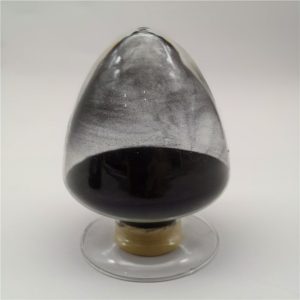
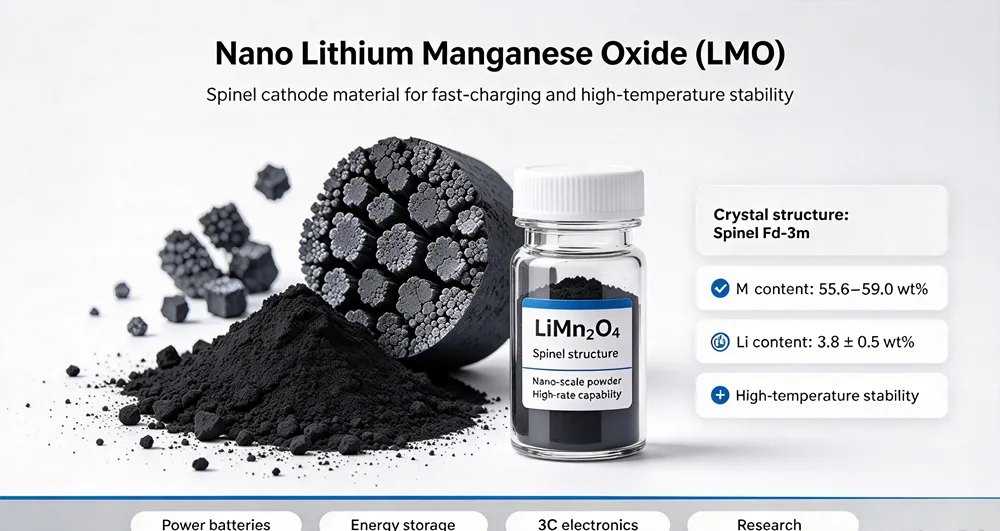
Nano Lithium Manganese Oxide (LMO) is a spinel-structure cathode material with the chemical formula LiMn₂O₄. It features a unique three-dimensional lithium-ion diffusion channel architecture that enables rapid charge and discharge. Through advanced nanonization technology, Nano Lithium Manganese Oxide (LMO) delivers significantly improved rate capability and high-temperature cycling performance compared to conventional micron-grade products.
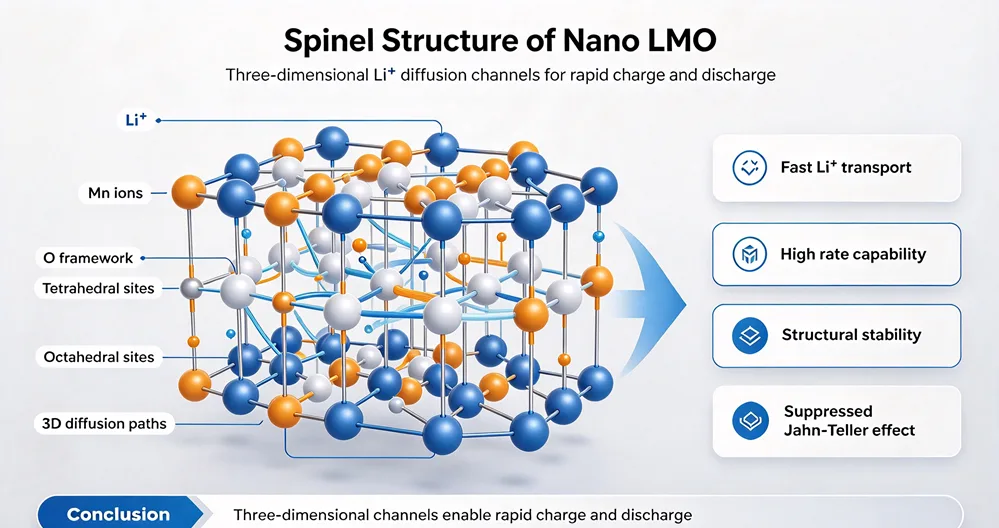
The spinel structure of Nano Lithium Manganese Oxide (LMO) belongs to the Fd-3m space group. This structure provides three-dimensional Li⁺ diffusion paths, allowing lithium ions to move freely in all directions during charge and discharge. This is a key advantage over layered oxide cathodes, which have two-dimensional diffusion paths and are more sensitive to structural degradation.
1.2 Why High-Rate and High-Temperature Performance Matters
Lithium-ion batteries are being pushed to higher charge rates and higher operating temperatures than ever before. Electric vehicles need to charge quickly to minimize downtime. Power tools and e-bikes need to deliver high current on demand. Energy storage systems in hot climates need to maintain capacity and cycle life at elevated temperatures.
Conventional micron-grade LMO suffers from two major limitations at high rates and high temperatures. First, the long lithium-ion diffusion paths in micron-sized particles limit rate capability. Second, the Jahn-Teller effect causes Mn²⁺ disproportionation, leading to capacity fading, especially at elevated temperatures.
Nano Lithium Manganese Oxide (LMO) addresses both limitations through nanonization. The smaller particle size shortens lithium-ion diffusion pathways, improving rate capability. The nanoscale structure also suppresses the Jahn-Teller effect, reducing high-temperature capacity fade.
1.3 Why Nano Lithium Manganese Oxide (LMO) Stands Out
Among cathode materials, Nano Lithium Manganese Oxide (LMO) offers a unique combination of advantages. It provides the high-rate capability needed for fast charging and high-power applications. It offers better thermal stability than layered oxide cathodes such as NCM and LCO. It is more cost-effective than cobalt-containing cathodes. And it is more environmentally friendly than nickel-cobalt-manganese chemistries.
For applications that require fast charging, high power, and reliable operation at elevated temperatures, Nano Lithium Manganese Oxide (LMO) is a compelling choice.
2. Understanding the Basics of Spinel LMO
2.1 Crystal Structure and Diffusion Pathways
Nano Lithium Manganese Oxide (LMO) has a spinel crystal structure with the Fd-3m space group. In this structure, lithium ions occupy tetrahedral sites, manganese ions occupy octahedral sites, and oxygen ions form a cubic close-packed framework.
The spinel structure provides three-dimensional diffusion pathways for lithium ions. Unlike layered oxides, where lithium ions can only move in two dimensions, the spinel structure allows lithium ions to move in all three dimensions. This enables faster charge and discharge, particularly at high rates.
2.2 The Jahn-Teller Effect and Mn Dissolution
One of the main challenges with LMO is the Jahn-Teller effect. At elevated temperatures, Mn³⁺ ions can disproportionate into Mn²⁺ and Mn⁴⁺. The Mn²⁺ ions can dissolve into the electrolyte, leading to capacity fading and structural degradation.
Nano Lithium Manganese Oxide (LMO) suppresses the Jahn-Teller effect through nanonization. The smaller particle size reduces the strain associated with the Jahn-Teller distortion, and the higher surface area allows for more uniform lithium-ion extraction and insertion. This significantly reduces Mn dissolution and improves high-temperature cycling performance.
2.3 Key Properties of Nano Lithium Manganese Oxide (LMO)
Nano Lithium Manganese Oxide (LMO) offers a combination of properties that make it suitable for demanding battery applications.
- Spinel crystal structure: Fd-3m space group, providing three-dimensional Li⁺ diffusion channels for rapid charge/discharge.
- Nanonization advantages: Smaller particle size and larger specific surface area, significantly shortened lithium-ion diffusion pathways.
- Suppressed Jahn-Teller effect: Effectively inhibits Mn²⁺ disproportionation, a common issue in conventional LMO materials.
- Reduced high-temperature capacity fade: Substantially lower capacity loss during operation at elevated temperatures compared to micron-sized counterparts.
- High Mn content: 55.6–59.0 wt% (typical 57.5 ± 0.5 wt%).
- Controlled lithium content: 3.8 ± 0.5 wt% (typical 3.96 wt%).
- Low impurities: Fe, Ni, and other impurities compliant with industry standards.
3. Why High-Rate and High-Temperature Performance Matters
3.1 Fast Charging Requirements
Fast charging is one of the most important requirements for modern lithium-ion batteries. Electric vehicles need to charge quickly to minimize downtime. Consumer electronics need to charge quickly to improve user experience. Power tools need to deliver high current on demand.
Fast charging requires cathode materials with high rate capability. The rate capability of a cathode is determined by the lithium-ion diffusion coefficient and the diffusion path length. Nano Lithium Manganese Oxide (LMO) shortens the diffusion path length through nanonization, enabling faster lithium-ion extraction and insertion.
3.2 High-Temperature Operation
Lithium-ion batteries often operate at elevated temperatures, particularly in power tools, electric vehicles, and energy storage systems in hot climates. High temperatures accelerate the degradation of cathode materials, leading to capacity fade and reduced cycle life.
Nano Lithium Manganese Oxide (LMO) offers better high-temperature performance than conventional LMO. The nanoscale structure suppresses the Jahn-Teller effect, reducing Mn dissolution and capacity fade at elevated temperatures.
3.3 Safety Considerations
Safety is a critical concern for lithium-ion batteries, particularly in high-power and high-temperature applications. Nano Lithium Manganese Oxide (LMO) offers better thermal stability than layered oxide cathodes such as NCM and LCO. The spinel structure is more resistant to oxygen release at elevated temperatures, reducing the risk of thermal runaway.
4. How Nanonization Improves LMO Performance
4.1 Shorter Diffusion Pathways
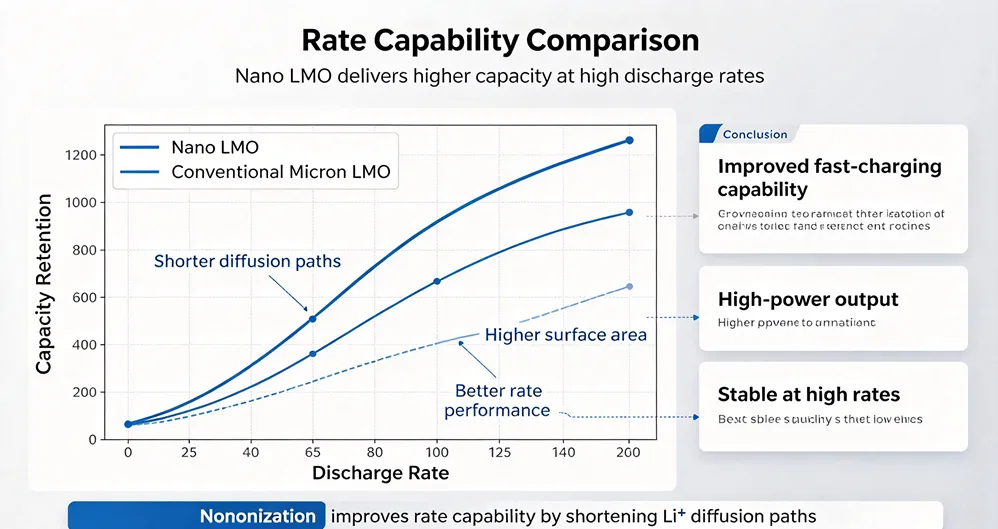
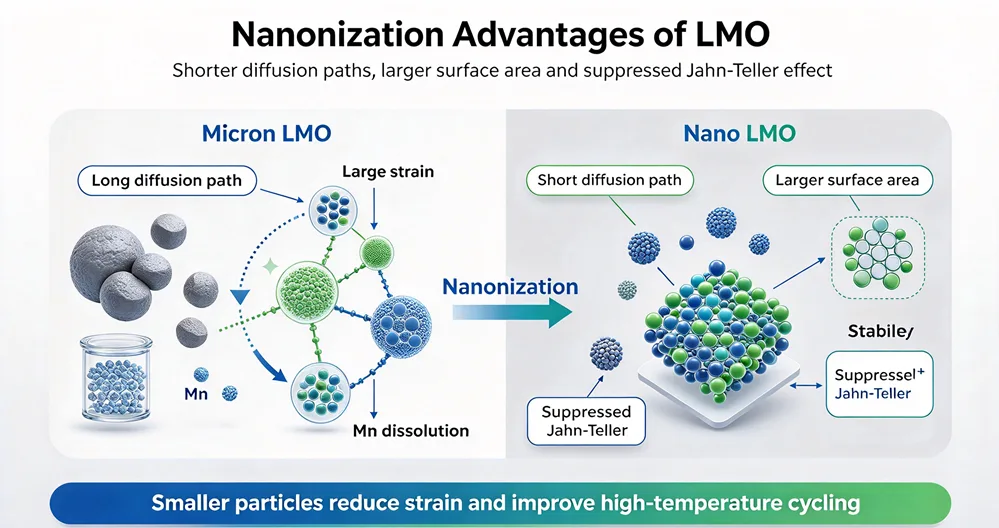
The most direct benefit of nanonization is the shortening of lithium-ion diffusion pathways. In micron-sized particles, lithium ions must travel long distances to reach the particle surface. In nanoscale particles, the diffusion distance is much shorter, enabling faster charge and discharge.
4.2 Larger Specific Surface Area
Nanonization also increases the specific surface area of the cathode material. A larger surface area provides more active sites for lithium-ion insertion and extraction, improving rate capability. It also improves contact between the cathode material and the electrolyte, enhancing ionic conductivity.
4.3 Suppressed Jahn-Teller Effect
The Jahn-Teller effect is a structural distortion that occurs when Mn³⁺ ions are present in the spinel lattice. This distortion can lead to Mn dissolution and capacity fade. Nanonization reduces the strain associated with the Jahn-Teller distortion, suppressing Mn dissolution and improving high-temperature cycling performance.
4.4 Enhanced High-Temperature Cycling
The combination of shorter diffusion pathways, larger surface area, and suppressed Jahn-Teller effect results in significantly improved high-temperature cycling performance. Nano Lithium Manganese Oxide (LMO) maintains higher capacity and longer cycle life at elevated temperatures compared to micron-sized LMO.
5. Key Technical Specifications of Nano LMO
| Parameter | Specification / Value |
|---|---|
| Crystal Structure | Spinel (Fd-3m space group) |
| Mn Content | 55.6 – 59.0 wt% (57.5 ± 0.5 wt% typ.) |
| Li Content | 3.8 ± 0.5 wt% (3.96 wt% typ.) |
| Impurities (Fe, Ni, etc.) | Compliant with industry standards |
| Particle Size | Nanoscale (specific size available upon request) |
| Specific Surface Area | Enhanced due to nanonization |
| Rate Capability | Significantly improved vs. micron-grade LMO |
| High-Temperature Performance | Suppressed Jahn-Teller effect, reduced capacity fade |
6. Matching Nano LMO to Your Battery Application
6.1 Power Batteries
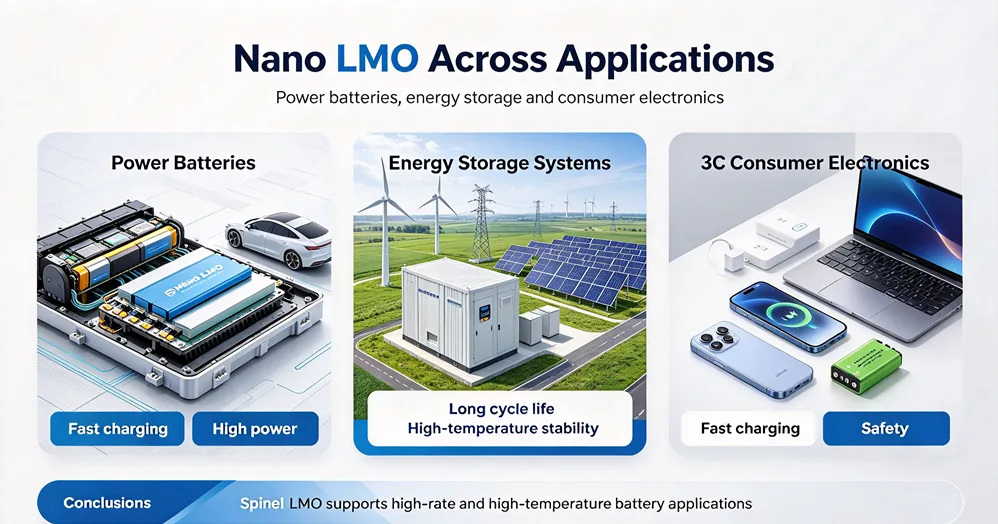
Nano Lithium Manganese Oxide (LMO) is widely used in power batteries for electric vehicles, new energy vehicles, e-bikes, electric sightseeing vehicles, power tools, and new energy marine vessels. The high rate capability of Nano Lithium Manganese Oxide (LMO) supports fast charging and high-power output, while the high-temperature stability ensures reliable operation in demanding environments.
6.2 Energy Storage Systems (ESS)
Nano Lithium Manganese Oxide (LMO) is suitable for energy storage systems including solar street lights, landscape lighting storage batteries, mobile communication base station batteries, wind power storage systems, home energy storage systems, UPS batteries, and grid peak-shaving storage systems. The long cycle life and high-temperature stability of Nano Lithium Manganese Oxide (LMO) make it well-suited for these applications.
6.3 3C Consumer Electronics
Nano Lithium Manganese Oxide (LMO) is used in 3C consumer electronics including mobile phone batteries, laptop batteries, e-book batteries, and electric toy batteries. The fast-charging capability of Nano Lithium Manganese Oxide (LMO) improves user experience, while the thermal stability ensures safety.
6.4 Cutting-Edge Research
Nano Lithium Manganese Oxide (LMO) is also used in cutting-edge research, including electrochemical property studies of nano LMO and LMO/graphene composites, and the development and testing of modified nano LMO. Researchers value the well-defined spinel structure and the ability to tune particle size and surface properties.
7. Common Misconceptions About LMO Cathode Materials
7.1 “LMO Has Poor Cycle Life”
Conventional micron-grade LMO does suffer from capacity fade, particularly at elevated temperatures. However, Nano Lithium Manganese Oxide (LMO) addresses this issue through nanonization and suppression of the Jahn-Teller effect. The result is significantly improved cycle life, particularly at high temperatures.
7.2 “LMO Is Only for Low-Cost Applications”
While LMO is more cost-effective than cobalt-containing cathodes, Nano Lithium Manganese Oxide (LMO) offers performance that is competitive with more expensive materials in high-rate and high-temperature applications. Its combination of fast charging, thermal stability, and cost-effectiveness makes it a compelling choice for many applications.
7.3 “LMO Cannot Be Used in Electric Vehicles”
Nano Lithium Manganese Oxide (LMO) is widely used in power batteries for electric vehicles, new energy vehicles, e-bikes, and other traction applications. Its high rate capability supports fast charging, and its thermal stability ensures safe operation.
7.4 “Nano LMO Is Difficult to Process”
Nano Lithium Manganese Oxide (LMO) is produced using advanced nanonization technology that ensures consistent particle size and surface properties. It can be processed using standard battery manufacturing equipment, including mixing, coating, and calendering.
7.5 “LMO Is Not Suitable for High-Voltage Applications”
Nano Lithium Manganese Oxide (LMO) can be used in high-voltage applications when paired with appropriate electrolytes and cell designs. The spinel structure is stable at high voltages, and the nanoscale morphology resists structural degradation.
8. Quick Evaluation Checklist
Before selecting Nano Lithium Manganese Oxide (LMO) for your battery application, verify the following key parameters:
- Crystal structure (spinel, Fd-3m space group)
- Mn content (55.6–59.0 wt%)
- Li content (3.8 ± 0.5 wt%)
- Impurity levels (Fe, Ni, etc.)
- Particle size and distribution
- Specific surface area
- Rate capability requirements
- High-temperature performance requirements
- Cycle life requirements
- Compatibility with electrolyte and other cell components
- Supplier quality and technical support
9. Real-World Application Scenarios
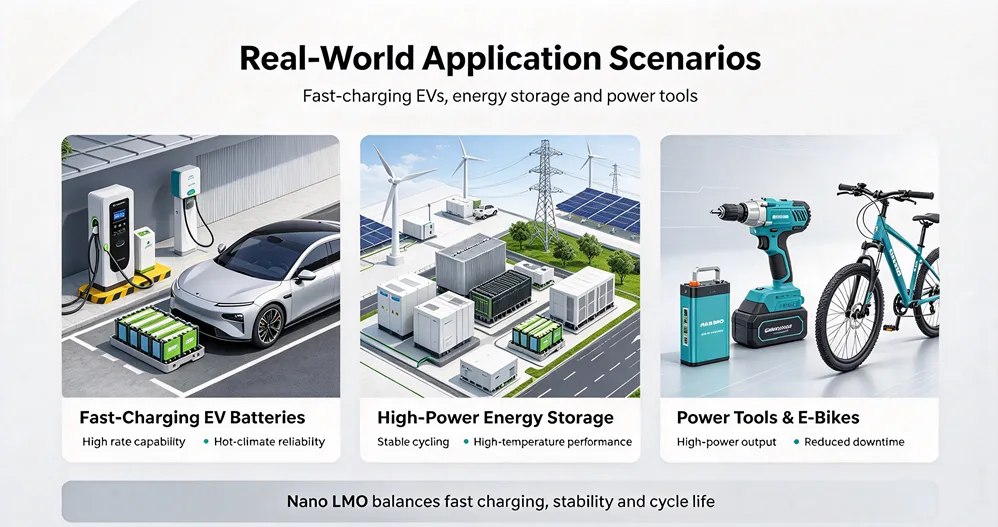
9.1 Fast-Charging Electric Vehicle Batteries
An electric vehicle manufacturer selected Nano Lithium Manganese Oxide (LMO) for its fast-charging battery packs. The nanoscale particle size shortened lithium-ion diffusion pathways, enabling faster charging without compromising cycle life. The high-temperature stability of Nano Lithium Manganese Oxide (LMO) ensured reliable operation in hot climates.
9.2 High-Power Energy Storage Systems
An energy storage system manufacturer used Nano Lithium Manganese Oxide (LMO) for grid peak-shaving and renewable energy storage. The high rate capability of Nano Lithium Manganese Oxide (LMO) supported high-power charge and discharge, while the suppressed Jahn-Teller effect ensured long cycle life at elevated temperatures.
9.3 Power Tools and E-Bikes
A power tool manufacturer selected Nano Lithium Manganese Oxide (LMO) for high-power battery packs. The fast-charging capability of Nano Lithium Manganese Oxide (LMO) reduced downtime, while the thermal stability ensured safe operation under heavy load.
10. Frequently Asked Questions (FAQs)
Q1: What is the crystal structure of this nano LMO material?
It features a spinel structure (Fd-3m space group), which provides three-dimensional lithium-ion diffusion channels for excellent rate performance.
Q2: How does nano LMO differ from conventional micron-grade LMO?
Nano LMO has smaller particle size and larger specific surface area, which shortens Li⁺ diffusion paths, improves rate capability, and suppresses the Jahn-Teller effect, significantly reducing high-temperature capacity fade.
Q3: What is the typical lithium content in this product?
The lithium content is 3.8 ± 0.5 wt%, with a typical value of approximately 3.96 wt%.
Q4: Is this material suitable for electric vehicle batteries?
Yes, it is widely used in power batteries for electric vehicles, new energy vehicles, e-bikes, and other traction applications.
Q5: What packaging options are available?
Packaging is customizable according to customer requirements. Please contact us for detailed specifications and options.
Q6: What is the Mn content in Nano Lithium Manganese Oxide (LMO)?
The Mn content is 55.6–59.0 wt%, with a typical value of 57.5 ± 0.5 wt%.
Q7: Can Nano Lithium Manganese Oxide (LMO) be used in high-temperature applications?
Yes, Nano Lithium Manganese Oxide (LMO) is specifically designed for high-temperature stability. The nanoscale structure suppresses the Jahn-Teller effect, reducing capacity fade at elevated temperatures.
Q8: Is Nano Lithium Manganese Oxide (LMO) compatible with standard battery manufacturing processes?
Yes, Nano Lithium Manganese Oxide (LMO) can be processed using standard battery manufacturing equipment, including mixing, coating, and calendering.
11. What Nano LMO Means for the Future of Lithium-Ion Batteries
Nano Lithium Manganese Oxide (LMO) represents a significant advancement in cathode material technology. By combining the inherent advantages of the spinel structure with the benefits of nanonization, Nano Lithium Manganese Oxide (LMO) delivers fast charging, high-temperature stability, and long cycle life at a competitive cost.
For battery manufacturers, Nano Lithium Manganese Oxide (LMO) offers a compelling alternative to layered oxide cathodes for applications that require high rate capability and thermal stability. It is particularly well-suited for power batteries, energy storage systems, and 3C consumer electronics.
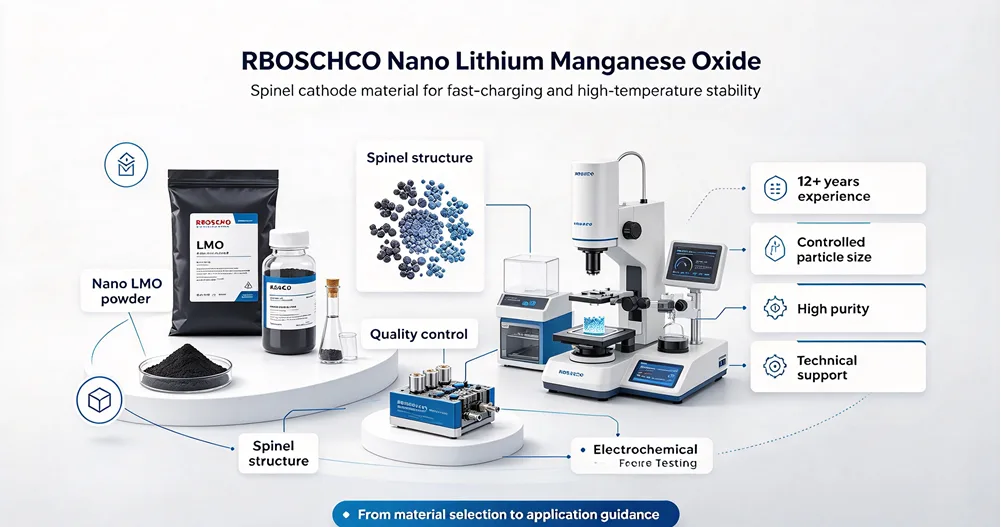
RBOSCHCO offers Nano Lithium Manganese Oxide (LMO) with controlled particle size, high purity, and consistent electrochemical performance. For fast-charging and high-temperature lithium-ion battery applications, Nano Lithium Manganese Oxide (LMO) is a proven choice.
Supplier
RBOSCHCO is a trusted global chemical material supplier and manufacturer with over 12 years of experience in providing high-quality chemicals and nanomaterials, including boride powder, nitride powder, graphite powder, sulfide powder, and 3D printing powder. The company has a professional technical department and quality supervision department, a well-equipped laboratory with advanced testing equipment, and a dedicated after-sales customer service center. RBOSCHCO supplies Nano Lithium Manganese Oxide (LMO) worldwide, suitable for power batteries, energy storage systems, 3C consumer electronics, and cutting-edge research applications. The company offers comprehensive technical support, from product selection to application guidance. If you are looking for high-quality Nano Lithium Manganese Oxide (LMO) for lithium-ion battery applications, please feel free to contact us.