Professional and high-quality metal alloys, ceramic products and concrete additives | RBOSCHCO

10Supplier
1. Overview of Thermal Conductive Filler Selection
1.1 What Are Thermal Conductive Fillers?
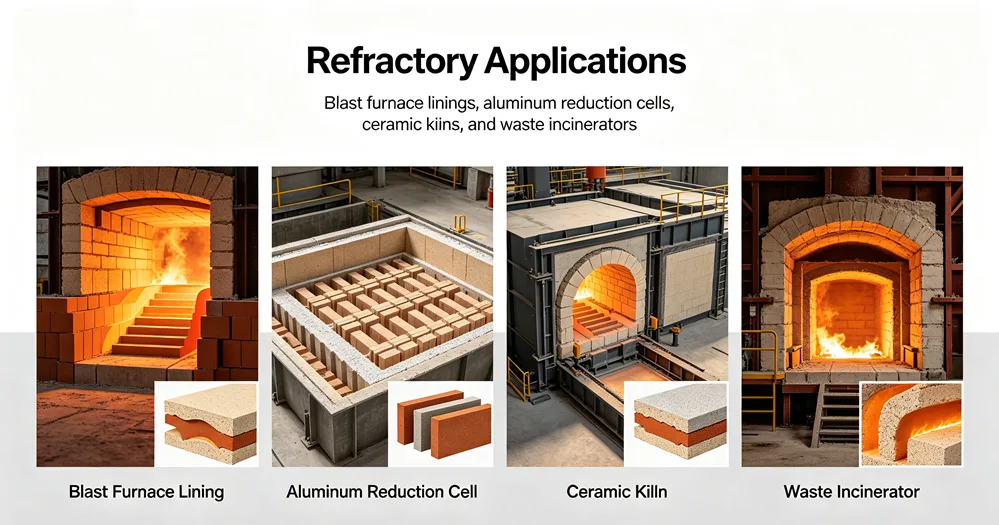
Thermal conductive fillers are a class of functional materials used to improve the heat transfer capability of refractory materials. By filling into refractory matrices, they build pathways for heat to travel through, giving otherwise poorly conductive refractories a usable level of thermal conductivity. These fillers are widely used in high-temperature industrial applications such as blast furnace linings, aluminum reduction cells, ceramic kilns, and waste incinerators. They are indispensable in applications where thermal management and lining life are critical.
The role of thermal conductive fillers goes beyond simply raising thermal conductivity. They also need to balance chemical compatibility with the refractory matrix, thermal expansion matching, high-temperature stability, and long-term reliability. Different applications have different requirements for thermal conductivity, insulation, particle size, morphology, and surface characteristics, which makes selection a multi-objective optimization problem.
1.2 The Cost of Choosing the Wrong Filler
When a thermal conductive filler is poorly chosen, it rarely causes immediate failure. Instead, problems gradually appear — thermal conductivity falls short, thermal shock resistance declines, mechanical properties degrade, interfacial thermal resistance grows, and long-term reliability suffers. In high-temperature industrial applications, insufficient heat dissipation can lead to thermal stress concentration, lining cracking, and shortened furnace campaign life.
More seriously, a wrong choice can trigger batch quality issues. Poor compatibility between filler and refractory matrix leads to uneven dispersion and breaks in the thermal network. Poor particle size grading results in low packing density and lower-than-expected thermal conductivity at the same loading. Improper surface treatment causes high interfacial thermal resistance, making the actual thermal conductivity far below theoretical predictions. These problems may not be obvious in lab-scale trials, but they amplify significantly in mass production, reducing yield and driving up costs. Therefore, filler selection is not a simple material substitution — it is an engineering decision that requires systematic analysis of application needs, processing conditions, and cost constraints.
Comparison Table of Common Thermally Conductive Fillers
| Category | Common Fillers | Typical Intrinsic Thermal Conductivity W/(m·K) | Key Characteristics | Application Scenarios |
|---|---|---|---|---|
| Metal-based | Silver (Ag) | ~430 | Extremely high thermal conductivity, electrically conductive, high cost | Conductive, high thermal conductivity |
| Metal-based | Copper (Cu) | ~400 | High thermal conductivity, electrically conductive, oxidation concerns | Conductive, high thermal conductivity |
| Metal-based | Aluminum (Al) | ~230 | Relatively low cost, lightweight, electrically conductive | Cost-sensitive, conductive |
| Metal-based | Nickel (Ni) | ~90 | Stable, electrically conductive | Stable conductive systems |
| Carbon-based | Diamond | ~1000–2200+ | Ultra-high thermal conductivity, high-end thermal management | Extreme thermal management |
| Carbon-based | Graphite | ~100–500+ (direction-dependent) | High thermal conductivity, electrically conductive, pronounced anisotropy | 2D thermal conductive networks |
| Carbon-based | Graphene | Extremely high in-plane intrinsic | Easy to form thermal conductive networks, difficult to disperse | High-end thermal conduction |
| Carbon-based | Carbon Nanotubes (CNT) | Very high intrinsic | High aspect ratio, easy to form networks, electrically conductive | Thermal conductive networks |
| Carbon-based | Carbon Fiber | ~10–1000+ (grade-dependent) | Strong directionality, also provides reinforcement | Structural thermal conduction |
| Ceramic-based | Alumina (Al₂O₃) | ~20–35 | Low cost, insulating, mature, high filling capability | Low-cost insulating thermal conduction |
| Ceramic-based | Magnesium Oxide (MgO) | ~40–60 | Thermally conductive, insulating, moisture resistance concerns | Insulating thermal conduction |
| Ceramic-based | Zinc Oxide (ZnO) | ~20–30 | Good thermal conductivity and processing performance | Insulating thermal conduction |
| Ceramic-based | Aluminum Nitride (AlN) | ~140–220 | High thermal conductivity + electrical insulation, hydrolysis concerns | High thermal conductivity insulation |
| Ceramic-based | Hexagonal Boron Nitride (h-BN) | ~30–600+ (direction-dependent) | High thermal conductivity + insulation, platelet structure, pronounced anisotropy | High thermal conductivity insulating networks |
| Ceramic-based | Silicon Nitride (Si₃N₄) | ~20–90 | Good strength, toughness, and reliability | High reliability requirements |
| Ceramic-based | Silicon Carbide (SiC) | ~80–200+ | High thermal conductivity, high hardness, high temperature resistance | High-temperature/wear-resistant |
| Composite/Modified | Al₂O₃ + AlN | Depends on formulation | Balances cost and thermal conductivity | Cost-performance balance |
| Composite/Modified | Al₂O₃ + BN | Depends on formulation | Different morphologies improve thermal conductive networks | High thermal conductivity insulation |
| Composite/Modified | AlN + BN | Depends on formulation | Designed for high thermal conductivity insulating systems | High-end insulating thermal conduction |
| Composite/Modified | Surface-modified ceramic powder | Depends on matrix | Improves resin compatibility and interfacial heat transfer | Interface optimization |
Note: The thermal conductivity values in the table are typical reference ranges. Actual values are affected by factors such as crystal form, purity, density, testing direction, and particle size. In refractory applications, chemical compatibility with the refractory matrix and thermal expansion matching must also be considered.
2. Step 1: Define Thermal and Insulation Requirements
2.1 Thermal Conductivity Target: Working Backwards from Demand to Filler Solution
The first step in selecting a thermal conductive filler is to define the target thermal conductivity of the refractory composite. Requirements vary widely across applications. High-temperature refractory linings may require moderate thermal conductivity to avoid excessive heat loss, while certain thermal management components may demand higher conductivity to prevent hot spots. The thermal conductivity target determines the basic direction of the filler system.
A low target can be met mainly with low-cost fillers such as alumina. A medium target requires blending alumina with aluminum nitride or boron nitride. A high target requires aluminum nitride or hexagonal boron nitride as the main fillers, possibly with silicon carbide added for high-temperature thermal management. It is worth emphasizing that the actual thermal conductivity of a composite depends not only on the intrinsic thermal conductivity of the filler but also on whether the fillers form a continuous thermal network, the contact state between particles, interfacial thermal resistance, and orientation. Therefore, when setting the target, it is wise to leave some margin between the actual value and the theoretical value.
2.2 Electrical Insulation: The Dividing Line Between Conductive and Insulating
Electrical insulation is the second critical dimension in filler selection. Some refractory applications, such as those in aluminum reduction cells or certain electrochemical environments, may require electrical insulation in addition to thermal conductivity. In such cases, only ceramic fillers such as alumina, aluminum nitride, hexagonal boron nitride, and silicon nitride can be considered. Metal and carbon-based fillers, despite their high thermal conductivity, are usually electrically conductive and are suitable only for applications where conductivity is acceptable.
In applications with strict insulation requirements, volume resistivity, dielectric constant, and dielectric loss also matter. Aluminum nitride and hexagonal boron nitride offer high volume resistivity and low dielectric constant, making them suitable for high-frequency and high-insulation environments. Alumina has good insulation performance and low cost, making it the first choice for low-cost insulating thermal systems. The electrical performance of silicon carbide needs to be evaluated based on purity, crystal form, and the specific system — some grades may show semiconductor behavior and should be chosen carefully in high-insulation applications.
2.3 Balancing Thermal Conductivity and Insulation
In practice, thermal conductivity and insulation often need to be balanced. High thermal conductivity fillers such as aluminum nitride and hexagonal boron nitride are costly, while low-cost fillers such as alumina have limited thermal conductivity. A common balancing strategy is blending: using spherical alumina as the main filler to control cost, adding aluminum nitride or hexagonal boron nitride to raise thermal conductivity, and optimizing the thermal network through particle size grading and surface treatment. This blending strategy can achieve a good balance among thermal conductivity, insulation, and cost.

3. Step 2: Analyze Application Scenarios and Processing Conditions
3.1 Application Scenarios: Refractory Castables, Bricks, Kiln Furniture
Different refractory applications have significantly different requirements for thermal conductive fillers. Refractory castables usually need good flowability and low viscosity so they can fill complex molds and structures, along with good compatibility with the refractory matrix to avoid settling or separation. Refractory bricks require high green strength and density, with fillers that can be uniformly distributed during mixing and pressing. Kiln furniture requires high thermal shock resistance and mechanical strength, with fillers that can maintain performance under rapid thermal cycling.
The application scenario also determines the choice of particle size and morphology. Castables usually use spherical fillers to reduce viscosity. Bricks may use platelet-shaped fillers to build in-plane thermal pathways. Kiln furniture may blend fillers of different morphologies to balance thermal conductivity and mechanical properties. Therefore, when selecting a filler, it is important to clarify the specific requirements of the application, including thermal conductivity, insulation, flowability, mechanical properties, and reliability.
3.2 Processing Conditions: Mixing, Molding, Curing
Processing conditions have a major impact on filler selection. The mixing process determines the difficulty and uniformity of dispersion. High aspect ratio fillers such as carbon nanotubes and carbon fibers are difficult to disperse and require special dispersion processes, while spherical fillers disperse relatively easily. The molding process affects filler orientation and distribution. Pressing may cause platelet-shaped fillers to align in a certain direction, affecting thermal anisotropy. Casting may affect dispersion uniformity. The curing process affects interfacial bonding strength and the stability of the thermal network.
In addition, processing conditions determine the abrasiveness of the filler and the processing window. Hard fillers such as silicon carbide and diamond wear down processing equipment, requiring wear-resistant equipment and mold materials. High filler loading causes a sharp rise in viscosity, requiring optimization of particle size grading and morphology to reduce viscosity. Therefore, filler selection must take processing conditions into account to ensure the system can be smoothly scaled to mass production.
3.3 Environmental Conditions: Temperature, Humidity, Chemical Exposure
Environmental conditions have a major impact on the long-term reliability of thermal conductive fillers. High temperatures can accelerate aging at the filler-matrix interface and affect thermal performance. Humid environments can cause some fillers to hydrolyze — for example, aluminum nitride readily reacts with moisture to form aluminum hydroxide and ammonia, compromising insulation and thermal conductivity. Chemical exposure can degrade the filler or matrix and affect long-term stability.
When selecting a filler, it is important to choose based on the application environment. For high-temperature scenarios, fillers such as silicon carbide, aluminum nitride, and silicon nitride offer good heat resistance. For humid scenarios, aluminum nitride needs surface coating or coupling treatment to improve hydrolysis resistance. For chemical exposure scenarios, fillers and matrix systems with good chemical stability should be chosen. Environmental conditions also determine the surface treatment method, such as silane coupling or surface coating, to improve the filler’s environmental durability.
4. Step 3: Understand the Main Categories of Thermal Conductive Fillers
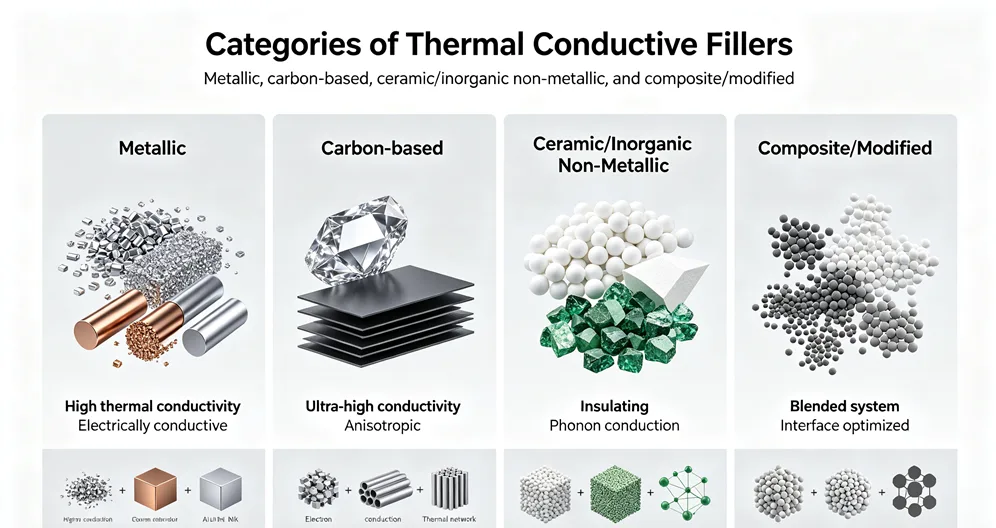
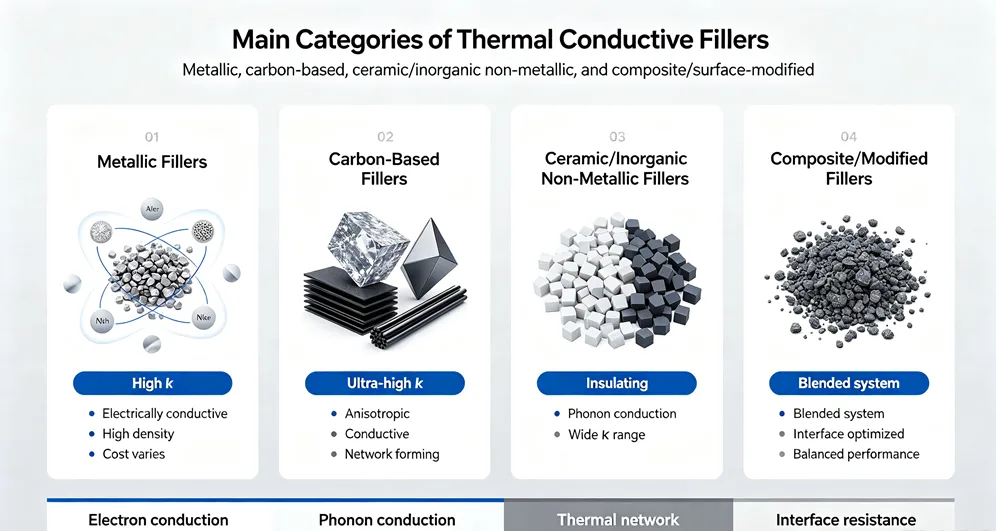
Thermal conductive fillers are mainly used to improve the heat transfer capability of refractory composites. Based on the material system, they can be professionally divided into four major categories: metallic, carbon-based, ceramic/inorganic non-metallic, and composite/surface-modified. These four categories differ significantly in heat conduction mechanism, electrical properties, cost structure, and processing characteristics, making them suitable for different applications.
4.1 Metallic Thermal Conductive Fillers
Metallic fillers were among the first thermal conductive fillers to be widely studied and applied. Metals usually have high intrinsic thermal conductivity, and their heat conduction mechanism relies mainly on the movement of free electrons. Common metallic fillers include silver, copper, aluminum, and nickel. Silver has an intrinsic thermal conductivity of about 430 W/(m·K), the highest among metallic fillers, along with excellent electrical conductivity and chemical stability, but at a high price. Copper has an intrinsic thermal conductivity of about 400 W/(m·K), offering excellent thermal performance, but oxidation is a concern. Aluminum has an intrinsic thermal conductivity of about 230 W/(m·K), with low cost and light weight, making it a relatively cost-effective choice among metallic fillers. Nickel has an intrinsic thermal conductivity of about 90 W/(m·K), with good chemical stability, making it suitable for conductive thermal systems that require stability.
The common features of metallic fillers are high thermal conductivity, electrical conductivity, and relatively high density. In refractory applications that usually require electrical insulation, metallic fillers are clearly limited. In addition, metallic fillers generally have poor compatibility with ceramic matrices and limited interfacial bonding strength, often requiring surface treatment to improve interfacial heat transfer. The high density of metallic fillers also increases composite weight, which needs careful consideration in lightweight applications.
4.2 Carbon-Based Thermal Conductive Fillers
Carbon-based fillers have developed rapidly in recent years as a class of high-performance thermal conductive fillers. Carbon materials have rich allotropic structures, from zero-dimensional diamond to two-dimensional graphene, and one-dimensional carbon nanotubes and carbon fibers. Different dimensions of carbon materials show great differences in thermal conductivity, while also offering rich options for building multi-dimensional thermal networks.
Diamond has the highest intrinsic thermal conductivity among carbon-based fillers, about 1000–2200+ W/(m·K), making it an important candidate for extreme thermal management. However, its cost is high, and the interfacial thermal resistance between filler and matrix, surface modification, and processing technology are critical. Graphite has an intrinsic thermal conductivity of about 100–500+ W/(m·K), with obvious direction dependence. It is also electrically conductive, making it suitable for conductive thermal systems. Graphene is a two-dimensional material made of a single layer of carbon atoms, with extremely high in-plane intrinsic thermal conductivity. It readily builds thermal networks in ceramic matrices, but dispersion and interface control are difficult. Carbon nanotubes have extremely high intrinsic thermal conductivity and a high aspect ratio, easily forming continuous thermal networks, and are also electrically conductive, but dispersion is challenging. Carbon fibers have an intrinsic thermal conductivity of about 10–1000+ W/(m·K), with obvious directionality and the added benefit of reinforcement.
The common features of carbon-based fillers are high thermal conductivity, electrical conductivity, and obvious anisotropy. In applications requiring electrical insulation, carbon-based fillers are generally not suitable. In addition, dispersion and interface control are the main difficulties in practical applications, requiring appropriate surface treatment and dispersion processes.
4.3 Ceramic/Inorganic Non-Metallic Thermal Conductive Fillers
Ceramic/inorganic non-metallic fillers are the most widely used class of fillers in refractory and high thermal conductivity insulation systems. Ceramic materials usually have excellent electrical insulation and transfer heat through lattice vibrations (phonons), covering a wide range of intrinsic thermal conductivity from low to high, offering rich choices for different applications.
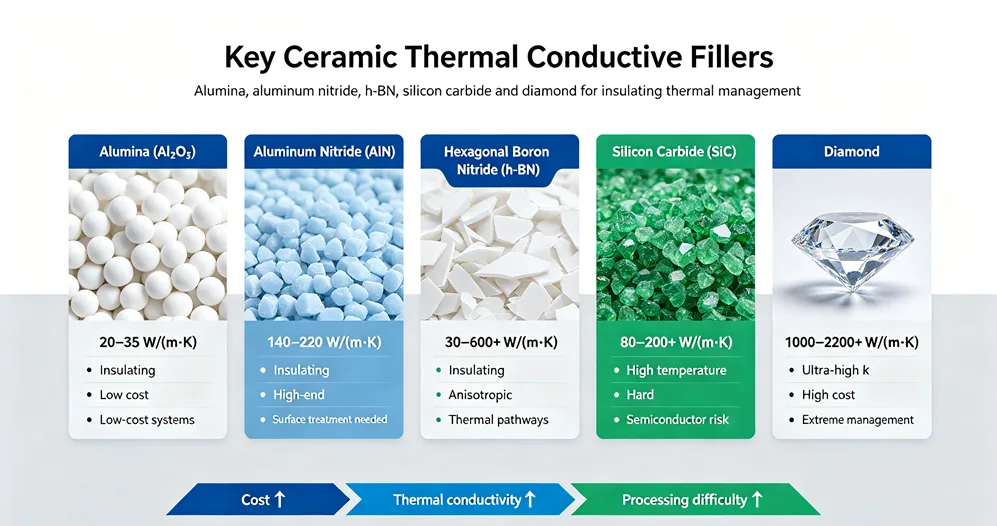
Alumina is currently one of the most mainstream insulating thermal conductive fillers, with an intrinsic thermal conductivity of about 20–35 W/(m·K). It is relatively low in cost with a mature supply chain, and spherical alumina in particular offers good flowability and high filling capability. Magnesium oxide has an intrinsic thermal conductivity of about 40–60 W/(m·K), offering thermal conductivity and insulation, but moisture resistance is a concern. Zinc oxide has an intrinsic thermal conductivity of about 20–30 W/(m·K), with good thermal and processing performance. Aluminum nitride is a high-performance insulating thermal conductive filler with an intrinsic thermal conductivity of about 140–220 W/(m·K), significantly higher than alumina. It is suitable for high-end thermal management materials, but the cost is higher and hydrolysis stability and surface treatment need attention. Hexagonal boron nitride has a layered structure similar to graphite but with good electrical insulation. Its intrinsic thermal conductivity is about 30–600+ W/(m·K), with outstanding in-plane thermal conductivity, making it suitable for building high thermal conductivity insulating networks. Silicon nitride has an intrinsic thermal conductivity of about 20–90 W/(m·K), with good strength, toughness, and reliability. Silicon carbide has an intrinsic thermal conductivity of about 80–200+ W/(m·K), with high thermal conductivity, high hardness, and good high-temperature resistance.
The common features of ceramic fillers are good insulation, a wide range of thermal conductivity, and large cost differences. In practical applications, comprehensive selection is needed based on thermal requirements, insulation requirements, cost budget, and processing conditions. The hydrolysis stability, moisture resistance, and surface treatment needs of some ceramic fillers also need to be fully considered during selection.
4.4 Composite and Surface-Modified Thermal Conductive Fillers
Composite and surface-modified fillers are the most common strategy in practical formulation design. A single filler often cannot simultaneously meet multiple requirements such as thermal conductivity, insulation, processability, and cost. By blending different fillers and applying surface modification, a better balance can be achieved across multiple performance dimensions.
Common composite filler systems include Al₂O₃ + AlN, Al₂O₃ + BN, and AlN + BN. The Al₂O₃ + AlN system balances cost and thermal conductivity, using alumina as the main filler to reduce formulation cost while introducing aluminum nitride to raise overall thermal conductivity. The Al₂O₃ + BN system uses different morphologies to improve the thermal network — spherical alumina provides high filling and low viscosity, while platelet-shaped boron nitride builds in-plane thermal pathways. The AlN + BN system targets high thermal conductivity insulating systems, suitable for high-end thermal management. Surface-modified ceramic powders improve matrix compatibility and interfacial heat transfer through silane coupling and surface coating, which are key means of raising actual thermal conductivity.
The core idea of composite and surface-modified fillers is that the final thermal conductivity of the composite depends not only on the intrinsic thermal conductivity of the filler but also on whether the fillers form a continuous thermal network, the contact state between particles, interfacial thermal resistance, orientation, and matrix properties. Therefore, in practical formulation design, blending strategies and surface modification are often more effective than simply pursuing a single filler with the highest intrinsic thermal conductivity.
5. Step 4: Know the Characteristics of Key Thermal Conductive Fillers
5.1 Alumina (Al₂O₃)
Alumina is currently one of the most mainstream insulating thermal conductive fillers. It is relatively low in cost with a mature supply chain, and spherical alumina in particular offers good flowability and high filling capability, widely used in refractory castables, thermal silicones, potting compounds, thermal pads, and thermal plastics. Alumina’s crystal structures mainly include α-Al₂O₃ and γ-Al₂O₃, among which α-Al₂O₃ has higher thermal conductivity and good chemical stability, making it the main choice for thermal conductive fillers. Spherical alumina is produced through special preparation processes, with a regular spherical morphology that allows higher filling in ceramic matrices while maintaining low viscosity.
Alumina has good insulation performance and high volume resistivity, making it suitable for electrical insulation. Its cost advantage is obvious, making it the first choice for low-cost insulating thermal systems. However, alumina’s intrinsic thermal conductivity is about 20–35 W/(m·K), so in high thermal conductivity applications it often needs to be blended with other high thermal conductivity fillers. In practice, alumina is usually used with multi-level particle size grading to increase packing density. By mixing spherical alumina of different particle sizes in a certain ratio, the voids between particles can be reduced, improving the packing efficiency of the filler in the matrix.
5.2 Aluminum Nitride (AlN)
Aluminum nitride is a high-performance insulating thermal conductive filler with an intrinsic thermal conductivity of about 140–220 W/(m·K), significantly higher than alumina. It is suitable for high-end thermal management materials, but the cost is higher and hydrolysis stability and surface treatment need attention. Aluminum nitride’s heat conduction mechanism is mainly phonon-based. The covalent bonding in its crystal structure gives it a relatively long phonon mean free path, resulting in high intrinsic thermal conductivity. Aluminum nitride also has excellent electrical insulation, high volume resistivity, and low dielectric constant, making it suitable for high-frequency applications.
However, aluminum nitride readily hydrolyzes in humid environments, forming aluminum hydroxide and ammonia, which degrades its insulation and thermal conductivity. Therefore, aluminum nitride usually requires surface coating or coupling treatment to improve hydrolysis resistance. Common surface treatment methods include silane coupling agent treatment, phosphate coating, and organic acid treatment. In high thermal conductivity insulating systems, aluminum nitride can be blended with alumina, using alumina as the main filler to reduce cost while using aluminum nitride to raise overall thermal conductivity.
5.3 Hexagonal Boron Nitride (h-BN)
Hexagonal boron nitride has a layered structure similar to graphite but with good electrical insulation. Its in-plane thermal conductivity is outstanding, making it suitable for building high thermal conductivity insulating networks, while orientation-induced anisotropy needs attention. Hexagonal boron nitride has a layered crystal structure, with in-plane atoms bonded by covalent bonds and layers held together by van der Waals forces. This structure gives it high in-plane thermal conductivity and lower through-plane thermal conductivity. Its intrinsic thermal conductivity is about 30–600+ W/(m·K), with the specific value closely related to the test direction.
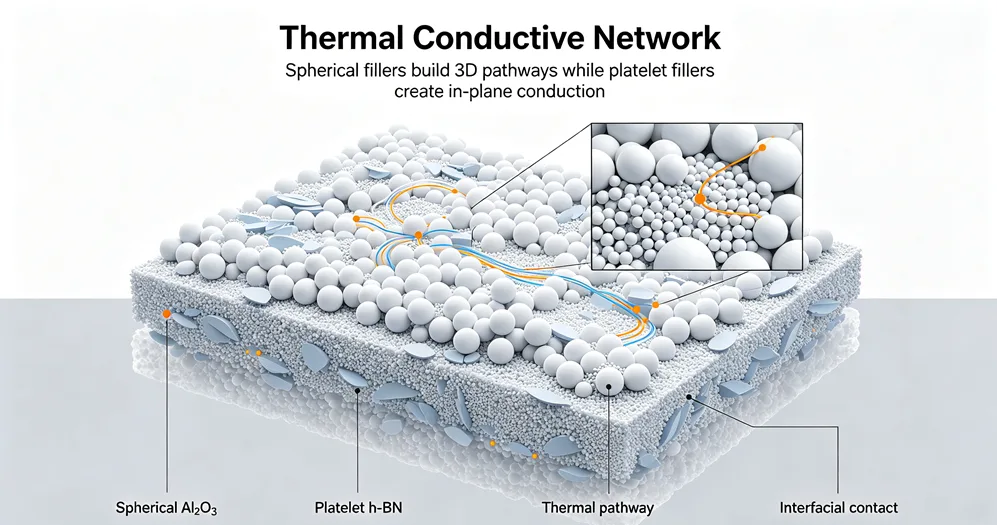
Hexagonal boron nitride has excellent electrical insulation, high volume resistivity, and low dielectric constant, making it suitable for high-frequency and high-insulation applications. Platelet-shaped hexagonal boron nitride readily aligns in ceramic matrices, building continuous in-plane thermal pathways. In practice, hexagonal boron nitride is usually used as an auxiliary filler, blended with spherical alumina or aluminum nitride. A small amount of platelet-shaped hexagonal boron nitride can build in-plane thermal pathways in the matrix, working together with the three-dimensional thermal network formed by spherical fillers to improve the overall thermal conductivity of the composite.
5.4 Silicon Carbide (SiC)
Silicon carbide has relatively high thermal conductivity, high hardness, and good high-temperature resistance, making it suitable for high-temperature and wear-resistant thermal management systems. Its intrinsic thermal conductivity is about 80–200+ W/(m·K), with the specific value closely related to crystal form, purity, and density. Silicon carbide has high hardness and good high-temperature performance, suitable for high-temperature and wear-resistant thermal management systems. In high-temperature environments, silicon carbide’s thermal conductivity and chemical stability outperform many other fillers.
The electrical performance of silicon carbide needs to be evaluated based on purity, crystal form, and the specific system. High-purity silicon carbide has high resistivity and can be used as an insulating filler, while silicon carbide containing impurities or specific crystal forms may show semiconductor behavior and should be chosen carefully in high-insulation applications. The high hardness of silicon carbide also wears down processing equipment, especially in high-fill and long-term continuous production, requiring wear-resistant processing equipment and mold materials.
5.5 Diamond
Diamond has extremely high intrinsic thermal conductivity, making it an important candidate for extreme thermal management. However, the cost is high, and the interfacial thermal resistance between filler and matrix, surface modification, and processing technology are critical. Diamond’s intrinsic thermal conductivity is about 1000–2200+ W/(m·K), one of the highest among known materials. Its heat conduction mechanism is mainly phonon-based, and the strong covalent bonding in its crystal structure gives it an extremely long phonon mean free path and thermal conductivity. Diamond also has excellent electrical insulation and high volume resistivity, making it suitable for high thermal conductivity insulating applications.
However, diamond’s cost is high, and the interfacial thermal resistance between filler and matrix, surface modification, and processing technology are critical. Diamond’s high hardness causes severe wear on processing equipment, which needs to be considered in process design. Diamond’s high surface energy makes it poorly compatible with ceramic matrices, usually requiring surface modification to improve interfacial bonding and dispersion. In extreme thermal management scenarios, diamond can be used as the main filler or blended with other high thermal conductivity fillers to achieve high thermal conductivity.
6. Step 5: Evaluate the Critical Selection Indicators
Selecting a thermal conductive filler is a multi-objective optimization process that requires comprehensive consideration of the following key indicators.
Intrinsic thermal conductivity is the core indicator of a filler’s own heat conduction potential. The higher the intrinsic thermal conductivity, the stronger the theoretical thermal capability the filler can provide. However, the actual thermal conductivity of a composite is not a simple weighted average of the fillers’ intrinsic values — it is also affected by filler content, dispersion state, interfacial thermal resistance, orientation, and matrix properties. Therefore, intrinsic thermal conductivity is an important reference but not the only deciding factor.
Electrical insulation is a key indicator for applications that need to combine thermal conductivity with insulation. Metal and carbon-based fillers are mostly conductive and suitable for applications where conductivity is acceptable; ceramic fillers are mostly insulating and suitable for applications requiring electrical insulation. When selecting, it is important to clarify the insulation requirements of the application and choose the appropriate filler category accordingly.
Particle size and particle size grading are important factors affecting filler packing density and thermal network formation. Reasonable multi-level particle sizes can increase packing density and reduce voids between particles, achieving higher thermal conductivity at the same loading. The design of particle size grading needs to consider the filler’s particle size distribution, morphology, and the rheological properties of the matrix. Typically, a bimodal or multimodal particle size distribution can achieve higher packing density and lower viscosity.
Particle morphology significantly affects filling capability, thermal network construction, and processing flowability. Spherical shapes favor high filling and low viscosity, suitable for applications requiring flowability such as castables; platelet and fibrous shapes favor building continuous thermal pathways, suitable for applications requiring directional heat conduction or thermal network construction. Blending fillers of different morphologies can leverage their respective advantages and achieve better overall performance.
Maximum filling amount is an indicator that needs careful balancing in filler selection. High thermal conductivity composites usually require high filler volume fractions, but this significantly affects flowability and mechanical properties. Too high a filling amount causes a sharp rise in viscosity, processing difficulties, and declining mechanical properties; too low a filling amount fails to form a continuous thermal network, limiting thermal conductivity improvement. Therefore, a balance must be found among thermal conductivity, viscosity, mechanical properties, and processability.
Interfacial thermal resistance is an important factor affecting the actual thermal conductivity of composites at the filler-matrix and filler-filler interfaces. The presence of interfacial thermal resistance causes a temperature drop at the interface, reducing the effective thermal conductivity of the composite. The magnitude of interfacial thermal resistance depends on filler surface properties, matrix characteristics, interfacial bonding strength, and interfacial area. Reducing interfacial thermal resistance is one of the key ways to improve the actual thermal conductivity of composites.
Surface treatment is an important means of improving filler-matrix compatibility, dispersion, and interfacial bonding. Silane coupling and surface coating can improve filler-matrix compatibility, reduce interfacial thermal resistance, and raise actual thermal conductivity. The effectiveness of surface treatment depends on the type of coupling agent, treatment process, and matrix characteristics, and needs to be optimized for the specific system.
Cost and processability are practical factors that cannot be ignored in filler selection. Raw material price, viscosity, processing equipment, wear, and mass production stability all need to be considered. Cost is not just the filler unit price — it also includes processing cost, yield, and long-term supply stability. When selecting, a balance must be found between performance requirements and cost budget to choose the most cost-effective filler solution.
7. Step 6: Design a High Thermal Conductivity Insulation Formulation
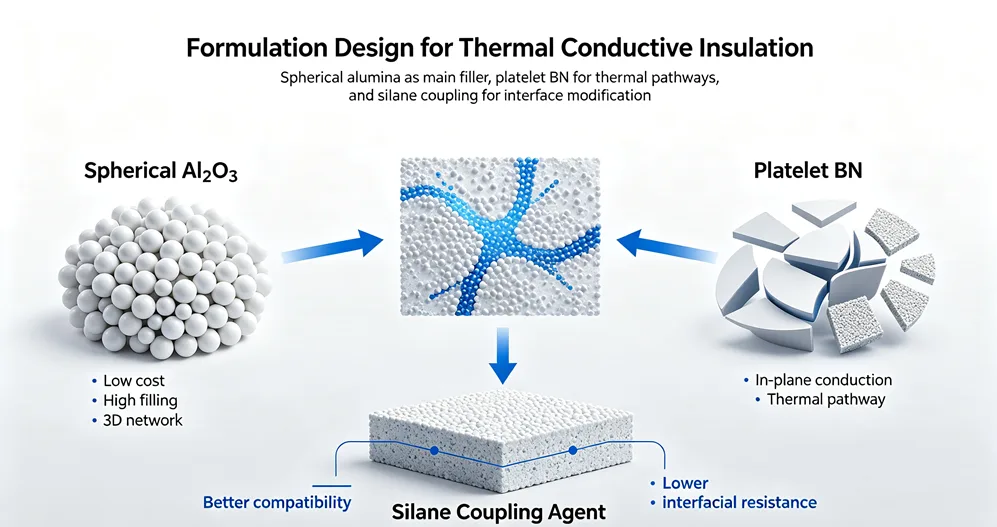
For a refractory system that needs “high thermal conductivity + electrical insulation + controllable cost,” a blending strategy can be adopted rather than simply pursuing a single filler with the highest intrinsic thermal conductivity.
A typical formulation approach is: use spherical alumina as the main filler, leveraging its low cost, insulation, maturity, and high filling capability to build the basic thermal network; use multi-level particle size grading to increase packing density and reduce voids, improving thermal conductivity; introduce a small amount of platelet-shaped hexagonal boron nitride to build thermal pathways, using its high in-plane thermal conductivity to form a directional thermal network in the matrix; and use a silane coupling agent for interface modification to improve filler-matrix compatibility and reduce interfacial thermal resistance.
The core idea of this formulation approach is that the final thermal conductivity of the composite depends not only on the intrinsic thermal conductivity of the filler but also on whether the fillers form a continuous thermal network, the contact state between particles, interfacial thermal resistance, orientation, and matrix properties. Therefore, blending strategies and surface modification are often more effective than simply pursuing a single filler with the highest intrinsic thermal conductivity.
In practical formulation design, adjustments need to be made based on the specific application and performance requirements. For applications requiring higher thermal conductivity, the proportion of aluminum nitride or hexagonal boron nitride can be increased. For cost-sensitive applications, spherical alumina can be used as the main filler with a small amount of high thermal conductivity filler. For applications requiring higher flowability, particle size grading and morphology can be optimized to reduce viscosity. In addition, the choice of matrix also affects the final thermal performance — different matrices have different thermal conductivity, viscosity, curing characteristics, and interfacial compatibility, and need to be matched with the filler system and processing technology. Processing technology also has a major impact on final thermal performance — mixing, dispersion, molding, and curing processes all affect the dispersion state, orientation, and interfacial bonding of fillers in the matrix.
8. Step 7: Quick Selection Guide and Common Questions
8.1 Quick Selection Guide
To help readers quickly identify suitable thermal conductive fillers, the table below summarizes the preferred choices for different goals.
| Goal | Preferred Fillers |
|---|---|
| Low-cost insulating thermal conduction | Spherical Al₂O₃ |
| High thermal conductivity insulation | AlN, h-BN, AlN/BN blends |
| Ultra-high thermal conductivity | Diamond, high-quality graphite/graphene (when conductivity is acceptable) |
| High filling, low viscosity | Spherical Al₂O₃, spherical AlN |
| High temperature/wear resistance | SiC, AlN, Si₃N₄ |
| Building two-dimensional thermal networks | Platelet h-BN, graphite, graphene |
For low-cost insulating thermal conduction, spherical alumina is the first choice. For high thermal conductivity insulation, aluminum nitride, hexagonal boron nitride, and AlN/BN blends are preferred. For ultra-high thermal conductivity, when conductivity is acceptable, diamond, high-quality graphite, or graphene are important candidates. For high filling and low viscosity, spherical alumina and spherical aluminum nitride are preferred. For high temperature and wear resistance, silicon carbide, aluminum nitride, and silicon nitride are preferred. For building two-dimensional thermal networks, platelet hexagonal boron nitride, graphite, and graphene are preferred.
8.2 Frequently Asked Questions
What are the main categories of thermal conductive fillers?
Based on the material system, thermal conductive fillers can be divided into four major categories: metallic, carbon-based, ceramic/inorganic non-metallic, and composite/surface-modified.
Which thermal conductive filler has the highest thermal conductivity?
In terms of intrinsic thermal conductivity, diamond is one of the highest among known materials, at about 1000–2200+ W/(m·K). However, the actual thermal conductivity of a composite is not a simple weighted average of the fillers’ intrinsic values — it is also affected by filler content, dispersion state, interfacial thermal resistance, orientation, and matrix properties.
What fillers are used for high thermal conductivity insulating materials?
High thermal conductivity insulating materials usually prioritize aluminum nitride, hexagonal boron nitride, and AlN/BN blends. For cost-sensitive applications, spherical alumina can be used as the main filler with a small amount of aluminum nitride or hexagonal boron nitride to balance thermal conductivity, insulation, and cost.
Is a higher filler loading always better?
Not necessarily. Higher filling can improve thermal conductivity but significantly affects flowability and mechanical properties. A balance must be found among thermal conductivity, viscosity, mechanical properties, and processability.
How can interfacial thermal resistance be reduced?
Methods to reduce interfacial thermal resistance include surface treatment, silane coupling, surface coating, optimizing particle size grading, and improving filler-matrix compatibility.
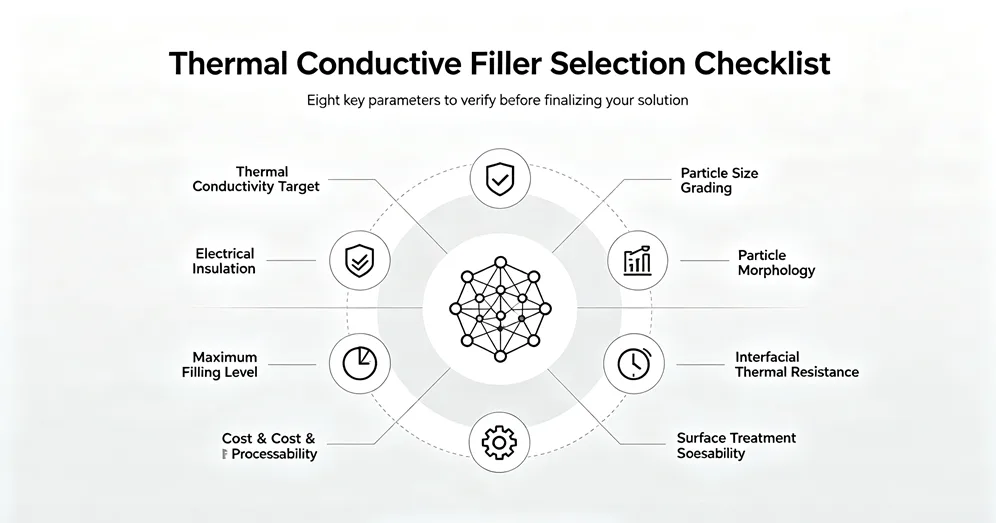
9. Thermal Conductive Filler Selection Checklist
9.1 Step-by-Step Selection Summary
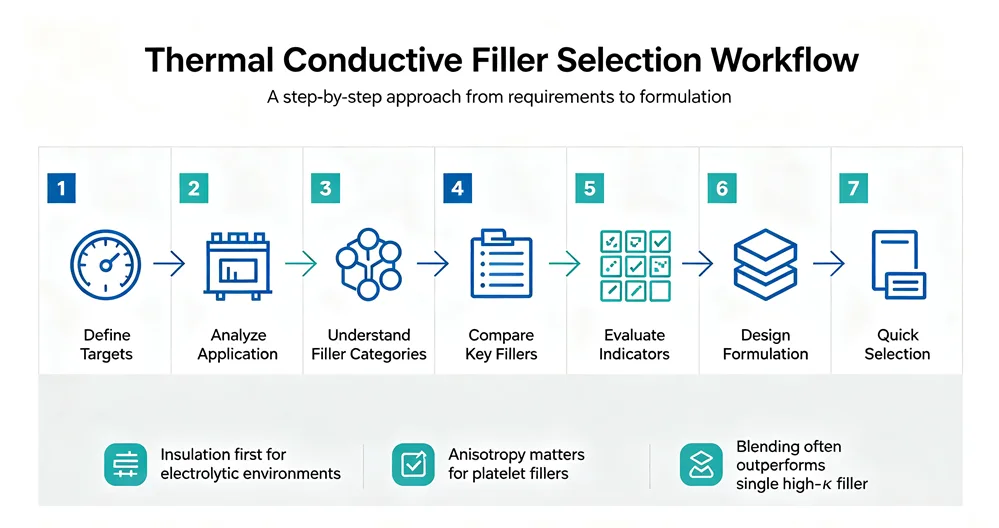
Step one: define the thermal conductivity target and electrical insulation requirements. Step two: analyze the application scenario and processing conditions. Step three: understand the main categories of thermal conductive fillers. Step four: know the characteristics of key fillers. Step five: evaluate the critical selection indicators. Step six: design a high thermal conductivity insulation formulation. Step seven: refer to the quick selection guide to determine the preferred filler system.
9.2 Key Parameters to Verify Before Final Selection
Before finalizing the thermal conductive filler solution, the following key parameters need to be verified: whether thermal conductivity meets the target, whether electrical insulation meets the application requirements, whether particle size grading is optimized, whether particle morphology suits the processing technology, whether the filling amount is within the processable range, whether interfacial thermal resistance is controlled through surface treatment, whether cost is within budget, and whether the supplier is stable and reliable.
9.3 Practical Tips for Materials Engineers
Always refer to the filler supplier’s technical data sheet to understand key parameters such as intrinsic thermal conductivity, particle size distribution, morphology, surface treatment, and electrical properties. Avoid selecting based solely on experience or a single indicator — comprehensive consideration of thermal conductivity, insulation, processability, mechanical properties, and cost is necessary. In formulation design, prioritize blending strategies and surface modification rather than simply pursuing a single filler with the highest intrinsic thermal conductivity. Before mass production, conduct thorough process validation and reliability testing to ensure the filler system meets actual production requirements.
Supplier
RBOSCHCO is a trusted global chemical material supplier and manufacturer with over 12 years of experience in providing high-quality chemicals and nanomaterials, including boride powder, nitride powder, graphite powder, sulfide powder, and 3D printing powder. The company has a professional technical department and quality supervision department, a well-equipped laboratory with advanced testing equipment, and a dedicated after-sales customer service center. RBOSCHCO supplies high-quality thermal conductive fillers worldwide, including alumina, magnesium oxide, aluminum nitride, boron nitride, silicon nitride, and silicon carbide, suitable for refractory materials, thermal management, electronic packaging, and other high-temperature applications. The company offers comprehensive technical support, from product selection to application guidance. If you are looking for high-quality thermal conductive fillers for refractory applications, please feel free to contact us.
RELATED POSTS
Why Protein-Based Foaming Agent for Lightweight Concrete?

Aerogel: Why Is It Called “Strong Smoke”?

Understanding the Waterproofing Mechanism of Calcium Stearate Powder in Concrete: From Pore Structure to Hydrophobic Effect
5 Keys to Consider When Choosing a Water Reducer for Your Project
Why Chromium Carbide Overlay (CCO) Chips Are the Secret to Extreme Abrasion Resistance