Professional and high-quality metal alloys, ceramic products and concrete additives | RBOSCHCO

PRODUCT PARAMETERS
Description
1. Overview
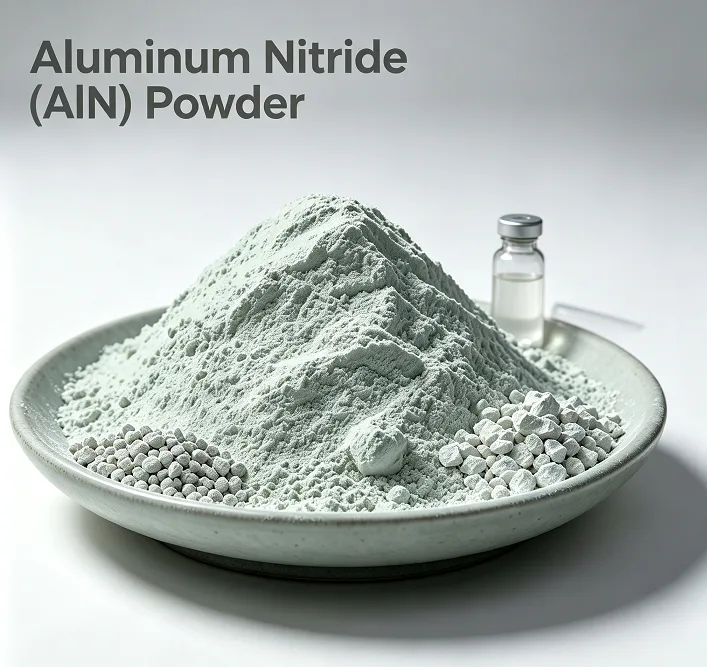
Aluminum Nitride (AlN) is an advanced ceramic material valued for its combination of high thermal conductivity, electrical insulation, low thermal expansion, high-temperature stability, and relatively low density. Compared with conventional oxide ceramics, AlN provides a particularly useful balance between thermal and electrical performance, which makes it an important material for semiconductor equipment, power electronics, electronic packaging, thermal management components, high-temperature fixtures, and other demanding applications. From an engineering perspective, however, the performance of Aluminum Nitride is not determined by chemical purity alone. Oxygen content, particle size distribution, powder morphology, specific surface area, crystallinity, surface chemistry, and sintering behavior can all affect the final density and thermal conductivity of the ceramic.
AlN has a hexagonal wurtzite crystal structure and a theoretical density of approximately 3.26 g/cm³. Its intrinsic thermal conductivity can be very high, while its coefficient of thermal expansion is relatively close to that of silicon and other semiconductor materials. This combination reduces thermomechanical mismatch in electronic and semiconductor-related applications. At the same time, AlN is electrically insulating, allowing it to transfer heat without creating an electrical conduction path. For powder processing, the challenge is to retain these intrinsic properties after forming and sintering. Oxygen-containing surface layers, residual impurities, insufficient densification, and inappropriate sintering conditions can introduce phonon-scattering centers and grain-boundary phases that substantially reduce the thermal conductivity of the finished component.
2. Product Performance and Engineering Characteristics
2.1 High Thermal Conductivity
The most important engineering advantage of Aluminum Nitride is its high thermal conductivity. Unlike electrically conductive metals, AlN can dissipate heat while maintaining electrical insulation, which is particularly valuable in power electronics and semiconductor-related thermal management. In a dense ceramic, heat is primarily transferred through the crystal lattice, and phonon scattering has a major influence on the final thermal conductivity. Oxygen impurities, lattice defects, secondary phases, grain boundaries, and pores can all increase phonon scattering. Consequently, high-purity powder with controlled oxygen content and excellent sinterability is generally preferred when the final component requires high thermal conductivity.
2.2 Electrical Insulation
AlN combines high thermal conductivity with strong electrical insulation, creating an important advantage over metallic heat-spreading materials. This property allows AlN ceramics to function as electrically insulating substrates, heat spreaders, insulating components, and structural parts in high-power electronic systems. The electrical behavior of the final ceramic depends not only on the intrinsic properties of AlN but also on porosity, impurity phases, surface contamination, and processing conditions. High-density sintered ceramics generally provide much more stable electrical performance than porous bodies.
2.3 Low Thermal Expansion
The coefficient of thermal expansion of Aluminum Nitride is relatively close to that of silicon, making it useful where thermal expansion mismatch must be controlled. During repeated heating and cooling, differences in thermal expansion between ceramic substrates, semiconductor dies, metallization layers, and other components can generate mechanical stress. AlN can reduce this mismatch and thereby improve the dimensional stability and reliability of assembled components. This characteristic is especially valuable in applications involving repeated thermal cycling or localized heat generation.
2.4 High-Temperature Stability
AlN maintains useful mechanical, thermal, and electrical properties at elevated temperatures and is suitable for demanding thermal-processing environments. However, the actual operating temperature of an AlN component depends on atmosphere, surface condition, impurity content, mechanical loading, and component geometry. In oxidizing environments, surface oxidation becomes increasingly important at elevated temperature. Therefore, when Aluminum Nitride is used in high-temperature equipment, engineers should evaluate not only the nominal maximum temperature but also the atmosphere and exposure duration.
2.5 Powder Sinterability and Densification
For AlN powder, sinterability is one of the most important processing characteristics. AlN is difficult to densify fully without appropriate sintering conditions because surface oxides and the relatively strong covalent bonding of the crystal structure can inhibit mass transport. Sintering additives are therefore commonly used to promote densification by forming transient or secondary phases that facilitate grain-boundary diffusion. However, excessive secondary phases can negatively affect thermal conductivity. The engineering objective is consequently not simply to maximize density, but to achieve high density while minimizing thermally resistive grain-boundary phases.
2.6 Oxygen and Surface Chemistry Control
Oxygen content deserves particular attention when selecting Aluminum Nitride powder. AlN powders naturally tend to develop oxygen-containing surface layers when exposed to air, and excessive oxygen can contribute to the formation of oxygen-related defects or secondary phases during sintering. These effects can reduce thermal conductivity by increasing phonon scattering. For high-performance thermal ceramics, powder handling, storage, surface condition, oxygen content, and sintering additives should therefore be considered as an integrated material system.
3. Typical Specifications of Aluminum Nitride Powder
The following table provides a typical engineering reference range rather than a fixed universal specification. Actual values should be confirmed according to the selected AlN powder grade, production route, particle size, oxygen content, and final application.
| Parameter | Typical Value / Range | Engineering Significance |
|---|---|---|
| Product Name | Aluminum Nitride Powder | Advanced ceramic raw material |
| Chemical Formula | AlN | Main composition |
| CAS No. | 24304-00-5 | Chemical identification |
| Molecular Weight | 40.99 g/mol | Stoichiometric reference |
| Purity | ≥99.0% / ≥99.5% / ≥99.9% | Grade-dependent |
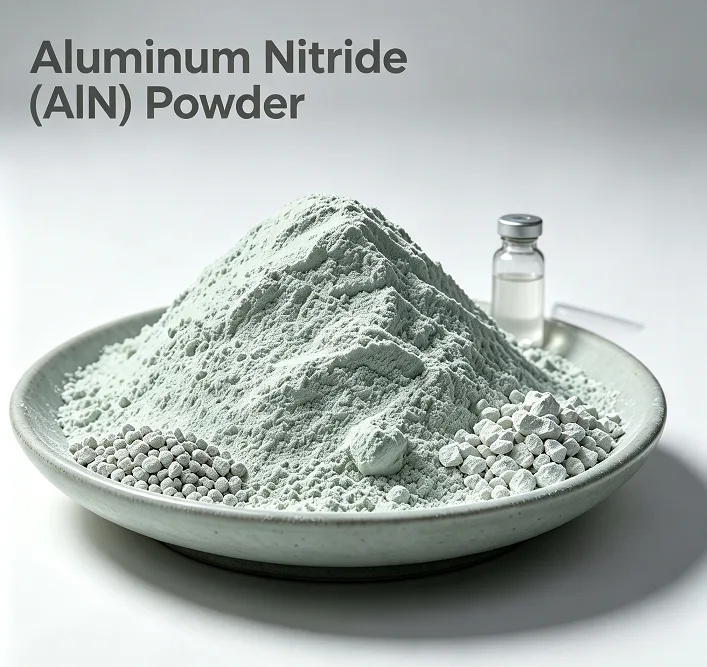
| Appearance | Gray to gray-white powder | Visual identification |
| Crystal Structure | Hexagonal Wurtzite | Stable AlN phase |
| Theoretical Density | Approx. 3.26 g/cm³ | Reference density |
| Particle Size | Submicron to tens of µm | Application-dependent |
| D50 | Typically 0.5–10 µm | Powder processing control |
| Specific Surface Area | Grade-dependent | Related to sintering behavior |
| Thermal Conductivity | High after proper densification | Thermal management |
| Coefficient of Thermal Expansion | Approx. 4.5–5.5 × 10⁻⁶/K | Thermal expansion compatibility |
| Electrical Property | Excellent electrical insulation | Electronic applications |
| Melting/Decomposition Behavior | High-temperature stability | High-temperature processing |
| Oxygen Content | Controlled according to grade | Critical for thermal conductivity |
| Moisture | Controlled | Important for powder stability |
| Packaging | Moisture-resistant sealed packaging | Protects powder quality |
| Customization | Purity, particle size, oxygen level and other parameters | Application-specific |
For high-performance applications, the powder should not be evaluated only according to the stated AlN purity. A material listed as 99.5% AlN may behave differently from another 99.5% grade if their oxygen content, particle morphology, surface area, impurity profile, or calcination history differs. For thermal management applications, oxygen content and sintering behavior can be particularly important because the final thermal conductivity depends strongly on the microstructure produced during densification.
4. Applications of Aluminum Nitride
4.1 Semiconductor and Electronic Components
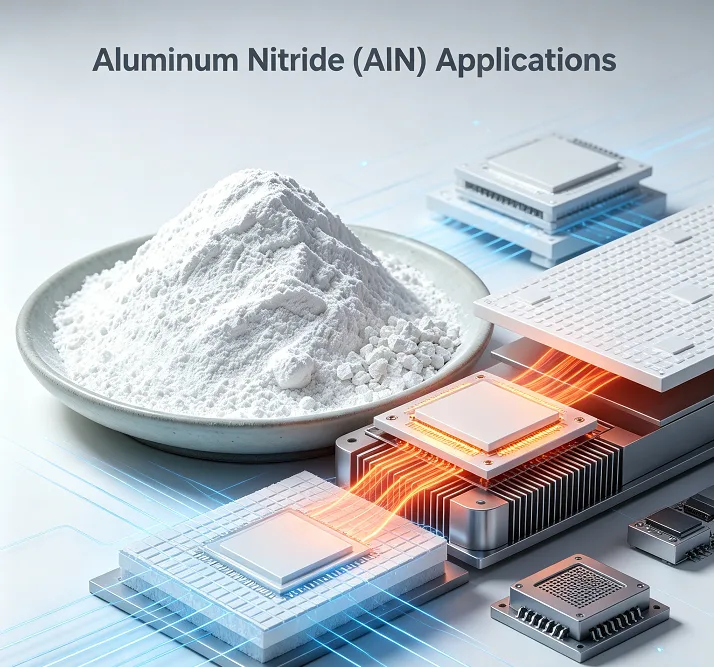
Aluminum Nitride is widely considered for semiconductor and electronic applications where heat dissipation and electrical insulation are required simultaneously. AlN substrates, insulating plates, heat spreaders, and packaging components can transfer heat away from high-power devices while maintaining electrical isolation. Its relatively low thermal expansion also helps reduce thermomechanical stress between ceramic components and semiconductor materials.
4.2 Power Electronics
Power semiconductor devices generate substantial heat during operation, making thermal management a major design consideration. AlN ceramics can serve as electrically insulating thermal paths in power modules and high-power electronic assemblies. Their combination of thermal conductivity, dielectric performance, and thermal expansion compatibility makes them suitable for applications where conventional polymeric insulating materials cannot provide sufficient thermal stability.
4.3 LED and High-Power Thermal Management
High-brightness LEDs and other high-power optoelectronic devices require efficient heat removal to maintain stable operating temperatures and long-term reliability. Aluminum Nitride ceramic substrates and heat-spreading components can provide a direct thermal pathway while maintaining electrical insulation. The effectiveness of the final component depends on ceramic density, surface finish, metallization compatibility, and thermal conductivity.
4.4 Semiconductor Processing Equipment
AlN is also used for selected semiconductor processing components that require thermal stability, electrical insulation, dimensional stability, and resistance to demanding processing environments. The material can be manufactured into substrates, plates, rings, heaters, insulating components, and other precision ceramic parts. For these applications, purity and contamination control become increasingly important because metallic or particulate impurities can affect the surrounding semiconductor process.
4.5 Ceramic Substrates
AlN is an important substrate material for applications requiring high thermal conductivity and electrical insulation. Compared with alumina, AlN can provide substantially higher thermal conductivity, while maintaining useful mechanical strength and electrical insulation. The final substrate performance depends on powder purity, sintering additives, density, grain size, surface quality, and metallization process.
4.6 High-Temperature Insulating Components
Because of its high-temperature stability and electrical insulation capability, Aluminum Nitride can also be considered for specialized insulating and structural components operating under elevated temperatures. In these applications, thermal shock, oxidation behavior, mechanical loading, and chemical compatibility should be evaluated together with the material’s intrinsic thermal properties.

5. Company Profile
RBOSCHCO is a supplier of inorganic compound powders, advanced ceramic materials, functional materials, and related industrial products. Its product portfolio includes oxide, nitride, carbide, boride, silicide, sulfide, and other inorganic compound powders, as well as high-purity materials and advanced ceramic products. The company’s powder material approach focuses on controlling key parameters such as chemical composition, purity, particle size, morphology, crystalline phase, surface characteristics, and sintering behavior according to the requirements of different industrial applications.
For Aluminum Nitride, application-oriented material selection is particularly important because the thermal conductivity of the final ceramic depends strongly on powder characteristics and subsequent processing. Powder purity, oxygen content, particle size distribution, sinterability, and impurity control should therefore be considered together when defining a material specification. For customers developing thermal-management ceramics, semiconductor components, electrical insulation parts, or other AlN products, the powder grade can be selected according to the required forming process, sintering system, target density, and final thermal and electrical performance.

6. FAQs
Q1: Why is Aluminum Nitride considered a high-performance thermal ceramic?
The primary advantage of Aluminum Nitride is its ability to combine high thermal conductivity with excellent electrical insulation. In many electronic systems, the material must remove heat from a semiconductor or power device while preventing electrical current from passing through the thermal path. Metals provide excellent thermal conductivity but are electrically conductive, while many conventional electrical ceramics provide insulation but have relatively low thermal conductivity. AlN occupies a useful position between these two categories. Its crystal lattice allows efficient phonon transport, while its ceramic structure provides electrical insulation. When the powder is properly processed into a dense ceramic with low porosity and controlled grain-boundary chemistry, AlN can provide excellent thermal performance for demanding electronic and thermal-management applications.
Q2: Why does oxygen content affect the thermal conductivity of Aluminum Nitride?
Oxygen is one of the most important impurity considerations when processing Aluminum Nitride for high thermal conductivity. Oxygen can enter the material through surface oxidation of AlN powder or through other raw materials and processing conditions. During sintering, oxygen can contribute to oxygen-related defects and secondary phases, which can interfere with phonon transport. Since heat transfer through AlN is strongly associated with lattice vibration, these defects can increase phonon scattering and reduce thermal conductivity. This means that a powder with high nominal AlN purity does not necessarily produce a high-thermal-conductivity ceramic unless its oxygen level and impurity profile are also properly controlled. For demanding applications, oxygen content should therefore be included as a specific purchasing and quality-control parameter.
Q3: What particle size of Aluminum Nitride powder is suitable for ceramic sintering?
There is no single particle size suitable for every Aluminum Nitride ceramic process. Fine powders generally provide higher specific surface area and stronger sintering driving force, allowing densification to occur more readily under appropriate conditions. However, excessively fine particles can increase agglomeration, reduce powder flowability, increase moisture sensitivity, and make homogeneous dispersion more difficult. Coarser particles may provide better handling and packing behavior but can require more aggressive sintering conditions. In practice, the appropriate D50 should be selected according to the forming method, target density, sintering additives, desired grain size, and final thermal conductivity. Engineers should evaluate the complete particle-size distribution rather than specifying only an average particle size.
Q4: Why are sintering additives used with Aluminum Nitride?
AlN has strong covalent bonding and is not always easy to densify to near-theoretical density using conventional solid-state sintering alone. Sintering additives are therefore commonly introduced to improve mass transport and promote densification. These additives can react with surface oxides or form transient liquid phases that accelerate grain-boundary diffusion during sintering. However, the amount and type of additive must be carefully controlled. Excessive secondary phases remaining at grain boundaries can act as thermal barriers and reduce the final thermal conductivity. Therefore, the purpose of sintering additives is not simply to increase density but to achieve a dense microstructure while maintaining favorable grain-boundary chemistry and minimizing thermally resistive phases.
Q5: What is the relationship between the density and thermal conductivity of Aluminum Nitride ceramics?
Density has a strong influence on the thermal conductivity of Aluminum Nitride ceramics because residual pores act as barriers to heat transport. Even small amounts of porosity can significantly reduce the effective thermal conductivity compared with a fully dense material. However, achieving high density alone does not guarantee maximum thermal conductivity. Grain-boundary phases, oxygen-related defects, impurity segregation, and excessive sintering additives can continue to scatter phonons even after the ceramic has reached a high relative density. For this reason, high-performance AlN manufacturing requires simultaneous control of powder quality, green density, sintering conditions, final porosity, grain growth, and grain-boundary chemistry.
Q6: How does Aluminum Nitride compare with alumina for thermal management applications?
The primary difference is thermal conductivity. Alumina is widely used because of its good electrical insulation, mechanical properties, chemical stability, and relatively low cost, but its thermal conductivity is considerably lower than that of high-performance AlN ceramics. Aluminum Nitride is therefore selected when higher heat dissipation is required while electrical insulation must be maintained. AlN also has a relatively low coefficient of thermal expansion that is compatible with semiconductor materials. However, AlN generally requires more carefully controlled powder processing and sintering, and its cost can be higher than conventional alumina. The appropriate material should therefore be determined according to thermal load, electrical requirements, mechanical conditions, manufacturing process, and total component cost.
REQUEST A QUOTE
RELATED PRODUCTS
Silicon Hexaboride Silicon Boride with SiB6 Powder and CAS 12008-29-6
Solid Silica Dispersant TR-WSiOT10 Alkaline High Quality Silica Nanoparticle Dispersion

High Purity Titanium Sulfide TiS2 Powder CAS 2039-13-3
Factory 99% CuO Cupric Oxide / Copper Oxide / Copper (II) Oxide CAS 1317-38-0
Vanadium Powder V Powder CAS 7440-62-2Van