Professional and high-quality metal alloys, ceramic products and concrete additives | RBOSCHCO

PRODUCT PARAMETERS
Description
1. Overview
Magnesium Oxide (MgO) is a high-temperature inorganic oxide with a combination of refractory stability, chemical resistance, electrical insulation, and controllable reactivity that makes it valuable across refractory materials, advanced ceramics, electrical insulation, cement systems, chemical processing, and other high-temperature industrial applications. Unlike many oxide powders that are primarily selected according to chemical composition, the engineering performance of MgO is strongly influenced by its purity, crystal structure, calcination history, particle size distribution, specific surface area, and degree of sintering. These parameters determine whether the material behaves as a highly reactive fine powder, a sintering aid, a refractory-grade filler, or a relatively stable high-temperature ceramic constituent. For this reason, Magnesium Oxide should not be evaluated only by its nominal MgO content; particle morphology, impurities, bulk density, and thermal history are equally important when selecting a grade for a specific manufacturing process.
From a materials engineering perspective, MgO has a cubic rock-salt crystal structure and a theoretical density of approximately 3.58 g/cm³. Its high melting point, low chemical volatility at normal processing conditions, and resistance to many molten materials make it particularly suitable for high-temperature environments. At the same time, MgO is a basic oxide and can react with water and acidic components, so moisture control and surface condition become important during storage and formulation. Fine-particle Magnesium Oxide can exhibit considerably higher surface activity than coarse, highly calcined material, meaning that two powders with similar chemical purity can behave very differently during mixing, hydration, pressing, sintering, or reaction processing. Therefore, the appropriate grade should be selected according to the final application rather than purity alone.
2. Product Performance and Engineering Characteristics
2.1 High-Temperature Stability
One of the most important characteristics of Magnesium Oxide is its high-temperature capability. MgO has a melting point of approximately 2,850°C, allowing it to maintain structural and chemical stability under severe thermal conditions. This characteristic is particularly important in refractory systems, furnace linings, high-temperature ceramic formulations, crucible materials, and thermal processing equipment. However, the useful operating temperature of an MgO-containing component is not determined by melting point alone. Grain growth, porosity, thermal shock, secondary phases, mechanical strength, and chemical interaction with the surrounding material can become the actual limiting factors. For refractory formulations, engineers therefore need to evaluate MgO together with particle size, CaO/SiO₂/Fe₂O₃ and other impurity levels, apparent porosity, and firing conditions.
2.2 Controlled Chemical Reactivity
The reactivity of Magnesium Oxide is closely associated with its calcination temperature and specific surface area. Lightly calcined MgO generally possesses higher surface activity and reacts more readily with water or other chemical species, while hard-burned or dead-burned MgO has lower surface reactivity and is preferred when dimensional stability and refractory performance are more important than rapid reaction. This distinction is particularly significant in cementitious materials, magnesium-based binders, refractory mixes, and chemical formulations. From a process-engineering perspective, specifying only “99% MgO” is therefore insufficient. A more useful purchasing specification should define purity, particle size distribution, specific surface area, loss on ignition, moisture content, and the required calcination condition.
2.3 Electrical Insulation
Dense MgO is also an effective electrical insulating ceramic at elevated temperatures and is widely associated with high-temperature electrical insulation applications. Its combination of electrical resistance, thermal stability, and compatibility with metallic sheath materials makes MgO particularly useful as an insulating medium in heating elements and mineral-insulated electrical systems. The performance of MgO powder in these applications depends heavily on compaction density and moisture control. Fine MgO can absorb moisture from the environment, and moisture can significantly influence electrical insulation behavior before the material is properly dried or compacted. Therefore, packaging and storage conditions should be considered part of the material specification rather than treated as secondary logistics requirements.
2.4 Particle Size and Sintering Behavior
Particle size distribution is another critical parameter for Magnesium Oxide because it directly affects packing behavior, green density, reaction kinetics, sintering temperature, and final porosity. Fine powders generally provide higher surface area and stronger driving force for sintering, while coarser powders can provide better dimensional stability and lower reactivity. A controlled bimodal or multimodal particle distribution can sometimes improve packing efficiency by allowing smaller particles to occupy interparticle voids between larger particles. For advanced ceramic processing, the target D50 should therefore be determined together with D10, D90, morphology, surface area, and powder flow behavior instead of relying on a single average particle size.
2.5 Chemical Purity and Impurity Control
For high-temperature and electronic applications, chemical purity becomes particularly important because trace impurities can form secondary phases during firing. Elements such as calcium, silicon, iron, aluminum, and boron can influence sintering behavior, grain-boundary chemistry, refractoriness, electrical properties, and corrosion resistance. High-purity Magnesium Oxide is therefore preferred when the final product requires predictable thermal or electrical performance. In practical powder qualification, engineers should request a complete chemical analysis rather than relying exclusively on a single MgO purity value.
3. Typical Specifications of Magnesium Oxide Powder
The following specifications are suitable as a typical technical reference range for a high-purity industrial MgO powder. Actual values should be confirmed according to the selected grade, production process, particle size, and application requirements rather than presented as a fixed universal specification.
| Parameter | Typical Value / Range | Engineering Significance |
|---|---|---|
| Product Name | Magnesium Oxide Powder | Industrial inorganic oxide |
| Chemical Formula | MgO | Main chemical composition |
| CAS No. | 1309-48-4 | Chemical identification |
| Molecular Weight | 40.30 g/mol | Stoichiometric reference |
| Purity | ≥99.0% / ≥99.5% / ≥99.9% | Grade-dependent |
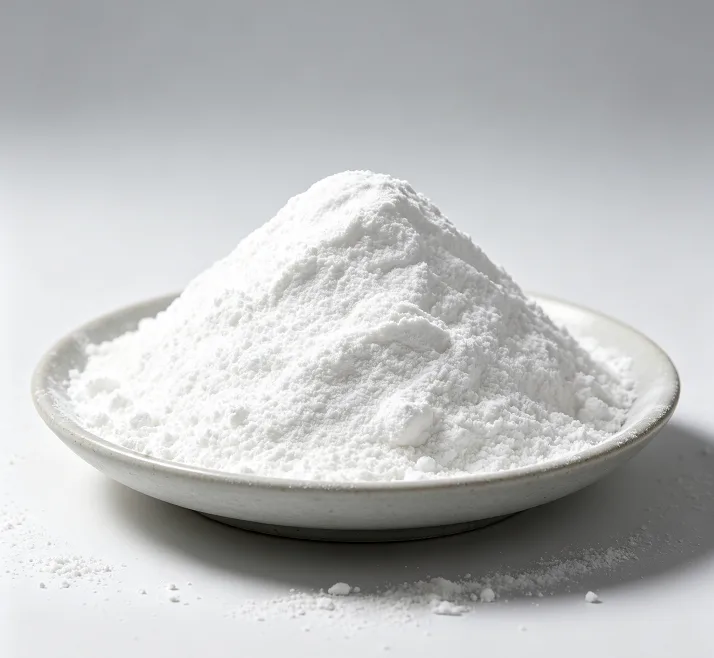
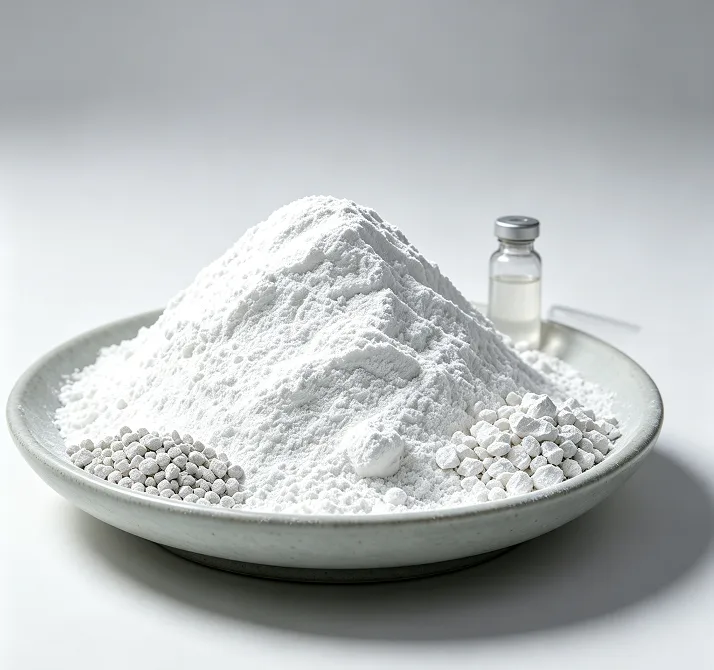
| Appearance | White to off-white powder | Visual identification |
| Crystal Structure | Cubic, Rock-Salt | Stable crystalline phase |
| True Density | Approx. 3.58 g/cm³ | Theoretical density |
| Particle Size | Customized, typically submicron to tens of µm | Process-dependent |
| D50 | Typically 0.5–20 µm | Controlled according to application |
| Specific Surface Area | Grade-dependent | Related to reactivity and sintering |
| Melting Point | Approx. 2,800–2,850°C | High-temperature capability |
| Boiling/Sublimation Temperature | Approx. 3,600°C | High-temperature reference |
| Solubility in Water | Low; reacts gradually with water | Important for storage/formulation |
| Electrical Property | High electrical resistivity when dense and dry | Electrical insulation |
| Thermal Stability | Excellent at high temperature | Refractory and ceramic applications |
| Moisture | Controlled according to grade | Important for electrical and reactive applications |
| Packaging | Sealed bags/drums according to grade | Protects against moisture |
| Customization | Purity, particle size, morphology and surface area | Application-specific |
For powder processing, Magnesium Oxide should ideally be specified through a combination of chemical and physical parameters. For example, a ceramic manufacturer may require ≥99.5% purity with a controlled D50 and low impurity content, while a refractory producer may prioritize MgO content, CaO/SiO₂/Fe₂O₃ levels, apparent density, and calcination condition. This is why a single “high purity MgO” designation does not automatically indicate that a powder is suitable for every application.
4. Applications of Magnesium Oxide
4.1 Refractory Materials
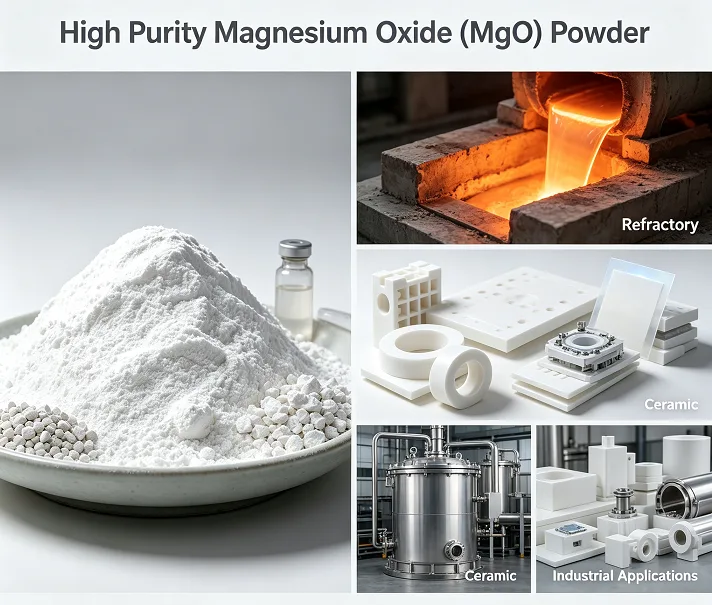
Magnesium Oxide is one of the important raw materials used in basic refractory systems because of its high melting point and resistance to many high-temperature environments. MgO-based refractory materials are used where resistance to heat, molten phases, and basic slags is required. The final performance depends on MgO purity, grain size, apparent porosity, bonding phase, firing temperature, and the presence of secondary oxides. Dead-burned MgO with relatively low reactivity is commonly considered when dimensional stability at high temperature is a priority.
4.2 Advanced Ceramics
In ceramic processing, Magnesium Oxide can function as a structural constituent, sintering-related additive, reaction component, or precursor for magnesium-containing ceramic compositions. Its effect depends strongly on particle size and firing conditions. Fine MgO can increase reaction kinetics and promote formation of secondary ceramic phases, while coarser or highly calcined material can provide greater thermal stability. Engineers developing ceramic formulations should therefore consider the interaction between MgO and the other oxide components rather than evaluating it as an isolated powder.
4.3 Electrical and Thermal Insulation
High-purity MgO is widely associated with mineral-insulated electrical systems because it combines thermal stability with electrical insulation. In such applications, powder compaction and moisture content are critical. Properly compacted and dried MgO can provide stable insulation between an electrical conductor and metallic sheath while allowing heat to transfer efficiently through the insulating medium.
4.4 Cement and Construction Materials
Reactive MgO is also used in selected cementitious and construction-related formulations. Its reactivity with water and ability to participate in magnesium-based reaction systems make it useful for specialized binders, flooring systems, boards, and other formulations. Here, particle size, calcination temperature, activity, and hydration behavior can have a greater influence on performance than simply increasing chemical purity.
4.5 Chemical and Environmental Applications
Because MgO is a basic oxide, it can be used for acid neutralization, pH adjustment, adsorption-related processes, and chemical treatment systems. The required grade depends strongly on reaction kinetics. Fine, high-surface-area Magnesium Oxide can offer faster reaction rates, while coarser material may be preferred when controlled reactivity and easier handling are required.
4.6 High-Temperature Processing
MgO can also be incorporated into crucibles, kiln furniture, thermal processing components, and other high-temperature materials where chemical and thermal stability are required. In these applications, the key engineering variables include thermal shock resistance, porosity, grain size, mechanical strength, impurity content, and chemical compatibility with the processed material. The powder specification should therefore be matched to the final component manufacturing process.

5. Company Profile
RBOSCHCO is a professional supplier and manufacturer of inorganic compound powders, advanced ceramic materials, functional materials, and related industrial products. According to its current website, the company provides powder materials including oxides, carbides, nitrides, borides, silicides, sulfides, and elemental powders, together with high-purity targets, functional ceramics, and structural devices. Its inorganic compound powder portfolio emphasizes controlled purity, particle size, morphology, crystalline phase, surface properties, and sinterability for industrial material processing.
For Magnesium Oxide, material selection can be adjusted according to the requirements of the downstream process, including chemical purity, particle size distribution, specific surface area, morphology, moisture control, and other technical parameters. This approach is important because MgO performance is highly dependent on powder characteristics and processing history. RBOSCHCO also states that OEM services are available for its powder materials, functional ceramics, and related products, allowing material specifications to be developed around particular application requirements rather than using a single standard formulation.

6. FAQs
Q1: What factors should be considered when selecting Magnesium Oxide for an industrial application?
Selecting Magnesium Oxide should not be based on MgO purity alone. From an engineering perspective, the selection should consider chemical purity, impurity profile, particle size distribution, specific surface area, calcination temperature, crystal structure, bulk density, moisture content, and the required thermal or chemical environment. For example, a high-purity fine MgO powder with a large specific surface area may be suitable for applications requiring high reaction activity or relatively low-temperature sintering, but the same characteristics may not be desirable for a refractory application where low reactivity and high dimensional stability are more important. Impurities such as CaO, SiO₂, Fe₂O₃ and Al₂O₃ can also influence grain growth, liquid-phase formation, electrical properties, corrosion resistance, and high-temperature stability. Therefore, the correct MgO grade should be selected according to the complete manufacturing process and final component requirements rather than simply choosing the highest available purity.
Q2: How does calcination temperature affect the properties of Magnesium Oxide powder?
Calcination temperature has a significant effect on the physical and chemical behavior of Magnesium Oxide. During calcination, magnesium compounds such as magnesium carbonate are thermally decomposed to form MgO. When the calcination temperature is relatively low, the resulting MgO generally retains a higher specific surface area, smaller crystallite size, and greater surface activity. As the calcination temperature increases, crystal growth and densification occur, reducing surface area and chemical reactivity while increasing thermal stability. Extremely high-temperature calcination can produce dead-burned MgO with relatively low hydration and reaction activity, which is advantageous for certain refractory applications. Therefore, when purchasing MgO for a controlled manufacturing process, the calcination history can be as important as the nominal chemical purity because it directly influences hydration, reaction kinetics, sintering behavior, and final material stability.
Q3: What is the difference between reactive Magnesium Oxide and dead-burned Magnesium Oxide?
Reactive MgO and dead-burned MgO have the same basic chemical formula but substantially different processing characteristics. Reactive Magnesium Oxide normally has a higher specific surface area, smaller crystallite size, and greater chemical activity because it has experienced less severe thermal treatment. It is commonly considered for cementitious formulations, chemical reactions, magnesium-based binders, and processes where controlled hydration or reaction is required. Dead-burned MgO, in contrast, is produced through much higher-temperature calcination, resulting in larger and more stable crystals with significantly lower reactivity. This makes it more appropriate for refractory products and high-temperature applications where dimensional stability and resistance to chemical attack are more important than rapid reaction. When specifying the material, engineers should therefore state whether the process requires high activity or low reactivity rather than simply requesting “high-purity MgO.”
Q4: How does particle size affect the performance of Magnesium Oxide?
Particle size has a direct influence on the processing and final performance of Magnesium Oxide. Smaller particles generally provide greater specific surface area, faster reaction kinetics, improved contact with other powder components, and stronger sintering driving forces. However, excessively fine powder can also increase agglomeration, moisture sensitivity, dust generation, and difficulties in powder flow and homogeneous feeding. Coarser MgO generally provides better handling characteristics and can offer greater dimensional stability during high-temperature processing, but it may require higher temperatures or longer dwell times to achieve the desired reaction or densification. For ceramic and refractory manufacturing, engineers should therefore consider D10, D50, D90, particle morphology, and agglomeration state together rather than specifying only one nominal particle size.
Q5: Why is impurity control important for high-purity Magnesium Oxide?
Impurity control becomes increasingly important when Magnesium Oxide is used in advanced ceramics, electrical insulation, high-temperature components, or other applications requiring predictable material behavior. Even relatively small concentrations of secondary oxides can modify grain-boundary chemistry, promote liquid-phase formation, change sintering kinetics, or introduce unwanted secondary phases. For example, calcium- and silicon-containing impurities can influence the formation of low-melting phases, while iron-containing impurities may affect color, electrical behavior, and high-temperature performance. Aluminum and other trace elements can also alter the interaction between MgO grains and surrounding ceramic phases. For this reason, a technical specification should ideally include a complete impurity analysis rather than stating only “99.9% MgO.” This provides engineers with a more reliable basis for predicting how the powder will behave during mixing, pressing, firing, and subsequent service.
Q6: Is high-purity Magnesium Oxide always better than standard-grade MgO?
Not necessarily. High-purity Magnesium Oxide provides tighter control over impurity-related effects, but the highest purity is not automatically the most economical or technically appropriate choice for every application. In a refractory formulation, for example, the required impurity limits depend on the operating temperature, slag chemistry, bonding system, and required service life. In a chemical formulation, surface activity and particle size may have a greater influence on performance than increasing purity from 99.5% to 99.9%. For advanced ceramic manufacturing, however, high purity can become more important because trace impurities may affect sintering behavior and electrical or thermal properties. The appropriate grade should therefore be determined by the tolerance of the final product rather than by selecting the highest purity specification available.
REQUEST A QUOTE
RELATED PRODUCTS
Tantalum Nitride TaN Powder CAS 12033-62-4
CAS 12045-64-6 ZrB2 Powder Zirconium Boride
china manufactured wear Resistant Chrome Carbide Chromium Carbide Steel Plate
CAS 12007-99-7 With Factory Price CaB6 Calcium Hexaboride
Titanium Oxide TiO2 powder CAS 13464-67-7