Professional and high-quality metal alloys, ceramic products and concrete additives | RBOSCHCO

1. Introduction to Crucible Selection for High-Temperature Experiments
1.1 What Is a High-Temperature Crucible?
A high-temperature crucible is a specialized container designed to hold materials during melting, sintering, calcination, and other thermal processes at elevated temperatures. Crucibles are used in materials science, metallurgy, chemical analysis, and semiconductor manufacturing, where the container must withstand extreme heat while maintaining chemical inertness and structural integrity.
Crucibles are made from a range of materials, including alumina, boron nitride, quartz, graphite, and platinum. Each material offers different combinations of temperature resistance, chemical inertness, thermal shock resistance, and cost. The choice of crucible material has a direct impact on the quality of the experiment, the purity of the sample, and the safety of the operation.
1.2 Why the Choice Between BN and Alumina Matters
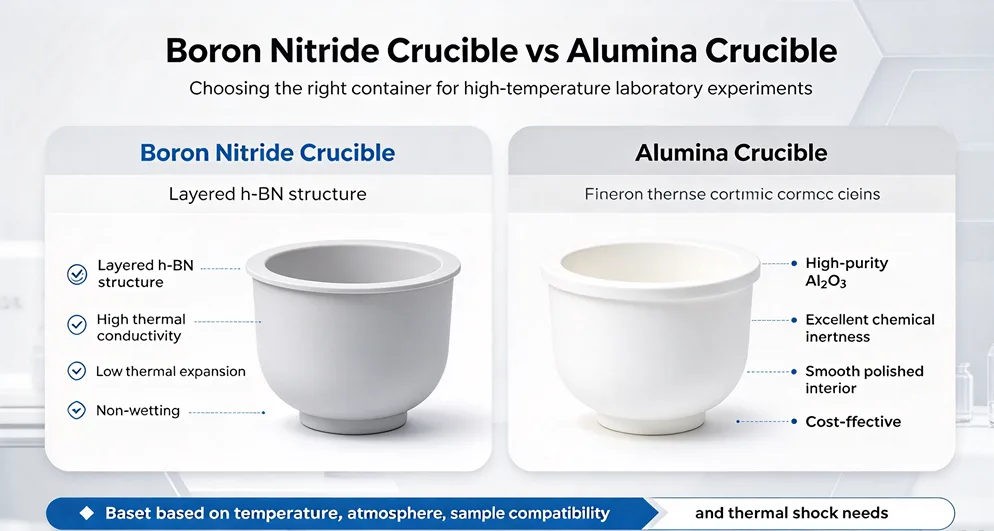
Boron nitride (BN) and alumina (Al₂O₃) are two of the most widely used crucible materials in high-temperature laboratories. Both offer excellent temperature resistance and chemical stability, but they differ significantly in their properties and ideal applications. Boron nitride crucibles are known for their high thermal conductivity, low thermal expansion, and non-wetting behavior, making them suitable for melting reactive metals and handling molten salts. Alumina crucibles, by contrast, are valued for their excellent chemical inertness, high purity, and affordability, making them a versatile choice for general high-temperature experiments.
Choosing the wrong crucible material can lead to sample contamination, crucible failure, or even safety hazards. For example, alumina can react with certain molten metals and strong bases at high temperatures, while boron nitride may oxidize in air above a certain temperature. Understanding the differences between these two materials is essential for selecting the right crucible for a specific experiment.
1.3 The Cost of Choosing the Wrong Crucible
A poorly chosen crucible rarely fails immediately. Instead, problems emerge gradually: the crucible may react with the sample, introducing impurities that compromise experimental results. It may crack under thermal shock, requiring replacement and interrupting the experiment. In extreme cases, crucible failure can cause equipment damage or safety incidents.
More seriously, crucible contamination can invalidate entire experiments. If the crucible reacts with the sample, the resulting data may be unreliable, leading to incorrect conclusions and wasted time and resources. For laboratories working with high-purity materials or reactive metals, the choice of crucible material is not a minor detail — it is a critical factor in experimental success.
2. Understanding Boron Nitride Crucible
2.1 Chemical Composition and Manufacturing Process
A boron nitride crucible is made from hexagonal boron nitride (h-BN), a compound with a layered crystal structure similar to graphite. The material is synthesized through high-temperature processes and formed into crucibles using sintering or hot-pressing techniques. The resulting product typically has a purity of >99% BN and a smooth, sometimes polished surface.
The layered structure of h-BN gives the material its unique combination of properties: high thermal conductivity, low thermal expansion, chemical inertness, and lubricity. These properties make boron nitride crucibles suitable for a wide range of high-temperature applications.
2.2 Key Physical and Chemical Properties
Boron nitride crucibles offer several distinctive properties that set them apart from other crucible materials.
- Maximum operating temperature: Up to 2100°C in non-oxidizing atmospheres; up to 900°C in air
- Thermal conductivity: High, promoting uniform heat distribution
- Coefficient of thermal expansion: Low, minimizing risk of thermal shock
- Chemical resistance: Resistant to most molten metals, salts, acids, and bases
- Electrical resistivity: High at elevated temperatures
- Purity: Typically >99% BN
- Porosity: Generally low, contributing to chemical inertness
- Color: White or light gray
The high thermal conductivity of boron nitride crucibles ensures uniform temperature distribution, which is important for consistent melting and sintering. The low thermal expansion coefficient reduces the risk of cracking under rapid temperature changes, making BN crucibles suitable for thermal cycling applications.
2.3 Advantages Over Other Crucible Materials
Boron nitride crucibles offer several advantages over other high-temperature crucible materials.
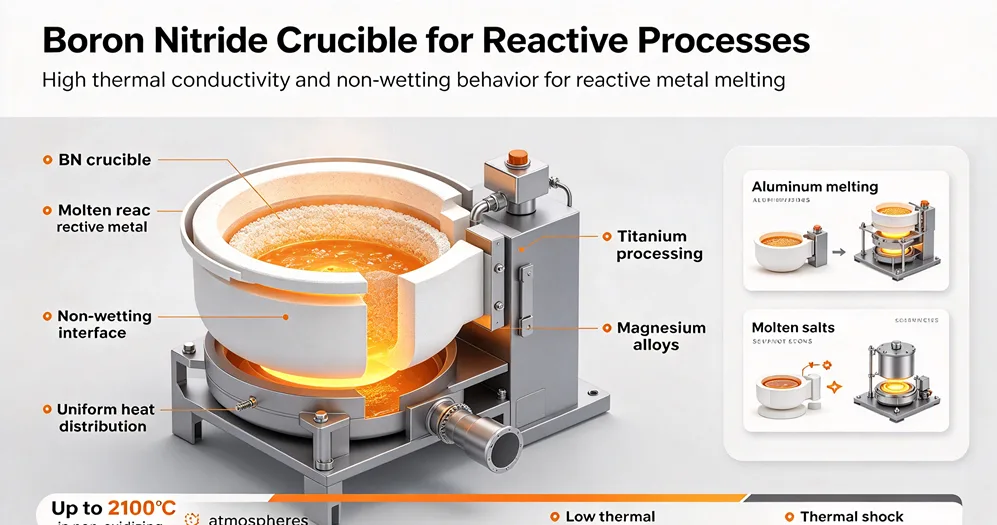
- Non-wetting behavior: BN does not react with most molten metals, making it ideal for melting reactive metals such as aluminum, titanium, and magnesium
- Lubricity: BN provides lubrication even at high temperatures, which can simplify the removal of solidified materials
- Electrical insulation: BN remains an electrical insulator at high temperatures, suitable for applications where electrical conductivity is undesirable
- Thermal shock resistance: The low thermal expansion coefficient allows BN crucibles to withstand rapid heating and cooling without cracking
3. Understanding Alumina Crucible
3.1 Chemical Composition and Manufacturing Process
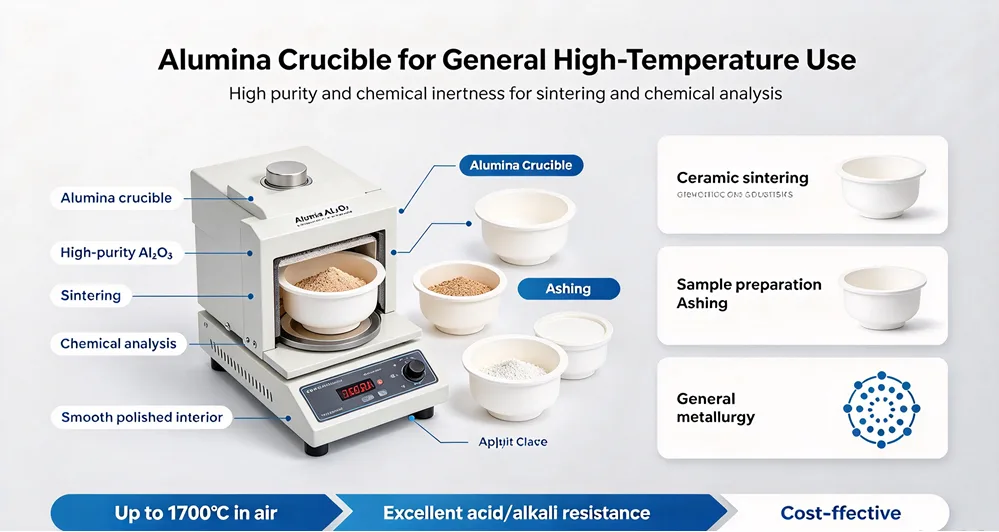
An alumina crucible is made from high-purity aluminum oxide (Al₂O₃), typically with a purity of ≥99.5%. The crucible is formed through processes such as slip casting, isostatic pressing, or dry pressing, followed by high-temperature sintering. The result is a dense, chemically inert ceramic body with a smooth, polished interior.
Alumina crucibles are one of the most widely used high-temperature labware items due to their excellent combination of temperature resistance, chemical inertness, and affordability.
3.2 Key Physical and Chemical Properties
Alumina crucibles offer a well-balanced set of properties for general high-temperature applications.
- Maximum operating temperature: Up to 1700°C
- Density: 3.95–4.00 g/cm³
- Porosity: <1%
- Thermal conductivity: 20–30 W/m·K
- Thermal expansion coefficient: 6–8 × 10⁻⁶/K
- Chemical resistance: Excellent resistance to acids and alkalis; inert to most chemicals
- Purity: ≥99.5%
- Surface finish: Smooth, polished interior
- Color: White
The low porosity of alumina crucibles contributes to their chemical inertness and prevents penetration by molten materials. The smooth interior surface minimizes sample adhesion and simplifies cleaning.
3.3 Advantages Over Other Crucible Materials
Alumina crucibles offer several advantages that have made them a standard choice in many laboratories.
- Chemical inertness: Alumina is resistant to most acids, alkalis, and chemical reagents
- High purity: With purity ≥99.5%, alumina crucibles minimize contamination risk
- Cost-effectiveness: Alumina crucibles are generally more affordable than BN or specialty ceramic crucibles
- Versatility: Suitable for a wide range of high-temperature applications including metal melting, ceramic sintering, and chemical analysis
- Thermal stability: Low thermal expansion coefficient provides good resistance to thermal shock
4. Step 1: Compare BN and Alumina Crucible — Key Selection Criteria
4.1 Physical and Chemical Properties
The following table summarizes the key differences between boron nitride crucibles and alumina crucibles.
| Comparison Dimension | Boron Nitride Crucible | Alumina Crucible |
|---|---|---|
| Material composition | Hexagonal boron nitride (h-BN) | High-purity aluminum oxide (Al₂O₃) |
| Purity | >99% BN | ≥99.5% |
| Maximum operating temperature (non-oxidizing) | Up to 2100°C | — |
| Maximum operating temperature (air) | Up to 900°C | Up to 1700°C |
| Thermal conductivity | High | 20–30 W/m·K |
| Coefficient of thermal expansion | Low | 6–8 × 10⁻⁶/K |
| Chemical resistance | Resistant to most molten metals, salts, acids, and bases | Excellent resistance to acids and alkalis |
| Electrical resistivity | High at elevated temperatures | High |
| Porosity | Low | <1% |
| Color | White or light gray | White |
| Shape availability | Cylindrical, boat-shaped, rectangular, custom | Cylindrical, conical, boat-shaped, custom |
| Surface finish | Smooth, sometimes polished | Smooth, polished interior |
4.2 Temperature Capability
The temperature capability of the two crucible materials differs significantly depending on the atmosphere. Boron nitride crucibles can operate at temperatures up to 2100°C in non-oxidizing atmospheres, making them suitable for very high-temperature processes such as melting refractory metals. In air, however, BN oxidizes above approximately 900°C, which limits its use in oxidizing atmospheres.
Alumina crucibles can operate at temperatures up to 1700°C in air, making them more suitable for general high-temperature experiments in ambient atmospheres. However, alumina has a lower maximum temperature than BN in non-oxidizing conditions.
4.3 Chemical Compatibility
Boron nitride crucibles are chemically inert to most molten metals, salts, acids, and bases. They are particularly suitable for melting reactive metals such as aluminum, titanium, and magnesium, which can react with alumina at high temperatures. BN crucibles are also non-wetting, which simplifies the removal of solidified materials.
Alumina crucibles offer excellent chemical inertness to acids and alkalis but can react with certain materials at high temperatures, including lead, tin, silicon, antimony, rare earth compounds, and strong bases such as sodium hydroxide or potassium hydroxide. These reactions can damage the crucible or contaminate the sample.
4.4 Thermal Shock Resistance
Boron nitride crucibles have a low coefficient of thermal expansion, which gives them excellent thermal shock resistance. They can withstand rapid heating and cooling without cracking, making them suitable for processes involving thermal cycling.
Alumina crucibles also have good thermal shock resistance, but their higher thermal expansion coefficient means they are more susceptible to cracking under severe thermal cycling than BN crucibles. For applications involving rapid temperature changes, BN may be the better choice.
4.5 Cost and Availability
Alumina crucibles are generally more affordable than boron nitride crucibles. They are widely available in a range of shapes and sizes and are considered a standard laboratory consumable. Boron nitride crucibles are more expensive due to the higher cost of raw materials and the more complex manufacturing process. However, their superior performance in certain applications may justify the higher cost.
5. Step 2: Match Crucible Material to Your Application
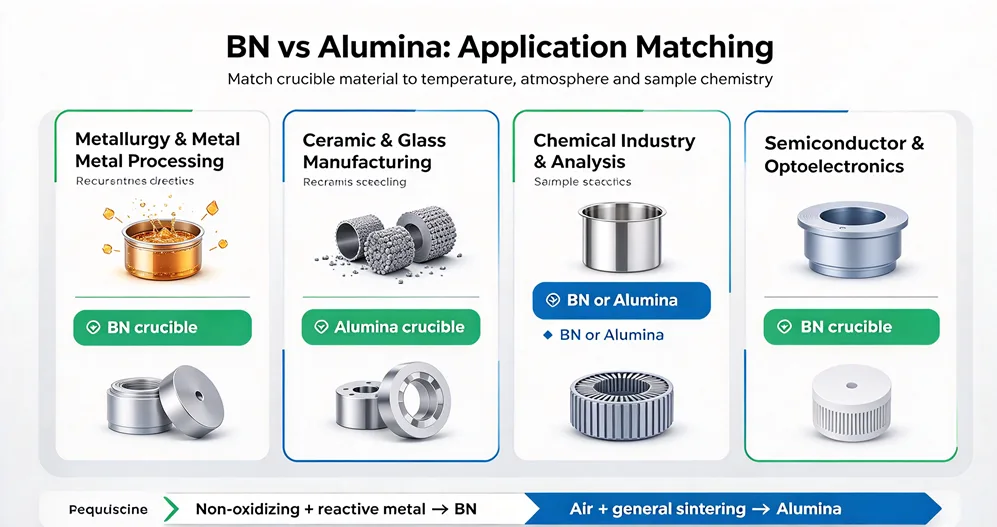
5.1 Metallurgy and Metal Processing
Boron nitride crucibles are particularly suitable for melting and casting reactive metals such as aluminum, titanium, and magnesium. Their non-wetting behavior and chemical inertness prevent reactions between the crucible and the molten metal, ensuring sample purity. BN crucibles are also used for heat treatment processes such as annealing, quenching, and hardening, where maintaining a non-reactive atmosphere is critical.
Alumina crucibles can be used for melting less reactive metals and alloys. They are suitable for general metallurgical applications where the molten metal does not react with alumina. However, for reactive metals or high-purity applications, BN is generally preferred.
5.2 Ceramic and Glass Manufacturing
Both boron nitride crucibles and alumina crucibles are used in ceramic and glass manufacturing. Boron nitride crucibles provide an inert atmosphere during the synthesis of advanced ceramics and glasses, preventing contamination and ensuring purity. Alumina crucibles are also used for firing and sintering ceramic materials at high temperatures without risking contamination.
The choice between the two depends on the specific material being processed and the required temperature. For very high temperatures in non-oxidizing atmospheres, BN is preferred. For general ceramic sintering in air, alumina is a cost-effective choice.
5.3 Chemical Industry and Laboratory Analysis
Boron nitride crucibles are used in the chemical industry for high-temperature reactions involving corrosive or reactive materials. They are also used in analytical chemistry for preparing samples for X-ray fluorescence (XRF) spectroscopy, where contamination must be prevented.
Alumina crucibles are widely used in chemical analysis for high-temperature melting and sample preparation. Their excellent chemical inertness makes them suitable for a variety of laboratory applications. However, care must be taken with certain materials that can react with alumina at high temperatures.
5.4 Semiconductor and Optoelectronics
Boron nitride crucibles are used in the semiconductor industry for growing single crystals and processing wafers. Their ability to withstand high temperatures while remaining chemically inert makes them suitable for epitaxial growth and other high-purity processes.
Alumina crucibles are also used in the electronics industry for the preparation of semiconductor materials and electronic ceramics. They provide a pure and stable high-temperature environment, ensuring high-quality production.
5.5 Nuclear Industry
Boron nitride crucibles are used in the nuclear industry for handling and processing radioactive materials, including waste management and fuel manufacture. Their chemical inertness and radiation resistance make them suitable for these demanding applications.
Alumina crucibles are not typically used in nuclear applications due to their different radiation response and chemical compatibility profile.
6. Step 3: Consider Operational Factors
6.1 Heating and Cooling Rates
Boron nitride crucibles can withstand rapid heating and cooling without cracking, thanks to their low thermal expansion coefficient. This makes them suitable for processes that involve thermal cycling or rapid temperature changes.
Alumina crucibles have good thermal shock resistance but are more susceptible to cracking under severe thermal cycling. Heating and cooling rates should be controlled to avoid thermal stress.
6.2 Atmosphere Control
The maximum operating temperature of boron nitride crucibles depends on the atmosphere. In non-oxidizing atmospheres (such as nitrogen or argon), BN can operate up to 2100°C. In air, the maximum temperature is limited to approximately 900°C due to oxidation.
Alumina crucibles can operate in air up to 1700°C, making them more suitable for experiments conducted in ambient atmospheres. They can also be used in inert atmospheres, but their maximum temperature remains the same.
6.3 Sample Purity Requirements
For experiments requiring the highest sample purity, boron nitride crucibles are often preferred because of their chemical inertness and non-wetting behavior. They minimize the risk of contamination from the crucible material. Alumina crucibles offer high purity (≥99.5%) and are suitable for most general applications, but they can react with certain materials at high temperatures, potentially introducing impurities.
6.4 Cleaning and Maintenance
Boron nitride crucibles are relatively easy to clean due to their non-wetting surface. Most residues can be removed with a soft cloth or gentle brushing. Alumina crucibles also have a smooth, polished interior that minimizes sample adhesion. For stubborn residues, alumina crucibles can be heated to approximately 1000°C to burn off organic contaminants.
7. Step 4: Cost and Supplier Selection
7.1 Initial Cost vs Lifetime Cost
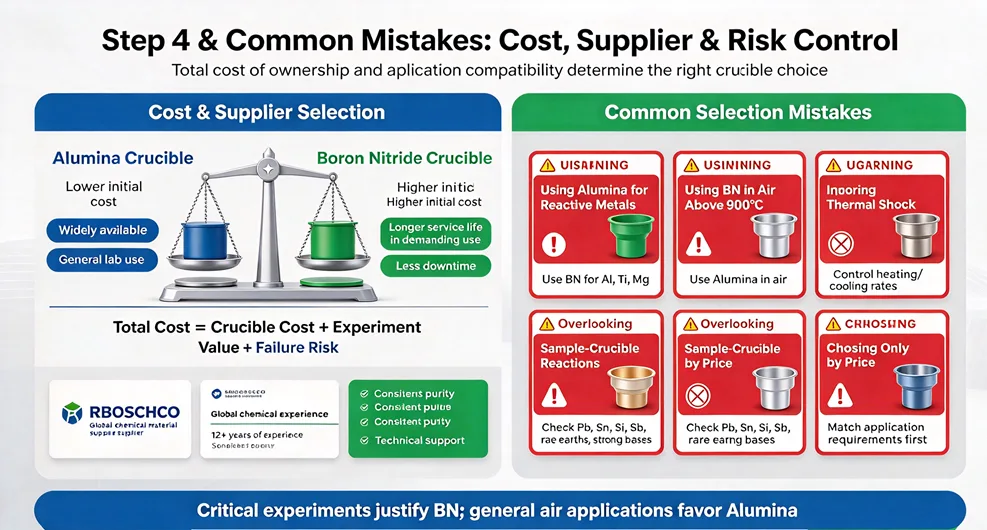
Alumina crucibles have a lower initial cost and are widely available, making them a cost-effective choice for general laboratory use. Boron nitride crucibles are more expensive but may offer longer service life and better performance in demanding applications, potentially reducing replacement frequency and experimental downtime.
When selecting a crucible, it is important to consider the total cost of ownership, including the cost of the crucible, the value of the experiment, and the potential cost of failure. For critical experiments where contamination or failure is not acceptable, the higher cost of BN may be justified.
7.2 Supplier Reliability
Both boron nitride crucibles and alumina crucibles are available from RBOSCHCO, a trusted global chemical material supplier with over 12 years of experience. RBOSCHCO provides high-quality crucibles with consistent purity and performance, along with technical support to help customers select the right product for their application.
8. Common Selection Mistakes to Avoid
8.1 Using Alumina Crucibles for Reactive Metals
Alumina can react with certain molten metals at high temperatures, leading to crucible damage and sample contamination. For reactive metals such as aluminum, titanium, and magnesium, boron nitride crucibles are generally the better choice.
8.2 Using BN Crucibles in Air at High Temperatures
Boron nitride crucibles oxidize in air above approximately 900°C. For experiments conducted in air at temperatures above this limit, alumina crucibles are more suitable.
8.3 Ignoring Thermal Shock Limitations
While alumina crucibles have good thermal shock resistance, they are more susceptible to cracking under severe thermal cycling than boron nitride crucibles. Heating and cooling rates should be controlled to avoid thermal stress.
8.4 Overlooking Sample-Crucible Interactions
Certain materials can react with alumina at high temperatures, including lead, tin, silicon, antimony, rare earth compounds, and strong bases. For these materials, boron nitride crucibles may be required to prevent contamination.
8.5 Choosing Based on Price Alone
While alumina crucibles are more affordable, they may not be suitable for all applications. Choosing a crucible based solely on price can lead to experimental failure or safety issues. The selection should be based on the specific requirements of the experiment.
9. Quick Selection Checklist
Before selecting a crucible for your high-temperature experiment, verify the following key parameters:
- Maximum operating temperature required
- Atmosphere (air, inert, reducing)
- Chemical compatibility with the sample material
- Thermal shock resistance requirements
- Sample purity requirements
- Heating and cooling rates
- Crucible shape and size availability
- Cost and budget constraints
- Supplier reliability and technical support
10. Real-World Application Scenarios
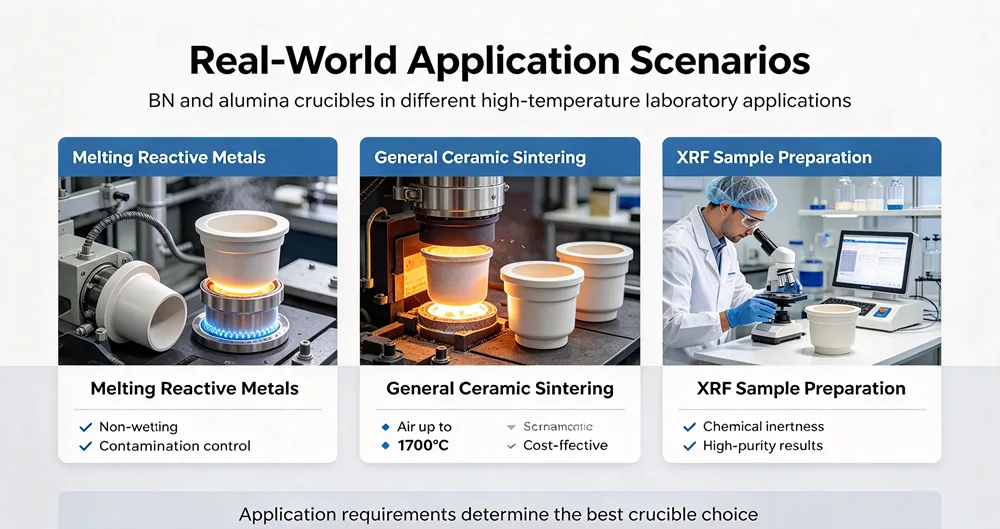
10.1 Melting Reactive Metals
A laboratory melting aluminum and magnesium alloys selected boron nitride crucibles because of their non-wetting behavior and chemical inertness. The BN crucibles prevented reactions between the molten metal and the crucible, ensuring sample purity and consistent results.
10.2 General Ceramic Sintering
A materials science laboratory conducting general ceramic sintering experiments in air chose alumina crucibles for their high-temperature capability, chemical inertness, and cost-effectiveness. The alumina crucibles provided a reliable container for the sintering process without introducing contamination.
10.3 XRF Sample Preparation
An analytical chemistry laboratory preparing samples for XRF analysis selected boron nitride crucibles to prevent contamination during high-temperature sample preparation. The chemical inertness of BN ensured that the sample composition was not altered by the crucible material.
11. FAQs
Q1: What is the maximum operating temperature of a boron nitride crucible?
Boron nitride crucibles can operate at temperatures up to 2100°C in non-oxidizing atmospheres. In air, the maximum temperature is approximately 900°C due to oxidation.
Q2: What is the maximum operating temperature of an alumina crucible?
Alumina crucibles can operate at temperatures up to 1700°C in air. They are suitable for general high-temperature laboratory applications.
Q3: Can alumina crucibles be used for melting reactive metals?
Alumina crucibles can be used for melting less reactive metals, but they may react with reactive metals such as aluminum, titanium, and magnesium at high temperatures. For these materials, boron nitride crucibles are generally preferred.
Q4: How should I clean a boron nitride crucible?
Boron nitride crucibles have a non-wetting surface that makes cleaning relatively easy. Most residues can be removed with a soft cloth or gentle brushing. Avoid using abrasive tools or harsh chemicals that could damage the surface.
Q5: How should I clean an alumina crucible?
Alumina crucibles can be cleaned with a mild detergent and a soft cloth. For stubborn residues, the crucible can be heated to approximately 1000°C to burn off organic contaminants. Avoid using strong acids or bases that could attack the alumina surface.
Q6: Are boron nitride crucibles more expensive than alumina crucibles?
Yes, boron nitride crucibles are generally more expensive than alumina crucibles due to the higher cost of raw materials and more complex manufacturing processes. However, their superior performance in certain applications may justify the higher cost.
Q7: Which crucible is better for thermal shock resistance?
Boron nitride crucibles have a lower coefficient of thermal expansion than alumina crucibles, giving them better thermal shock resistance. They can withstand rapid heating and cooling without cracking, making them suitable for processes involving thermal cycling.
Q8: Can both crucibles be used in a vacuum furnace?
Boron nitride crucibles can be used in vacuum or inert atmospheres up to 2100°C. Alumina crucibles can also be used in vacuum or inert atmospheres, but their maximum temperature remains 1700°C. The choice depends on the specific temperature and atmosphere requirements of the experiment.
12. Final Insights
Crucible selection for high-temperature experiments is not a matter of choosing the “best” material — it is a matter of matching the material to the specific requirements of the application. Boron nitride crucibles excel in applications requiring high thermal conductivity, non-wetting behavior, and chemical inertness with reactive metals and molten salts. Alumina crucibles offer excellent chemical inertness, high purity, and cost-effectiveness for general high-temperature experiments in air.
The key selection criteria include maximum operating temperature, atmosphere, chemical compatibility with the sample, thermal shock resistance, sample purity requirements, and cost. By evaluating these factors against the specific needs of the experiment, researchers can select the right crucible for the job.
RBOSCHCO supplies both boron nitride crucibles and alumina crucibles worldwide, backed by a professional technical department and quality supervision department. With a well-equipped laboratory and advanced testing equipment, RBOSCHCO provides the technical support needed to select the right crucible for specific applications. If you are looking for high-quality crucibles for high-temperature laboratory experiments, please feel free to contact us.
Supplier
RBOSCHCO is a trusted global chemical material supplier and manufacturer with over 12 years of experience in providing high-quality chemicals and nanomaterials, including boride powder, nitride powder, graphite powder, ceramic products, and 3D printing powder. The company has a professional technical department and quality supervision department, a well-equipped laboratory with advanced testing equipment, and a dedicated after-sales customer service center. RBOSCHCO supplies boron nitride crucibles and alumina crucibles worldwide, suitable for metallurgy, ceramics, chemical analysis, semiconductor manufacturing, and other high-temperature applications. The company offers comprehensive technical support, from product selection to application guidance. If you are looking for high-quality boron nitride crucibles or alumina crucibles, please feel free to contact us at [email protected].
RELATED POSTS
Alumina vs. Mullite — Which Ceramic Fits Your High-Temperature Application?

The Application of Tantalum Oxide in the field of Optics

Revolutionary Innovation: Molybdenum Disulfide (MoS TWO) Redefines Sustainable Solutions for Global Industries
Whats so unique about 3d printing metal powder
Why Al-TiB₂ Outperforms Traditional Al-Ti-B Alloys
