Professional and high-quality metal alloys, ceramic products and concrete additives | RBOSCHCO

13Supplier
1. Introduction: The Challenge of Combining Hardness and Precision
1.1 The Hardness-Precision Paradox in Ceramics
In ceramic manufacturing, hardness and precision are usually at odds with each other. Hard ceramics like silicon carbide are extremely difficult to machine, which means that the final dimensions must be achieved through forming and sintering rather than through grinding. But sintering typically causes significant shrinkage, which makes it difficult to maintain tight tolerances.
This is the hardness-precision paradox: the harder the ceramic, the more difficult it is to machine, and the more dependent you are on the sintering process to achieve the final shape. If the sintering process causes unpredictable shrinkage, the final part may not meet the required tolerances, leading to rejection or costly machining.
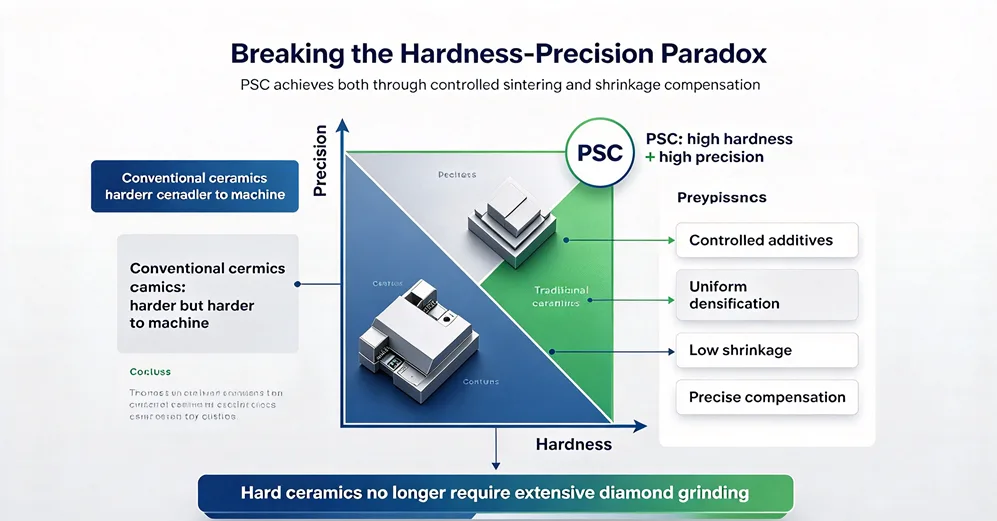
Pressureless Sintered Silicon Carbide (PSC) breaks this paradox. It achieves both high hardness and high dimensional precision through a combination of careful powder formulation, controlled sintering additives, and precise shrinkage compensation. This makes PSC one of the most versatile advanced ceramics for precision components.
1.2 What Is Pressureless Sintered Silicon Carbide (PSC) ?
Pressureless Sintered Silicon Carbide (PSC) is an advanced structural ceramic manufactured by compacting and shaping high-purity silicon carbide powder, followed by densification at elevated temperatures without applying external mechanical pressure. During the sintering process, carefully selected sintering additives promote grain boundary formation and reduce residual porosity, allowing the material to develop a dense and stable microstructure.
Unlike reaction-bonded SiC, which relies on silicon infiltration, Pressureless Sintered Silicon Carbide (PSC) achieves its mechanical integrity primarily through solid-state sintering and controlled grain growth. This manufacturing route preserves the inherent advantages of silicon carbide while providing excellent dimensional stability and the ability to produce complex geometries with relatively tight tolerances.
1.3 Why This Matters for Precision Components
For precision components such as mechanical seals, semiconductor process parts, and high-temperature fixtures, both hardness and precision are essential. Hardness provides wear resistance and dimensional stability under load. Precision ensures that the component fits properly and performs reliably.
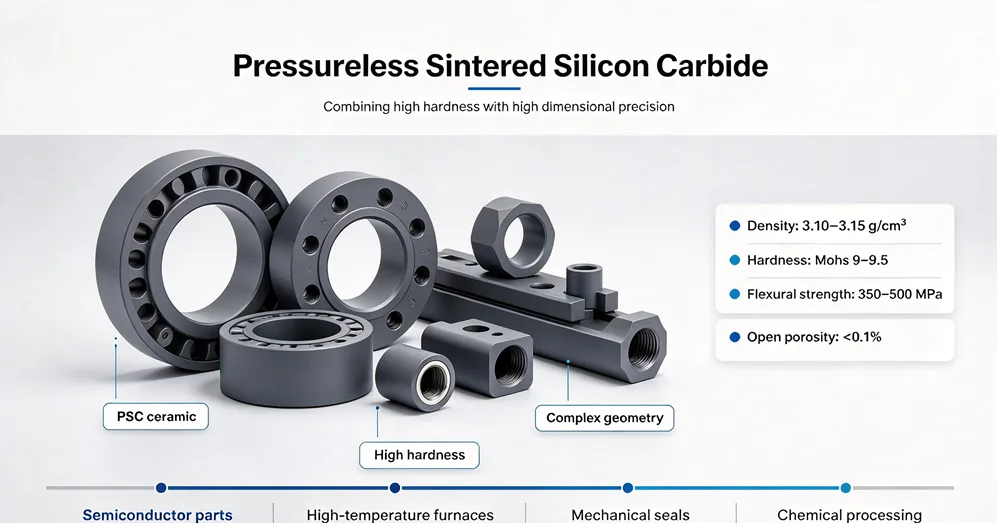
Pressureless Sintered Silicon Carbide (PSC) offers both. Its high hardness (Mohs 9–9.5) provides excellent wear resistance, while its near-net-shape forming capability ensures that complex geometries can be produced with tight tolerances. This combination makes PSC ideal for demanding precision applications.
2. Understanding Pressureless Sintered Silicon Carbide
2.1 Chemical Composition and Microstructure
Pressureless Sintered Silicon Carbide (PSC) is composed primarily of silicon carbide (SiC) with a small amount of sintering additives, typically boron and carbon, or aluminum-based compounds. The microstructure consists of fine, equiaxed SiC grains with a thin grain boundary phase that promotes densification.
The typical density of Pressureless Sintered Silicon Carbide (PSC) is 3.10–3.15 g/cm³, with open porosity of less than 0.1%. The material is dark gray or black in color and has a very fine-grained microstructure that contributes to its high strength and hardness.
2.2 Key Properties of Pressureless Sintered Silicon Carbide (PSC)
Pressureless Sintered Silicon Carbide (PSC) offers a combination of properties that make it suitable for precision components.
- High density and low open porosity: 3.10–3.15 g/cm³ density with <0.1% open porosity, reducing pathways for gas, liquid, and corrosive media penetration.
- Excellent high-temperature stability: Continuous operation above 1600°C in inert atmospheres, with a sublimation temperature of approximately 2700°C.
- Exceptional hardness and abrasion resistance: Mohs hardness of 9–9.5, providing strong resistance to abrasive wear, erosion, and sliding contact.
- High thermal conductivity and low thermal expansion: Thermal conductivity of 120–150 W/m·K at 20°C, with a coefficient of thermal expansion of 4.3–4.6 × 10⁻⁶/K.
- Strong chemical and corrosion resistance: Resistant to many acids, alkalis, molten salts, and corrosive gases.
- Near-net-shape manufacturing and precision machinability: Ability to produce complex geometries with tight tolerances.
2.3 Comparison with Other Silicon Carbide Grades
| Property | Pressureless Sintered SiC (PSC) | Reaction-Bonded SiC (RBSC) | Recrystallized SiC (RSiC) |
|---|---|---|---|
| Density (g/cm³) | 3.10–3.15 | 3.02–3.10 | 2.6–2.8 |
| Open Porosity (%) | <0.1 | <0.1 | 15–20 |
| Free Silicon Content | None | 8–15% | None |
| Flexural Strength (MPa) | 350–500 | 250–300 | 80–100 |
| Maximum Use Temperature (°C) | >1600 (inert) | 1380 (air) | 1650 (air) |
| Thermal Conductivity (W/m·K) | 120–150 | 120 | 100 |
| Thermal Shock Resistance | Very High | Good | Excellent |
| Near-Net-Shape Capability | Excellent | Excellent | Good |
| Precision Machinability | Good | Limited | Limited |
The comparison shows that Pressureless Sintered Silicon Carbide (PSC) offers the best combination of high strength, high density, and high-temperature capability. Unlike RBSC, it contains no free silicon, which improves its high-temperature stability and corrosion resistance. Unlike RSiC, it has low porosity and high strength, making it suitable for precision components.
3. Why Hardness and Precision Are Usually a Trade-Off
3.1 The Machining Problem
Silicon carbide is one of the hardest materials known, with a Mohs hardness of 9–9.5. This makes it extremely difficult to machine. Diamond grinding is the primary method for shaping fired SiC components, but it is slow, expensive, and limited in the geometries it can produce.
Complex features such as internal channels, undercuts, and fine details are difficult or impossible to machine. This means that the final shape must be achieved through forming and sintering rather than through grinding.
3.2 The Shrinkage Problem
Sintering typically causes significant shrinkage. For many ceramics, the shrinkage can be 15–20% or more. This means that the green body (the unfired ceramic shape) must be made significantly larger than the final product. Predicting and controlling the shrinkage is difficult, and variations in shrinkage can lead to dimensional inaccuracies and rejected parts.
For precision components, shrinkage is a major challenge. If the shrinkage is not accurately compensated, the final part may not meet the required tolerances.
3.3 How Conventional Processes Deal with the Trade-Off
Conventional ceramic manufacturing often deals with the hardness-precision trade-off by accepting looser tolerances or by investing in extensive diamond grinding. Both options increase cost and lead time. For complex components, the machining cost can exceed the material cost.
Some manufacturers use pressure-assisted sintering methods, such as hot pressing or hot isostatic pressing, to reduce shrinkage and improve density. However, these methods are limited in the shapes they can produce and are more expensive than pressureless sintering.
4. How the Pressureless Sintering Process Works
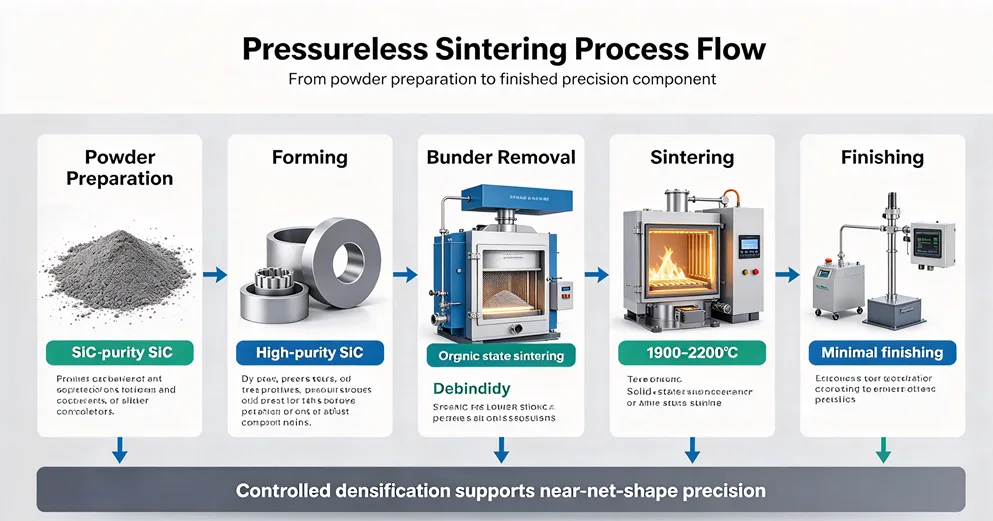
4.1 Step 1: Powder Preparation
The process begins with high-purity SiC powder, typically submicron in size. The powder is blended with sintering additives (such as boron and carbon) and organic binders to form a homogeneous mixture. The particle size distribution, purity, and morphology of the SiC powder are critical for achieving high density and fine grain size.
4.2 Step 2: Forming
The powder mixture is formed into the desired shape using techniques such as dry pressing, cold isostatic pressing, slip casting, or injection molding. The choice of forming method depends on the complexity of the shape and the required dimensional tolerance.
4.3 Step 3: Binder Removal
The formed green body is heated to a moderate temperature to remove the organic binders. This step must be carefully controlled to prevent cracking or deformation.
4.4 Step 4: Sintering
The green body is then sintered at high temperature (typically 1900–2200°C) in a controlled atmosphere (argon or vacuum). During sintering, the sintering additives promote grain boundary formation and reduce residual porosity. The material densifies through solid-state diffusion, achieving a density of 3.10–3.15 g/cm³.
4.5 Step 5: Finishing
After sintering, the component may require diamond grinding or polishing to achieve the final dimensions and surface finish. However, because the near-net-shape capability of PSC minimizes shrinkage, the amount of finishing required is significantly reduced compared to conventional ceramics.
5. The Role of Sintering Additives and Grain Boundary Formation
5.1 Why Sintering Additives Are Needed
Pure SiC is extremely difficult to sinter because of its strong covalent bonding and low self-diffusion coefficient. Without sintering additives, the material would require extremely high temperatures and pressures to achieve densification.
Sintering additives lower the sintering temperature and promote densification by forming a liquid phase or by enhancing grain boundary diffusion. Common additives for Pressureless Sintered Silicon Carbide (PSC) include boron, carbon, and aluminum-based compounds.
5.2 How Additives Promote Densification
The sintering additives work through several mechanisms. Boron and carbon react with the surface oxide layer on the SiC particles, reducing the oxide and promoting direct particle-to-particle contact. Aluminum-based additives form a liquid phase at the grain boundaries, which enhances diffusion and accelerates densification.
The result is a dense, fine-grained microstructure with strong grain boundaries. The grain boundary phase also contributes to the material‘s mechanical properties, including strength and fracture toughness.
5.3 Controlling Grain Growth
One of the challenges in pressureless sintering is controlling grain growth. Excessive grain growth can reduce strength and hardness. The sintering additives and the sintering temperature profile are carefully controlled to limit grain growth while achieving full densification.
The typical grain size in Pressureless Sintered Silicon Carbide (PSC) is in the range of 1–5 μm. This fine grain size contributes to the material’s high strength and hardness.
6. Shrinkage Compensation and Near-Net-Shape Forming
6.1 Why Shrinkage Compensation Matters
Shrinkage compensation is critical for achieving high dimensional precision. If the shrinkage is not accurately predicted and compensated, the final part will not meet the required tolerances. For complex components, even small errors in shrinkage compensation can lead to significant dimensional deviations.
6.2 How PSC Achieves Low Shrinkage
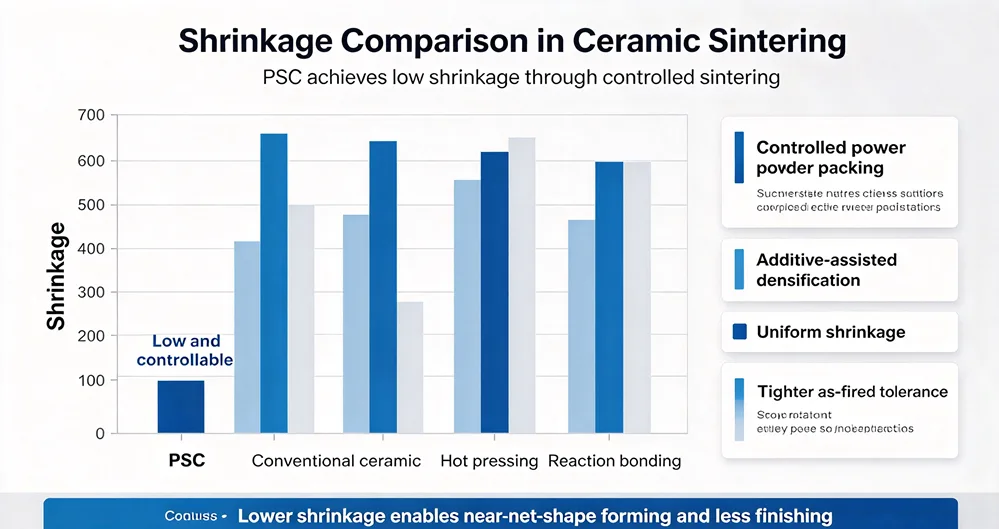
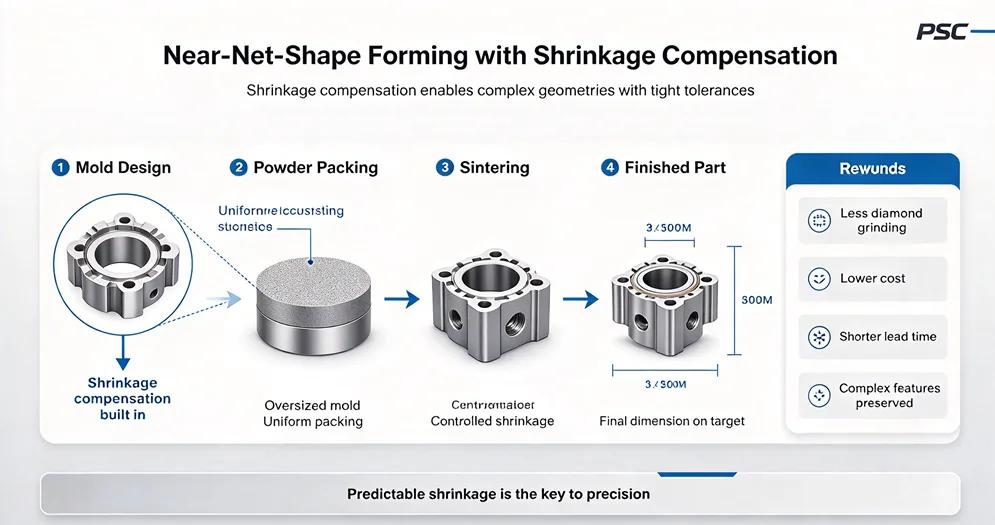
Pressureless Sintered Silicon Carbide (PSC) achieves relatively low shrinkage compared to other ceramics through careful control of the powder packing density, sintering additives, and sintering conditions. The green body is designed with a high and uniform packing density, which reduces the amount of shrinkage required for densification.
The sintering additives also promote uniform densification, reducing the risk of differential shrinkage that can cause warping or distortion.
6.3 Designing for Shrinkage
The mold and tooling for Pressureless Sintered Silicon Carbide (PSC) components are designed with shrinkage compensation built in. The dimensions of the mold are calculated based on the expected shrinkage of the material, so that the final part matches the desired dimensions.
This requires a deep understanding of the shrinkage behavior of the material under different sintering conditions. The shrinkage behavior is characterized through extensive testing and modeling, allowing the manufacturer to design molds with high accuracy.
6.4 Near-Net-Shape Capability
The combination of low shrinkage and precise shrinkage compensation gives Pressureless Sintered Silicon Carbide (PSC) its near-net-shape capability. Complex geometries can be produced with minimal machining, reducing cost and lead time.
This is particularly valuable for components with complex features that would be difficult or impossible to machine, such as internal channels, curved surfaces, and fine details.
7. Matching PSC to Your Application
7.1 Semiconductor and Electronic Processing Equipment
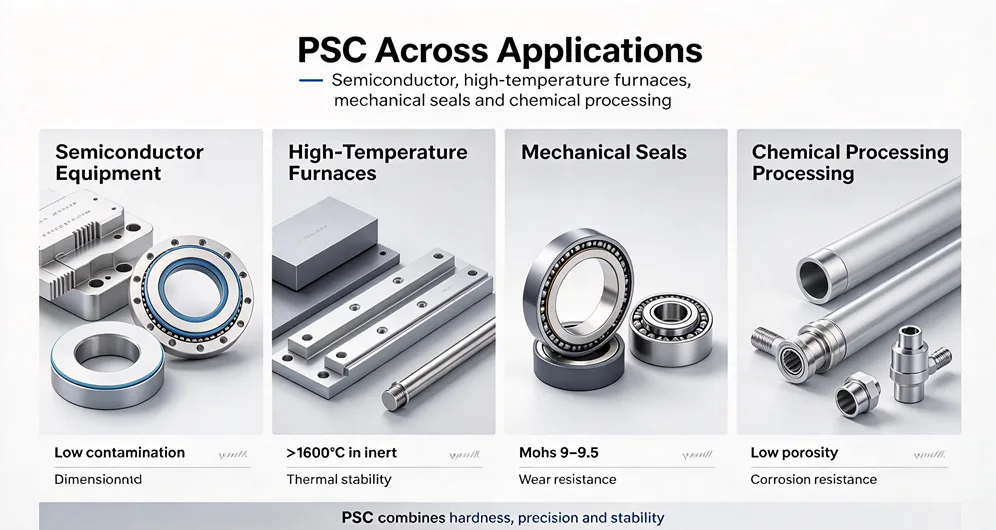
Pressureless Sintered Silicon Carbide (PSC) is used for wafer handling, process fixtures, susceptors, support rings, focus rings, and high-temperature structural components where low contamination and dimensional stability are critical. The high thermal conductivity (120–150 W/m·K) and low CTE (4.3–4.6 × 10⁻⁶/K) help maintain thermal uniformity and mechanical stability during repeated thermal cycles.
7.2 High-Temperature Furnace Components
Pressureless Sintered Silicon Carbide (PSC) is widely applied to furnace supports, setter plates, heating-system components, radiant tubes, kiln furniture, and structural fixtures operating under severe thermal conditions. The density of 3.10–3.15 g/cm³ and high-temperature stability above 1600°C allow components to retain their geometry during repeated heating and cooling.
7.3 Mechanical Seals, Bearings, and Wear Components
The combination of Mohs hardness of 9–9.5, high flexural strength (350–500 MPa), and excellent dimensional stability makes Pressureless Sintered Silicon Carbide (PSC) suitable for mechanical seal faces, bearings, wear rings, bushings, and pump components. The dense SiC structure provides strong resistance to sliding wear and erosion.
7.4 Chemical Processing and Corrosion-Resistant Components
Pressureless Sintered Silicon Carbide (PSC) components are used in heat exchanger tubes, reaction-system components, nozzles, fluid-handling parts, and corrosion-resistant structural components exposed to acids, alkalis, salts, and high-temperature process gases. The very low open porosity and dense microstructure reduce penetration of corrosive media.
7.5 High-Temperature and Wear-Resistant Industrial Components
Pressureless Sintered Silicon Carbide (PSC) is also used for burner components, nozzles, guide parts, protective tubes, abrasive-handling components, and precision structural ceramics subjected to high temperature, erosion, and mechanical loading.
8. Common Misconceptions About PSC
8.1 “PSC Is the Same as Reaction-Bonded SiC”
Pressureless Sintered Silicon Carbide (PSC) is not the same as reaction-bonded SiC (RBSC). PSC contains no free silicon, which gives it better high-temperature stability and corrosion resistance. PSC also has higher strength and density than RBSC.
8.2 “PSC Cannot Be Used at High Temperatures”
Pressureless Sintered Silicon Carbide (PSC) can operate continuously at temperatures above 1600°C in inert atmospheres. In air, the practical limit is around 1400–1500°C due to oxidation, but the material forms a protective silica layer that slows further oxidation.
8.3 “PSC Is Too Expensive for Most Applications”
While Pressureless Sintered Silicon Carbide (PSC) has a higher initial cost than some conventional ceramics, its longer service life, higher strength, and better precision can reduce total cost of ownership. For demanding applications, the cost premium is often justified.
8.4 “PSC Cannot Be Machined”
Pressureless Sintered Silicon Carbide (PSC) can be machined using diamond tooling. However, because of its high hardness, machining is costly and should be minimized through near-net-shape forming. The near-net-shape capability of PSC reduces the amount of machining required.
8.5 “PSC Has Poor Thermal Shock Resistance”
Pressureless Sintered Silicon Carbide (PSC) has excellent thermal shock resistance due to its low thermal expansion and high thermal conductivity. The thermal shock resistance is characterized by ΔTc > 500°C, making it suitable for rapid heating and cooling applications.
9. Quick Evaluation Checklist
Before selecting Pressureless Sintered Silicon Carbide (PSC) for your application, verify the following key parameters:
- Density (3.10–3.15 g/cm³)
- Open porosity (<0.1%)
- Flexural strength (350–500 MPa)
- Hardness (Mohs 9–9.5)
- Maximum use temperature (>1600°C in inert, 1400–1500°C in air)
- Thermal conductivity (120–150 W/m·K at 20°C)
- Coefficient of thermal expansion (4.3–4.6 × 10⁻⁶/K)
- Chemical compatibility with the process environment
- Component size and shape complexity
- Dimensional tolerance requirements
- Surface finish requirements
- Supplier quality and technical support
10. Real-World Application Scenarios
10.1 Semiconductor Focus Rings
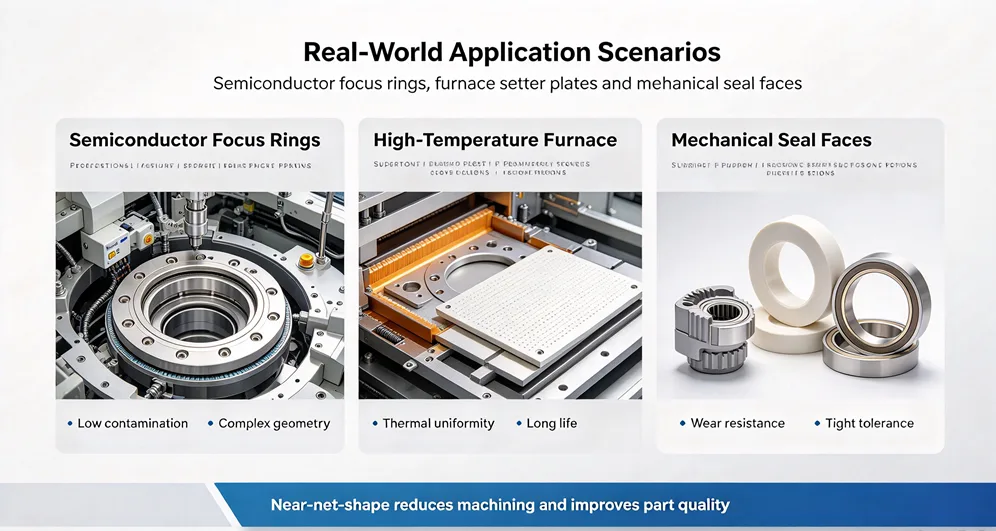
A semiconductor equipment manufacturer selected Pressureless Sintered Silicon Carbide (PSC) for focus rings used in plasma etching. The high purity and low contamination of PSC ensured consistent process performance, while the near-net-shape capability allowed complex ring geometries to be produced with minimal machining.
10.2 High-Temperature Furnace Setter Plates
A ceramics manufacturer used Pressureless Sintered Silicon Carbide (PSC) for setter plates in a high-temperature furnace. The high thermal conductivity and low thermal expansion of PSC ensured uniform heating and dimensional stability, while the high strength and hardness provided long service life.
10.3 Mechanical Seal Faces
A pump manufacturer selected Pressureless Sintered Silicon Carbide (PSC) for mechanical seal faces. The high hardness and wear resistance of PSC extended seal life, while the near-net-shape capability allowed complex seal geometries to be produced with tight tolerances.
11. Frequently Asked Questions (FAQs)
Q1: What is pressureless sintered silicon carbide ceramic, and how is it manufactured?
Pressureless Sintered Silicon Carbide (PSC) is a dense engineering ceramic produced by compacting and shaping SiC powder, followed by high-temperature sintering without applying external pressure during densification. Fine SiC powders are blended with carefully selected sintering additives and binders to promote particle rearrangement, grain-boundary formation, and densification. During firing, controlled grain growth and diffusion mechanisms reduce porosity and produce a dense ceramic body, typically achieving a density of approximately 3.10–3.15 g/cm³.
Q2: What temperature can pressureless sintered silicon carbide withstand?
The maximum operating temperature depends on the SiC grade, sintering additives, component geometry, mechanical load, and atmosphere. In many engineering applications, Pressureless Sintered Silicon Carbide (PSC) components can operate continuously at approximately 1400–1600°C, with some specially designed grades capable of higher-temperature service under controlled inert or vacuum conditions.
Q3: Why does pressureless sintered SiC have excellent thermal shock resistance?
The thermal shock resistance of Pressureless Sintered Silicon Carbide (PSC) results from the combination of low thermal expansion, relatively high thermal conductivity, high elastic modulus, and high mechanical strength. Its coefficient of thermal expansion is typically around 4.3–4.6 × 10⁻⁶/K, while thermal conductivity can reach approximately 120–150 W/m·K.
Q4: How does pressureless sintered SiC compare with reaction-bonded silicon carbide?
The primary difference is the densification mechanism and resulting microstructure. Pressureless Sintered Silicon Carbide (PSC) is densified through high-temperature sintering of SiC powder with sintering additives, whereas reaction-bonded SiC is generally produced by infiltrating molten silicon into a porous SiC/carbon preform. PSC can achieve a highly dense structure with typical density around 3.10–3.15 g/cm³ and very low open porosity, while reaction-bonded SiC normally contains a certain amount of residual free silicon.
Q5: What factors should be specified when ordering custom pressureless sintered SiC components?
For a technically reliable quotation and manufacturing assessment, the specification should include material grade, dimensions, dimensional tolerances, geometry, operating temperature, atmosphere, mechanical load, chemical environment, and surface-finish requirements.
Q6: Can PSC components be produced in complex shapes?
Yes, Pressureless Sintered Silicon Carbide (PSC) is well-suited to complex shapes because of its near-net-shape forming capability. The low shrinkage of the pressureless sintering process allows complex geometries to be produced with minimal machining.
Q7: What is the typical grain size of PSC?
The typical grain size of Pressureless Sintered Silicon Carbide (PSC) is in the range of 1–5 μm. This fine grain size contributes to the material’s high strength and hardness.
Q8: Is PSC suitable for use in oxidizing atmospheres?
Pressureless Sintered Silicon Carbide (PSC) can be used in oxidizing atmospheres up to approximately 1400–1500°C. Above this temperature, oxidation becomes significant, but the material forms a protective silica layer that slows further oxidation.
12. What PSC Means for the Future of Precision Ceramics
Pressureless Sintered Silicon Carbide (PSC) represents a significant advancement in precision ceramic manufacturing. By combining high hardness with high dimensional precision, PSC breaks the traditional hardness-precision paradox that has limited the use of advanced ceramics in precision components.
The key to this achievement lies in the pressureless sintering process itself. Through careful control of powder formulation, sintering additives, and shrinkage compensation, PSC achieves low shrinkage and uniform densification, enabling complex geometries to be produced with tight tolerances. The result is a material that offers both the wear resistance of a hard ceramic and the dimensional accuracy of a precision-machined component.
For industries that require high-performance ceramic components with complex shapes and tight tolerances — such as semiconductor manufacturing, high-temperature processing, and chemical processing — Pressureless Sintered Silicon Carbide (PSC) is a proven choice.
RBOSCHCO offers Pressureless Sintered Silicon Carbide (PSC) with controlled density, high purity, and consistent mechanical properties. For precision components in demanding environments, Pressureless Sintered Silicon Carbide (PSC) delivers the performance and reliability you need.
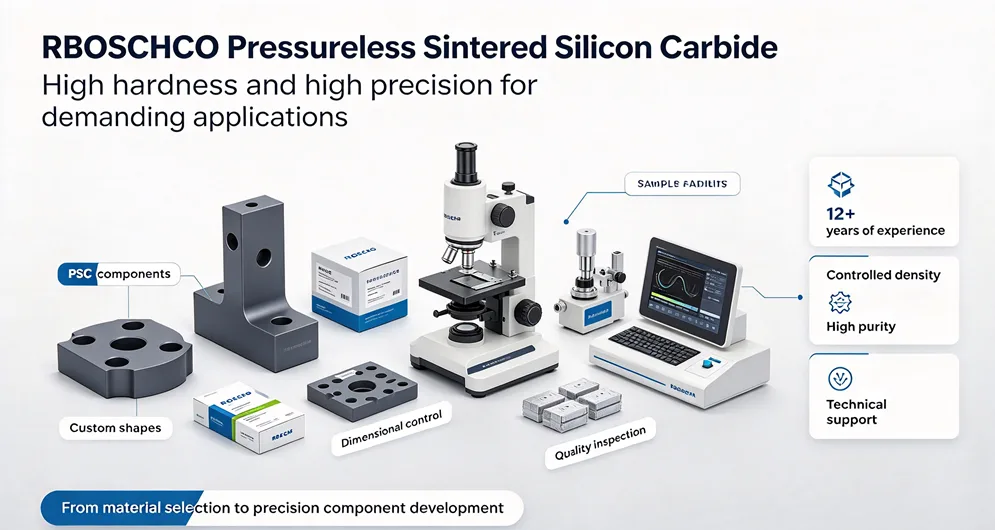
Supplier
RBOSCHCO is a trusted global chemical material supplier and manufacturer with over 12 years of experience in providing high-quality chemicals and nanomaterials, including boride powder, nitride powder, graphite powder, sulfide powder, and 3D printing powder. The company has a professional technical department and quality supervision department, a well-equipped laboratory with advanced testing equipment, and a dedicated after-sales customer service center. RBOSCHCO supplies Pressureless Sintered Silicon Carbide (PSC) worldwide, suitable for semiconductor equipment, high-temperature furnace components, mechanical seals, chemical processing, and wear-resistant applications. The company offers comprehensive technical support, from product selection to application guidance. If you are looking for high-quality Pressureless Sintered Silicon Carbide (PSC) for precision ceramic components, please feel free to contact us.
RELATED POSTS
Silicon Carbon TRGT-2000: The Advanced Material Solution for High-Performance Semiconductor and Industrial Applications

α Phase Silicon Carbide and β Phase Silicon Carbide: From Crystal Framework to Efficiency Distinctions
Changing Industries: The Rising Demand for SIC Grit in a Shifting Global Market
Nanoultrafine Molybdenum Disulfide MoS2 for Enhanced Lubrication and Antiwear Applications
Silicon Nitride: Powder and Ceramic – Characteristics and Industrial Applications