Professional and high-quality metal alloys, ceramic products and concrete additives | RBOSCHCO

12Supplier
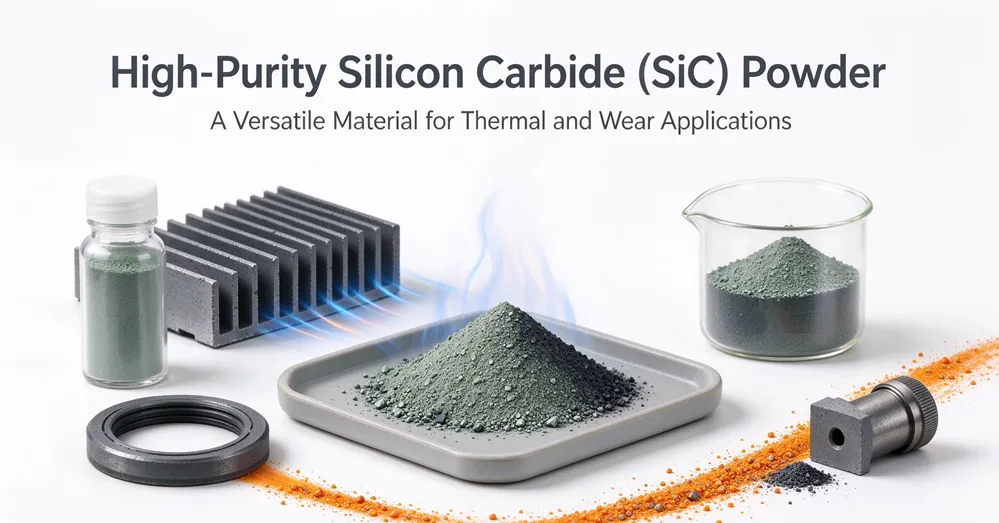
1. Introduction to High-Purity Silicon Carbide Powder
1.1 What Is Silicon Carbide (SiC) Powder?
Silicon Carbide (SiC) Powder is a high-performance synthetic ceramic material composed of silicon and carbon atoms bonded in a strong covalent crystal lattice. Among advanced ceramics, it stands out for its unique combination of extreme hardness, excellent thermal conductivity, and outstanding chemical stability .
High-purity Silicon Carbide (SiC) Powder is engineered to minimize impurities that could compromise its thermal or mechanical performance. This makes it indispensable in demanding applications ranging from thermal management in electronics to wear-resistant components in heavy industry .
1.2 Why Versatility Matters in Advanced Materials
Few materials can excel at both conducting heat away from sensitive electronics and resisting severe mechanical abrasion. Traditional metals are conductive but heavy and prone to wear. Standard ceramics are hard but often electrically insulating and thermally sluggish.
Silicon Carbide (SiC) Powder bridges this gap. Its covalent bonding gives it exceptional hardness (Mohs 9+), while its crystal structure allows for efficient phonon transport, resulting in high thermal conductivity. This dual functionality makes it a highly versatile material for engineers designing next-generation products .
1.3 Why High-Purity Silicon Carbide (SiC) Powder Stands Out
The emphasis on “high purity” is critical. Impurities like iron, aluminum, or free silicon can act as scattering centers for phonons, reducing thermal conductivity. They can also create weak grain boundaries that reduce mechanical strength. High-purity Silicon Carbide (SiC) Powder ensures predictable and maximized performance in both thermal and wear applications .
2. Understanding the Basics of Silicon Carbide Powder
2.1 Chemical Composition and Crystal Structure
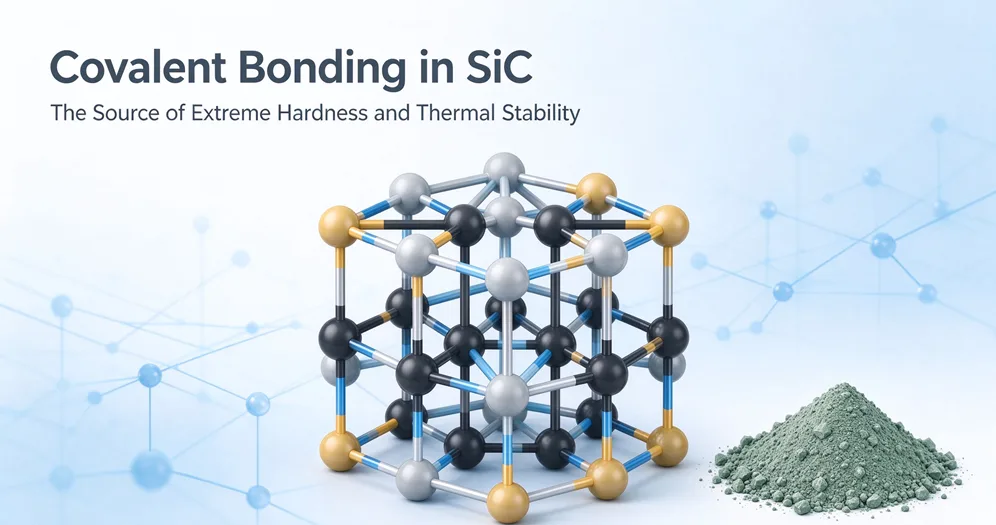
Silicon Carbide (SiC) Powder has the chemical formula SiC. It crystallizes in various polytypes (such as α-SiC and β-SiC), depending on the synthesis temperature and conditions. The strong Si-C covalent bond is responsible for its high melting point, exceptional hardness, and resistance to chemical attack.
2.2 Key Properties of Silicon Carbide (SiC) Powder
Silicon Carbide (SiC) Powder offers a combination of properties that make it suitable for dual thermal and wear applications.
- High Thermal Conductivity: Efficiently dissipates heat, making it ideal for thermal management and electronic packaging.
- Extreme Hardness and Wear Resistance: Mohs hardness of 9.2–9.5, second only to diamond and boron carbide.
- Excellent Chemical Stability: Resists oxidation, acids, and molten metals at elevated temperatures.
- High Mechanical Strength: Maintains structural integrity under heavy loads and high temperatures.
- Electrical Conductivity: Unlike insulating ceramics like alumina, SiC can be electrically conductive or semi-conductive, depending on doping.
- Low Thermal Expansion: Enhances thermal shock resistance, allowing it to withstand rapid temperature changes.
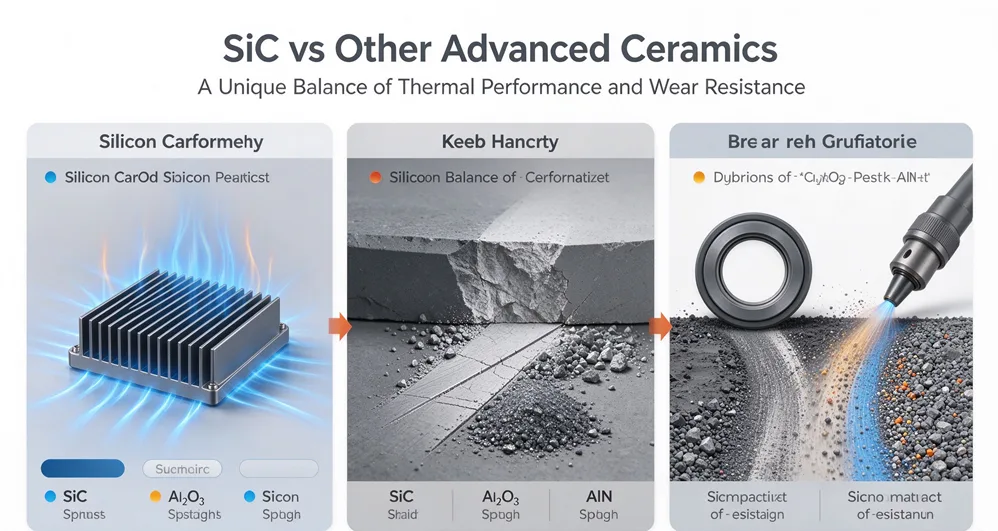
2.3 Comparison with Other Advanced Ceramics
| Property | Silicon Carbide (SiC) | Alumina (Al₂O₃) | Aluminum Nitride (AlN) |
|---|---|---|---|
| Thermal Conductivity | High | Moderate | Very High |
| Hardness (Mohs) | ~9.5 | ~9.0 | ~7-8 |
| Wear Resistance | Excellent | Good | Moderate |
| Electrical Insulation | Conductive/Semiconductive | Excellent | Excellent |
| Primary Focus | Thermal + Wear + Structural | Low-cost Insulation | High-end Insulation |
| Cost | Moderate to High | Low | High |
The comparison shows that Silicon Carbide (SiC) Powder is uniquely positioned when a combination of high thermal conductivity and extreme wear resistance is needed, especially in structural or electrically conductive environments .
3. Why Thermal Management and Wear Resistance Matter
3.1 The Heat Challenge in Modern Devices
As electronics, power modules, and electric vehicles become more compact and powerful, the heat they generate per unit area has skyrocketed. Efficient heat dissipation is critical to prevent overheating, thermal runaway, and device failure. Materials with high thermal conductivity are essential for heat sinks, thermal interface materials, and packaging substrates.
3.2 The Wear Challenge in Industry
In mining, manufacturing, pumping, and aerospace, components are subjected to severe mechanical abrasion, erosion, and high temperatures. Traditional metals wear out quickly or deform under heat, while many standard ceramics are prone to brittle failure.
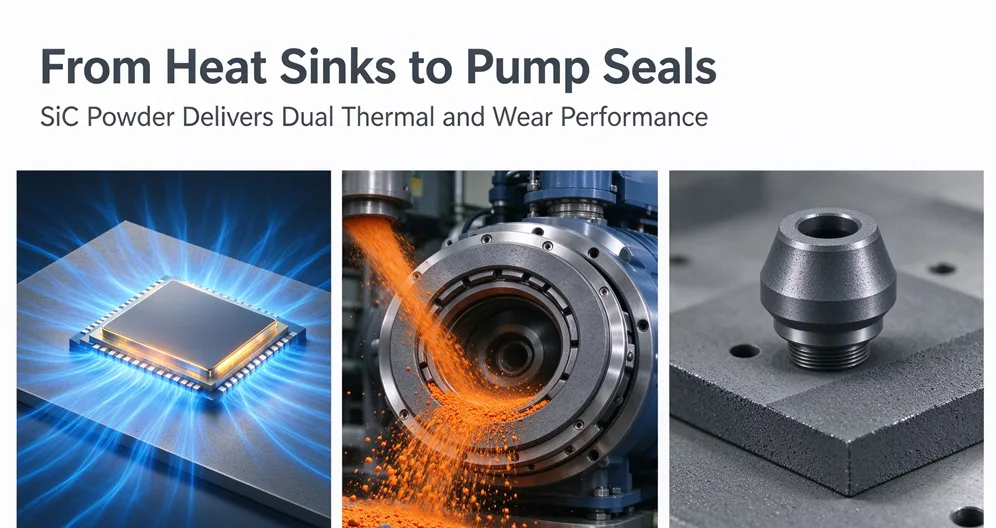
Silicon Carbide (SiC) Powder provides a solution to both challenges simultaneously. It is used to fabricate parts that not only resist extreme mechanical wear but also efficiently conduct heat away from critical systems.
4. How Silicon Carbide Powder Delivers Dual Performance
4.1 High Thermal Conductivity Through Phonon Transport
In non-metallic ceramics, heat is primarily transported by phonons (quantized lattice vibrations). The high purity and strong covalent lattice of Silicon Carbide (SiC) Powder allow phonons to travel with minimal scattering, resulting in excellent thermal conductivity. This makes SiC an ideal candidate for thermal fillers in polymer matrices and for making high-performance heat spreaders.
4.2 Extreme Wear Resistance Through High Hardness
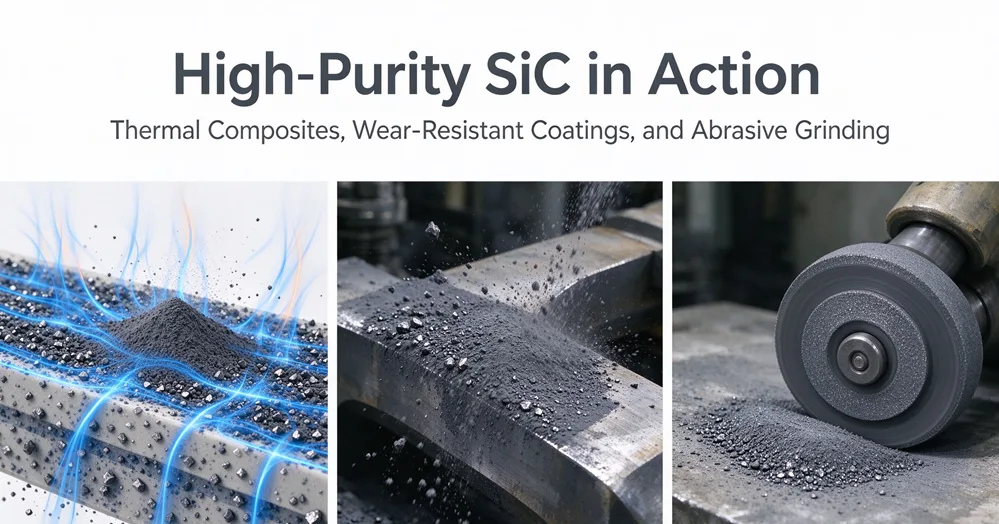
The strong Si-C bonds make Silicon Carbide (SiC) Powder incredibly hard. When used as a reinforcement in composites, as a coating material, or when sintered into solid parts, it provides a durable surface that resists scratching, grinding, and erosion. It is a standard material for sandblasting nozzles, pump seals, and mechanical faces.
4.3 Chemical Stability Under Harsh Conditions
Unlike metals, Silicon Carbide (SiC) Powder does not rust. It resists most acids and alkalis, making it suitable for chemical processing equipment and for use in harsh outdoor environments.
5. Key Technical Specifications of Silicon Carbide Powder
| Parameter | Typical Value |
|---|---|
| Chemical Formula | SiC |
| Purity | High Purity (≥ 99% available) |
| Appearance | Green to black powder |
| Mohs Hardness | 9.2 – 9.5 |
| Thermal Conductivity | High (varies by density and phase) |
| Melting Point | ~2700°C (decomposes) |
| Oxidation Resistance | Good (forms protective SiO₂ layer) |
| Acid/Alkali Resistance | Excellent |
6. Matching Silicon Carbide Powder to Your Application
6.1 Thermal Interface Materials (TIM)
High-purity Silicon Carbide (SiC) Powder can be used as a thermally conductive filler in polymers and greases. Its high thermal conductivity helps dissipate heat, while its hardness can sometimes provide mechanical reinforcement to the polymer matrix.
6.2 Wear-Resistant Coatings and Composites
Silicon Carbide (SiC) Powder is widely used to create wear-resistant coatings. It can be applied via thermal spraying or incorporated into resin matrices to create durable, abrasion-resistant surfaces for industrial equipment and pipelines.
6.3 Refractory Materials
Due to its high melting point and thermal shock resistance, Silicon Carbide (SiC) Powder is a key component in refractory bricks and castables used in blast furnaces, kilns, and incinerators.
6.4 Abrasives and Grinding
The extreme hardness of Silicon Carbide (SiC) Powder makes it a premier material for bonded abrasives, coated abrasives, and free grinding powders. It is used for grinding and polishing hard materials like cast iron, ceramics, and glass.
7. Common Misconceptions About Silicon Carbide
7.1 “SiC Is Just a Cheap Abrasive”
While Silicon Carbide (SiC) Powder is widely known for its use in sandpaper and grinding wheels, high-purity grades are highly sophisticated engineering materials. They are used in high-tech thermal management, semiconductor processing, and aerospace components.
7.2 “SiC Is Not a Good Thermal Conductor”
Actually, single-crystal SiC has a theoretical thermal conductivity even higher than copper. While practical sintered parts have lower conductivity due to grain boundaries and impurities, high-purity Silicon Carbide (SiC) Powder is an excellent conductor for ceramic materials.
7.3 “SiC Will Oxidize and Fail in Air”
While SiC does oxidize at very high temperatures in air, it forms a protective layer of silicon dioxide (SiO₂) that slows further oxidation. It is highly stable under most operating conditions and can be used in air up to approximately 1500°C.
8. Quick Evaluation Checklist
Before selecting Silicon Carbide (SiC) Powder, verify:
- Purity level required for your application
- Particle size distribution (for fillers or abrasives)
- Thermal conductivity target
- Required mechanical strength and wear resistance
- Operating environment (oxidation, chemicals, temperature)
- Compatibility with binders or matrices
- Cost and availability
9. Real-World Application Scenarios
9.1 Industrial Pump Seals
A manufacturer of slurry pumps used Silicon Carbide (SiC) Powder to fabricate mechanical seals. The SiC parts provided exceptional wear resistance against abrasive slurries and excellent heat dissipation to prevent the seals from overheating during operation.
9.2 High-Performance Heat Sinks
An electronics company utilized high-purity Silicon Carbide (SiC) Powder to manufacture advanced heat sinks for high-frequency power amplifiers. The SiC material provided the necessary thermal conductivity to draw heat away from the delicate circuitry while offering a lightweight, rigid structure.
10. Frequently Asked Questions (FAQs)
Q1: What is Silicon Carbide (SiC) Powder?
Silicon Carbide (SiC) Powder is a high-performance synthetic ceramic composed of silicon and carbon. It is known for its extreme hardness, high thermal conductivity, and excellent chemical stability.
Q2: Is Silicon Carbide Powder electrically conductive?
SiC can be electrically conductive or semi-conductive depending on its purity and crystal structure. Unlike alumina, it is not a good electrical insulator, which is important to consider for electronic applications.
Q3: What is the main application of high-purity SiC Powder?
High-purity Silicon Carbide (SiC) Powder is widely used in thermal management (as a filler or in heat sinks), as a precursor for sintered wear parts (seals, nozzles), and in high-end abrasives.
Q4: How does SiC compare to alumina for thermal management?
SiC generally has higher thermal conductivity and higher hardness than alumina. However, alumina is an excellent electrical insulator, whereas SiC is conductive/semiconductive. The choice depends on whether electrical insulation is required.
Q5: What particle sizes are available?
Silicon Carbide (SiC) Powder is available in a wide range of particle sizes, from sub-micron powders for advanced ceramics and thermal fillers to coarse grits for abrasives.
Q6: Can SiC powder be used in polymer composites?
Yes, Silicon Carbide (SiC) Powder can be incorporated into polymers to create thermally conductive and wear-resistant composites.
Q7: Is Silicon Carbide toxic?
Silicon carbide is generally considered non-toxic and safe to handle. However, as with any fine dust, inhalation should be avoided through the use of proper personal protective equipment (PPE).
Q8: How does high purity affect SiC performance?
High purity reduces impurities that can scatter phonons (reducing thermal conductivity) or weaken grain boundaries (reducing mechanical strength). Therefore, high-purity Silicon Carbide (SiC) Powder is essential for critical applications.
11. What Silicon Carbide Powder Means for Advanced Materials
Silicon Carbide (SiC) Powder is a highly versatile material that bridges the gap between thermal management and extreme wear resistance. Its unique combination of properties allows engineers to design lighter, more durable, and more efficient products across a wide range of industries.
As technology advances, the demand for materials that can perform under extreme conditions will continue to grow. High-purity Silicon Carbide (SiC) Powder is well-positioned to meet these demands, offering a reliable solution for both thermal and wear-related challenges.
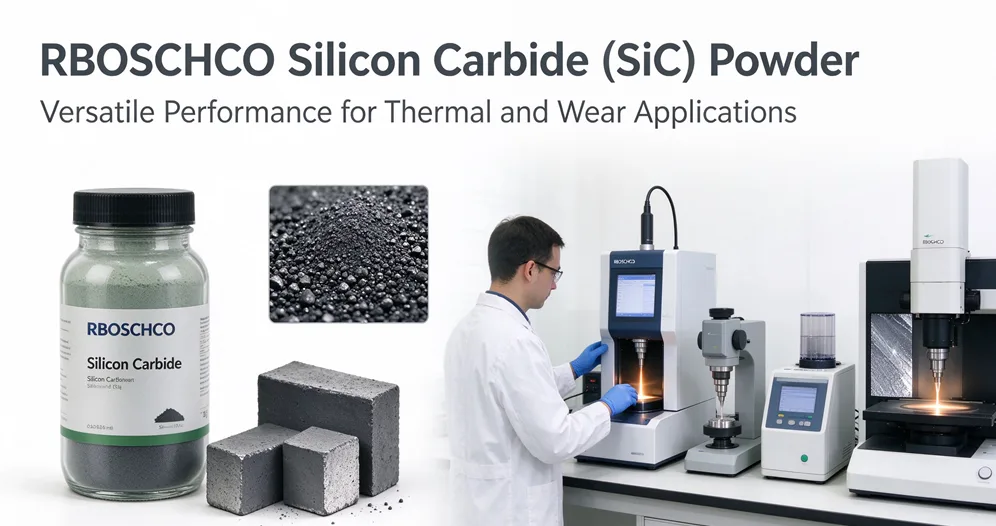
RBOSCHCO offers Silicon Carbide (SiC) Powder with high purity and consistent quality. For demanding thermal and wear applications, Silicon Carbide (SiC) Powder is a proven choice.
Supplier
RBOSCHCO is a trusted global chemical material supplier and manufacturer with over 12 years of experience in providing high-quality chemicals and nanomaterials, including boride powder, nitride powder, graphite powder, sulfide powder, and 3D printing powder. The company has a professional technical department and quality supervision department, a well-equipped laboratory with advanced testing equipment, and a dedicated after-sales customer service center. RBOSCHCO supplies Silicon Carbide (SiC) Powder worldwide, suitable for thermal management, wear-resistant components, abrasives, and refractory materials. The company offers comprehensive technical support, from product selection to application guidance. If you are looking for high-quality Silicon Carbide (SiC) Powder for your applications, please feel free to contact us.
RELATED POSTS

Adjustable Temperature Soldering Iron Heater: The Ultimate Guide to Precision, Efficiency, and Durability
Microstructure and Electrical Conductivity of Titanium Carbide Aluminum Powder
Summary of Uses of Industrial General Zinc Stearate Powder and Answers to Common Application Questions
Silicon Carbide: The Advanced Material Powering the Future of Electric Vehicles and High-Performance Electronics
Recrystallised Silicon Carbide: The Ultimate Choose in High-Temperature Industrial
