Professional and high-quality metal alloys, ceramic products and concrete additives | RBOSCHCO

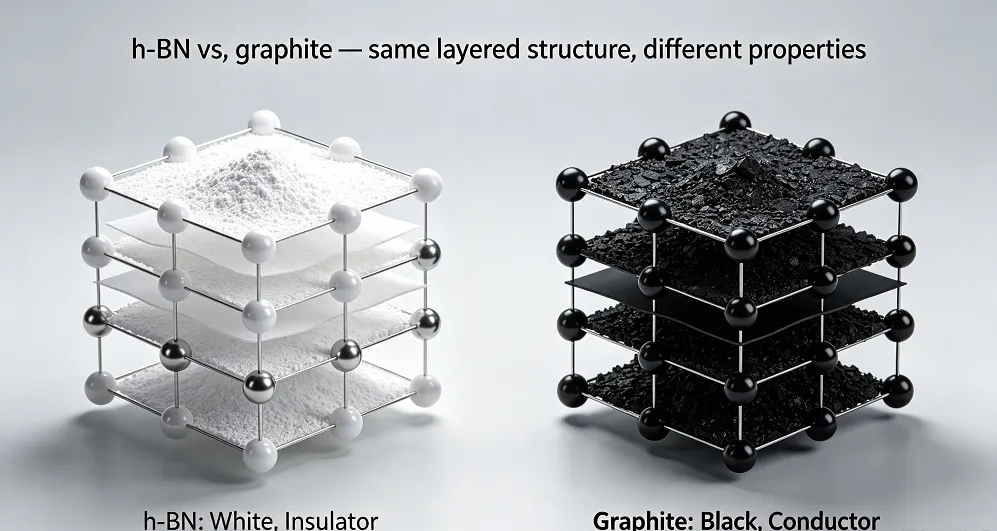
Boron nitride (BN) is a material that sounds simple but behaves in fascinating ways. One of its most common forms—hexagonal boron nitride (h-BN)—has a structure that is almost identical to graphite. The atoms are arranged in hexagonal layers, stacked loosely on top of each other. But here’s the twist: graphite conducts electricity, while h-BN is an excellent electrical insulator. Graphite is black; h-BN is white. Same structure, completely different behavior.
This combination of graphite-like layering with electrical insulation and high thermal conductivity is what makes h-BN so valuable in advanced applications. It’s used in everything from battery thermal management to high-temperature lubricants. But why does h-BN have this structure, and why does it matter?
The Graphite-Like Structure of h-BN
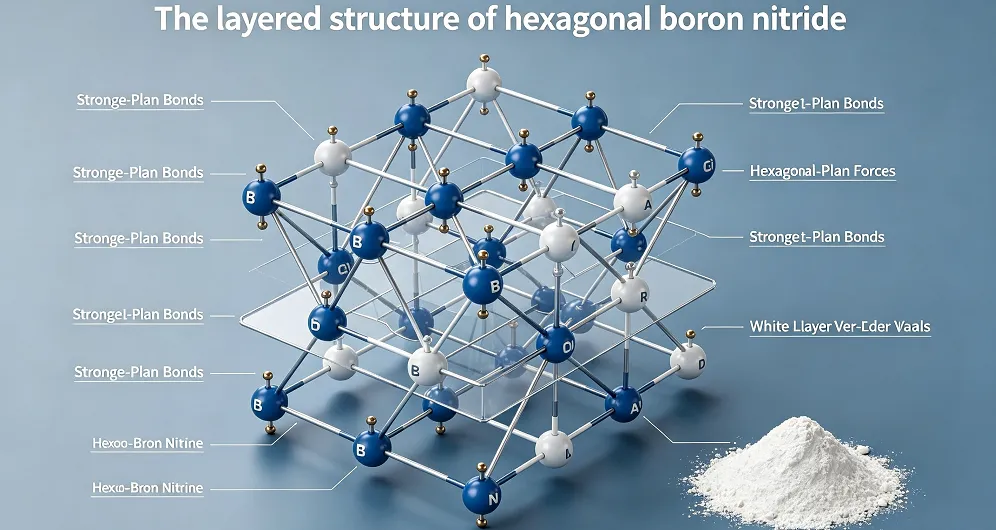
The structure of h-BN is remarkably similar to graphite, but the atoms involved are different. In graphite, the hexagonal rings are made of carbon atoms. In h-BN, the rings consist of alternating boron and nitrogen atoms. Both materials have the same layered morphology: strong bonds within the layers and weak van der Waals forces between them.
This weak interlayer bonding is what makes h-BN lubricious. The layers slide past each other with minimal resistance, making h-BN an effective solid lubricant, especially in environments where oil-based lubricants would break down or evaporate.
The boron-nitrogen bonds in h-BN are polar—electrons are not shared equally between the two atoms. This polarity affects how h-BN interacts with other substances, giving it different surface chemistry compared to graphite. It also contributes to h-BN’s chemical stability and resistance to oxidation.
One of the most interesting aspects of h-BN’s structure is that it can be exfoliated into atomically thin nanosheets—similar to how graphene is produced from graphite. These nanosheets retain the properties of bulk h-BN but have much higher surface area, making them useful for applications like composite reinforcement and separator coatings.
Why h-BN Is an Electrical Insulator
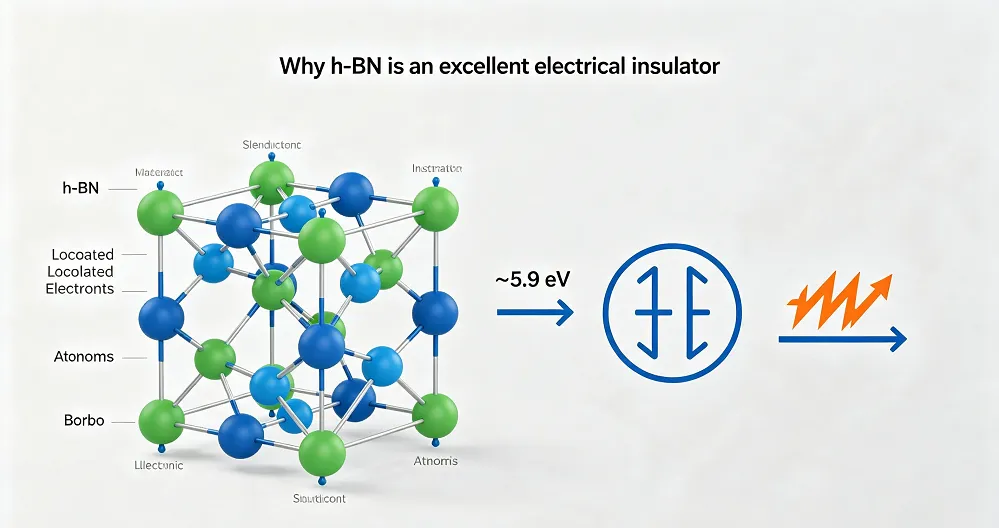
In graphite, the carbon atoms each contribute one electron to a delocalized π-electron cloud that extends across the entire layer. These electrons can move freely, which is why graphite is a good electrical conductor.
In h-BN, the situation is different. The boron and nitrogen atoms hold onto their electrons more tightly. The π-electrons are not as free to move, and the material has a wide band gap of approximately 5.9 eV. This wide band gap prevents electrons from moving freely through the structure, making h-BN an excellent electrical insulator.
This property is critical for applications where electrical isolation is required. In battery thermal management, for example, you need to conduct heat away from the cells without creating electrical pathways that could cause short circuits. h-BN provides exactly this combination of properties.
In electronic packaging, h-BN can be used as a substrate or filler material that provides both thermal management and electrical isolation for sensitive components.
Why h-BN Conducts Heat So Well
Thermal conductivity in ceramics is primarily carried by phonons—lattice vibrations that transfer energy through the material. In h-BN, the strong in-plane bonds allow phonons to travel efficiently without scattering.
The in-plane thermal conductivity of h-BN is among the highest of any ceramic material. When the material is oriented correctly, it can approach the thermal conductivity of metals, while still maintaining electrical insulation.
This combination of high thermal conductivity and electrical insulation is rare. Most materials that conduct heat well also conduct electricity—metals are prime examples. Materials that are electrically insulating typically have low thermal conductivity. h-BN is an exception: it can move heat efficiently while blocking electrical current.
This makes h-BN valuable in applications like thermal interface materials for power electronics, where you need to transfer heat from a semiconductor to a heat sink without creating an electrical connection.
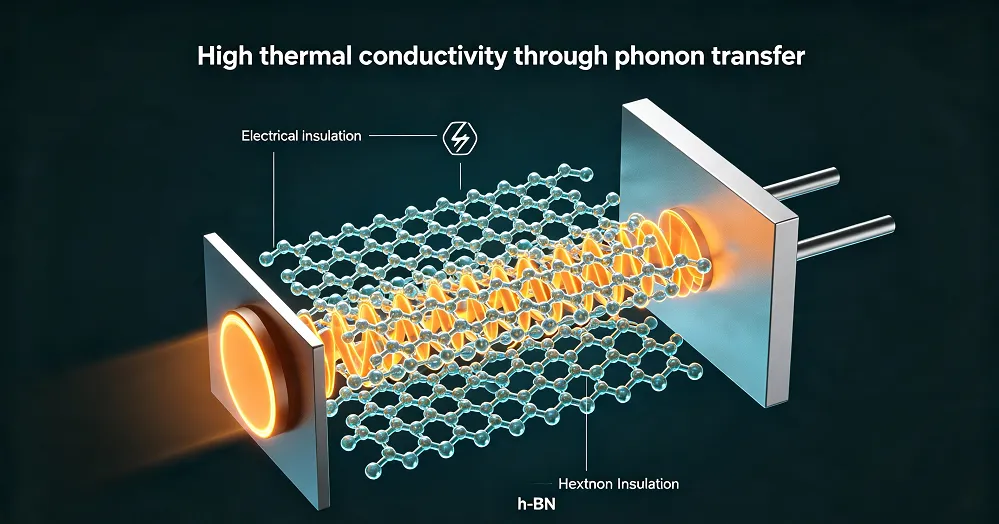
Graphite-Like Structure at the Nanoscale
Nanoscale h-BN (nano-h-BN) is produced through various methods, including liquid-phase exfoliation, mechanical exfoliation, and chemical vapor deposition. At the nanoscale, the graphite-like layered structure is preserved, but the material properties can be tuned by controlling particle size and thickness.
Nano-h-BN can be used as a coating material for battery separators, where the nanoscale sheets form a dense protective layer that improves thermal stability and mechanical strength. The high surface area of nano-h-BN makes it more effective as an additive in thermal interface materials and composites.
The nanoscale form of h-BN also has applications in electrode formulations, where it can improve structural stability and provide fast ion transport channels. The combination of nanoscale morphology with the intrinsic properties of h-BN—electrical insulation, thermal conductivity, and chemical stability—makes nano-h-BN a versatile additive for advanced battery systems.
Applications: Why This Structure Matters
The graphite-like structure of h-BN is not just a curiosity—it’s the foundation of its practical applications.
Battery thermal management. In high-performance battery systems, heat generation is a critical issue. h-BN sheets can be incorporated into thermal interface materials to conduct heat away from battery cells while maintaining electrical insulation. This helps prevent thermal runaway and extends battery life.
Separator coatings. Coating battery separators with h-BN improves thermal stability and mechanical strength. The layered structure of h-BN provides a dense barrier that suppresses dendrite growth and improves safety. Studies have shown that h-BN-coated separators exhibit improved puncture resistance and thermal shrinkage resistance.
Electrode additives. Adding h-BN to electrode formulations can improve structural stability by buffering volume changes during charge and discharge. In silicon anodes, for example, h-BN can form a flexible protective layer that reduces SEI film breakage and provides fast lithium-ion diffusion channels.
High-temperature lubricants. The layered structure of h-BN provides excellent lubricity at high temperatures where oil-based lubricants degrade. h-BN is used in high-temperature applications such as metal forming, aerospace components, and high-temperature bearings.
Electronic packaging. h-BN’s combination of thermal conductivity and electrical insulation makes it useful as a filler in polymer composites for electronic packaging, where it improves heat dissipation without compromising electrical isolation.
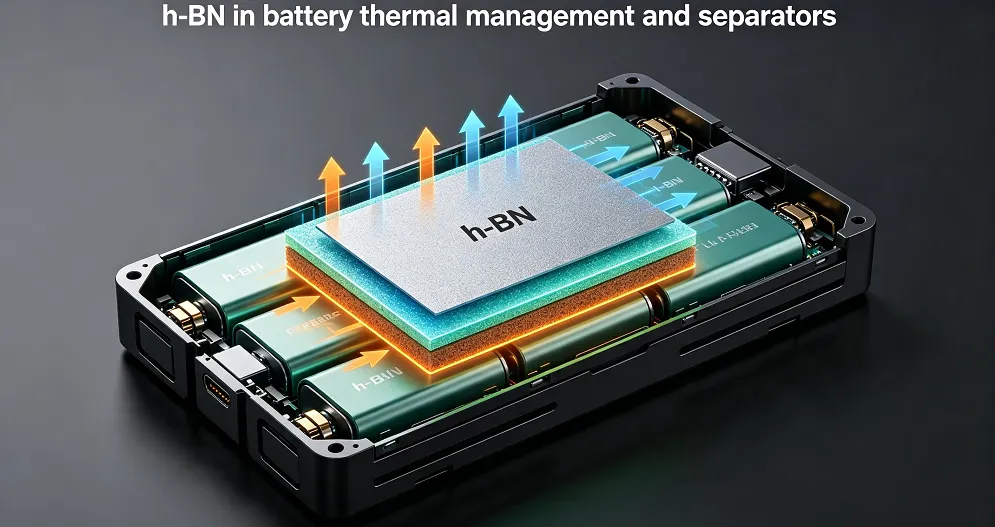
How Does h-BN Compare to Graphite?
| Structure | Layered hexagonal | Layered hexagonal |
| Color | White | Black |
| Electrical Conductivity | Insulator | Conductor |
| Thermal Conductivity | High (in-plane) | High (in-plane) |
| Lubricity | Excellent | Excellent |
| Chemical Stability | High | Moderate (oxidizes at high temperatures) |
| Band Gap | ~5.9 eV | ~0 eV (semimetal) |
| Key Applications | Thermal management, electrical insulation, high-temperature lubrication | Electrodes, lubricants, battery anodes |
The most striking difference between h-BN and graphite is their electrical behavior. Graphite is a semimetal—it conducts electricity—while h-BN is an insulator. This difference arises from the electronic structures of the two materials. In graphite, the π-electrons are delocalized, allowing electrical conduction. In h-BN, the polar boron-nitrogen bonds localize electrons, preventing conduction.
The color difference—white for h-BN, black for graphite—is a visual reflection of this electronic difference. Materials with band gaps in the UV range appear white or colorless, while materials with no band gap appear dark or metallic.
Supplier
RBOSCHCO is a globally recognized chemical material supplier and manufacturer with over 12 years of expertise in providing super high-quality chemicals and nanomaterials. The company has a professional technical department and quality supervision department, a well-equipped laboratory with advanced testing equipment, and a dedicated after-sales customer service center. RBOSCHCO supplies high-quality nano hexagonal boron nitride (h-BN) and other advanced materials for thermal management, electrical insulation, and high-temperature applications. The company serves clients across more than 50 countries and offers comprehensive technical support, from material selection to application guidance. If you are looking for high-quality nano h-BN powder, please feel free to contact us.
RELATED POSTS

Why Is High-Purity Antimony-Doped Tin Oxide (ATO) So Popular?

How Superplasticizer Makes Concrete Stronger and More Durable
Ceramic Plates: Features, Applications, Price, and Supplier Information
Tungsten SilicidePowder: A High-Performance Conductive Porcelain Product for Advanced Electronic Devices and High-Temperature Applications

Global Surge in Chromium Oxide Demand Driven by Green Industrial Transition and Regulatory Shifts