Professional and high-quality metal alloys, ceramic products and concrete additives | RBOSCHCO

12Supplier
1. Introduction to Hexagonal Boron Nitride Powder
1.1 What Is Hexagonal Boron Nitride (h-BN) Powder?
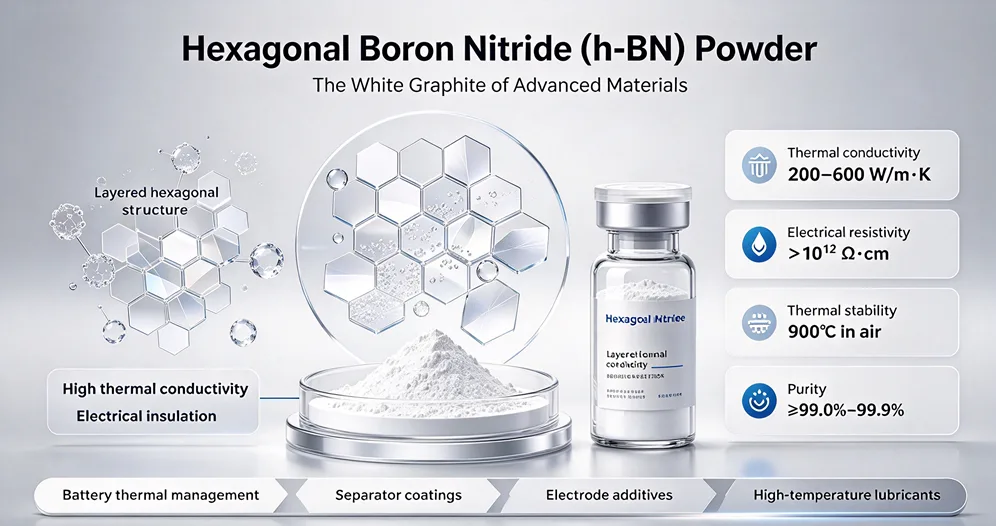
Hexagonal Boron Nitride (h-BN) Powder is a multifunctional advanced material featuring a two-dimensional layered structure analogous to graphite, combined with exceptional thermal conductivity and electrical insulation properties. This unique combination makes it an ideal candidate for thermal management and electrochemical optimization in battery systems.
With high thermal stability, chemical inertness, and excellent lubricity, Hexagonal Boron Nitride (h-BN) Powder serves as a versatile additive across multiple applications — including thermal interface materials, separator coatings, electrode formulations, and electrolytes — significantly enhancing safety, performance, and cycle life of next-generation energy storage devices.
1.2 Why “White Graphite”?
Hexagonal Boron Nitride (h-BN) Powder is often called “white graphite” because its crystal structure is almost identical to that of graphite, but its color is white instead of black. Both materials have a layered hexagonal structure with strong in-plane covalent bonds and weak van der Waals forces between layers. This structure gives both materials excellent lubricity, high thermal conductivity, and chemical inertness.
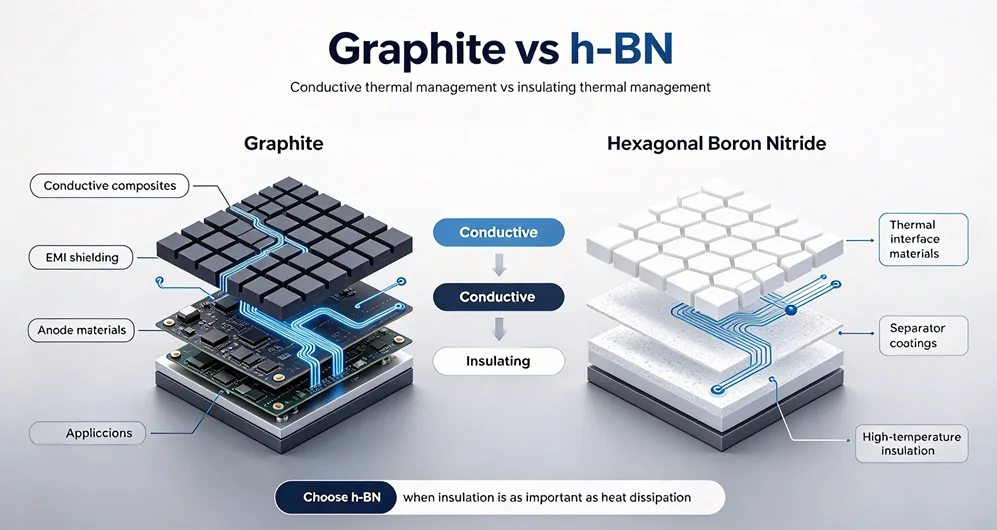
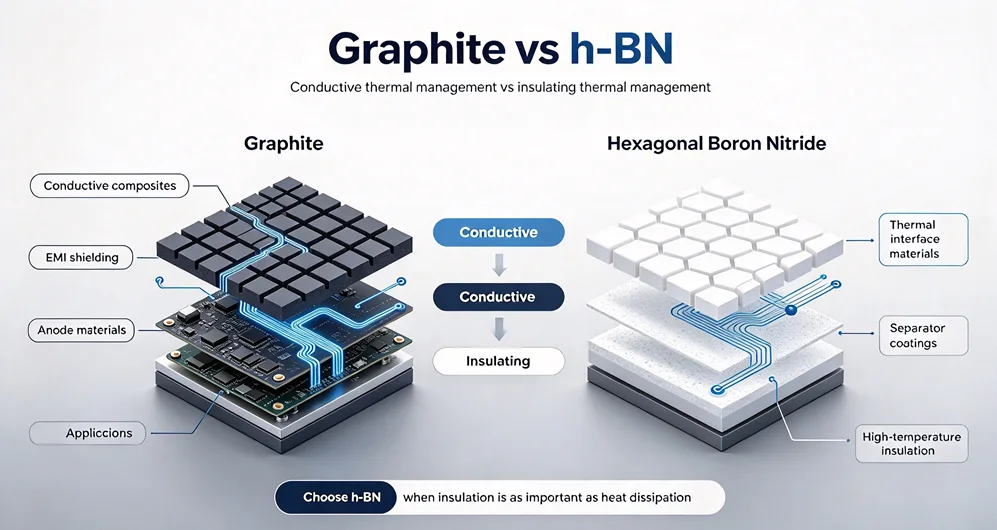
However, there is a critical difference: graphite is electrically conductive, while Hexagonal Boron Nitride (h-BN) Powder is electrically insulating. This makes h-BN valuable for applications where thermal conductivity is needed but electrical conductivity must be avoided — such as in battery thermal management, electronic packaging, and high-temperature insulation.
1.3 Why Hexagonal Boron Nitride (h-BN) Powder Matters
The demand for materials that can simultaneously conduct heat and insulate electricity continues to grow. Industries such as electric vehicles, consumer electronics, and renewable energy storage require materials that can manage heat without creating electrical hazards.
Hexagonal Boron Nitride (h-BN) Powder addresses this need with a combination of properties that few other materials can match. Its in-plane thermal conductivity can reach 200–600 W/m·K, while its electrical resistivity remains above 10¹² Ω·cm. This makes it suitable for thermal interface materials, separator coatings, and insulating composite layers in high-energy-density batteries.
2. Understanding the Basics of Hexagonal Boron Nitride
2.1 Crystal Structure and Morphology
Hexagonal Boron Nitride (h-BN) Powder has a layered crystal structure similar to graphite. Within each layer, boron and nitrogen atoms are bonded by strong covalent bonds in a hexagonal arrangement. Between layers, the atoms are held together by weak van der Waals forces.
This structure gives Hexagonal Boron Nitride (h-BN) Powder its unique combination of properties: high in-plane thermal conductivity, low friction coefficient, and excellent chemical inertness. The layered structure also allows h-BN to be exfoliated into nanosheets, which have even higher surface area and can be used in advanced composite applications.
2.2 Key Properties of Hexagonal Boron Nitride (h-BN) Powder
Hexagonal Boron Nitride (h-BN) Powder offers a combination of properties that make it suitable for demanding applications.
- High thermal conductivity and strong electrical insulation: In-plane thermal conductivity of 200–600 W/m·K, with electrical resistivity above 10¹²–10¹⁴ Ω·cm.
- Superior thermal and chemical stability: Maintains structural integrity at temperatures above 900°C in air and up to approximately 2800°C under inert environments.
- Two-dimensional layered structure and excellent lubricity: Low friction coefficient of approximately 0.10–0.20.
- High purity with strict impurity control: ≥99.0%–99.9% BN content, with controlled B₂O₃ content below 0.5%.
- Excellent dispersion performance and interface compatibility: Controlled particle sizes from 50 nm to 500 nm.
- Enhanced battery safety and cycle performance: Helps reduce thermal gradients and suppress temperature accumulation.
2.3 Comparison with Other Thermal Management Materials
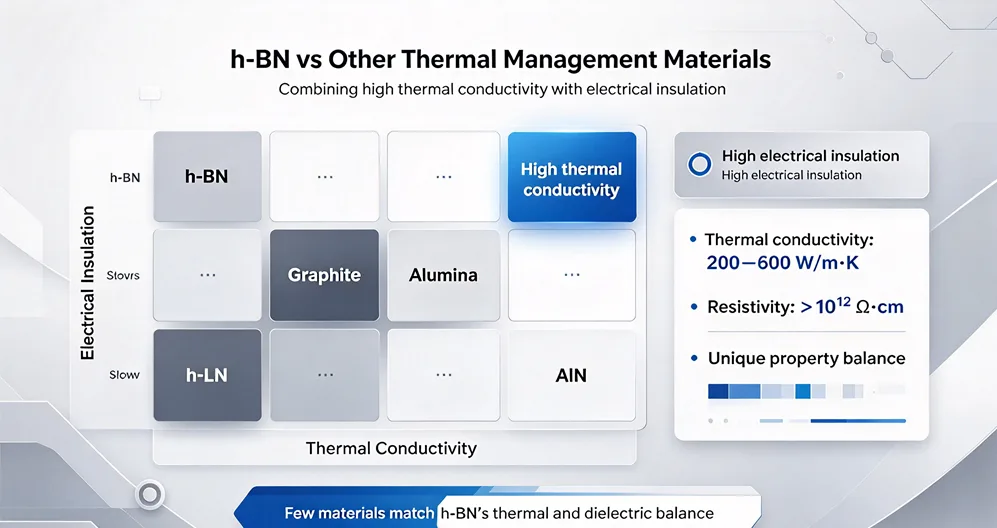
| Property | Hexagonal Boron Nitride (h-BN) | Graphite | Alumina (Al₂O₃) | Aluminum Nitride (AlN) |
|---|---|---|---|---|
| Thermal Conductivity (W/m·K) | 200–600 (in-plane) | 100–500 | 20–35 | 140–220 |
| Electrical Resistivity (Ω·cm) | >10¹² | Conductive | >10¹⁴ | >10¹² |
| Density (g/cm³) | 2.1–2.3 | 2.2 | 3.9 | 3.3 |
| Maximum Use Temperature (°C) | 900 (air) / 2800 (inert) | 400–600 (air) | 1700 | 1400–1500 |
| Chemical Inertness | Excellent | Good | Excellent | Good |
| Lubricity | Excellent | Excellent | Poor | Poor |
The comparison shows that Hexagonal Boron Nitride (h-BN) Powder offers a unique combination of thermal conductivity, electrical insulation, and lubricity that few other materials can match.
3. Why Hexagonal Boron Nitride Is Called “White Graphite”
3.1 Structural Similarity to Graphite
The crystal structure of Hexagonal Boron Nitride (h-BN) Powder is almost identical to that of graphite. Both materials have a layered hexagonal structure with strong in-plane covalent bonds and weak van der Waals forces between layers. This structure gives both materials their lubricity, thermal conductivity, and chemical inertness.
3.2 The Critical Difference: Electrical Properties
Despite their structural similarity, graphite and Hexagonal Boron Nitride (h-BN) Powder have fundamentally different electrical properties. Graphite is a semimetal with high electrical conductivity. h-BN is a wide-bandgap insulator with electrical resistivity above 10¹² Ω·cm.
This difference arises from the electronic structure of the two materials. In graphite, each carbon atom has one free electron that can move freely through the layers, enabling electrical conduction. In h-BN, the boron and nitrogen atoms are arranged such that all electrons are involved in covalent bonding, leaving no free electrons for conduction.
3.3 Why the “White” Matters
The color difference between graphite (black) and Hexagonal Boron Nitride (h-BN) Powder (white) is a visible reminder of their different electronic structures. The black color of graphite comes from its ability to absorb light across a broad spectrum, which is related to its electrical conductivity. The white color of h-BN reflects its wide bandgap and insulating nature.
For applications where appearance matters — such as thermal interface materials, coatings, and consumer electronics — the white color of Hexagonal Boron Nitride (h-BN) Powder is an advantage. It allows formulators to create white or light-colored products without the dark tint that graphite would impart.
4. How Hexagonal Boron Nitride Compares to Graphite
4.1 Thermal Conductivity
Both graphite and Hexagonal Boron Nitride (h-BN) Powder have high in-plane thermal conductivity. Graphite’s thermal conductivity ranges from 100 to 500 W/m·K, while h-BN’s ranges from 200 to 600 W/m·K. The actual values depend on purity, crystal perfection, and orientation.
4.2 Electrical Insulation
The most significant difference between graphite and Hexagonal Boron Nitride (h-BN) Powder is electrical conductivity. Graphite is electrically conductive, while h-BN is insulating. This makes h-BN the material of choice for applications where electrical insulation is required.
4.3 Lubricity
Both materials have excellent lubricity due to their layered structure. Graphite is widely used as a solid lubricant, and Hexagonal Boron Nitride (h-BN) Powder is also used as a lubricant, particularly in high-temperature applications where graphite would oxidize.
4.4 Chemical Stability
Hexagonal Boron Nitride (h-BN) Powder has better chemical stability than graphite. Graphite can be oxidized at temperatures above 400–600°C in air, while h-BN maintains its stability up to 900°C in air and approximately 2800°C in inert atmospheres.
4.5 Applications Where Each Excels
Graphite is preferred for applications where electrical conductivity is acceptable or desired, such as conductive thermal composites, electromagnetic shielding, and battery anodes. Hexagonal Boron Nitride (h-BN) Powder is preferred for applications where electrical insulation is required, such as thermal interface materials, separator coatings, and high-temperature insulation.
5. Key Technical Specifications of Hexagonal Boron Nitride Powder
| Parameter | Specification / Value |
|---|---|
| Main Content (h-BN) | ≥ 99.0% – 99.5% |
| Particle Size Distribution (D50) | 1 μm – 10 μm (nano-sheet customizable) |
| Boric Oxide (B₂O₃) | ≤ 0.3% – 0.6% |
| Carbon Content (C) | ≤ 0.05% – 0.1% |
| Moisture (H₂O) | ≤ 0.5% |
| Bulk Density | 0.2 – 0.4 g/cm³ |
| Specific Surface Area (BET) | 10 – 80 m²/g |
| Thermal Conductivity (film/composite) | 30 – 60 W/(m·K) |
| Breakdown Voltage (insulating sheet) | > 4 KV |
| Thermal Conductivity (in-plane) | 200 – 600 W/m·K |
| Electrical Resistivity | > 10¹² Ω·cm |
6. Matching Hexagonal Boron Nitride Powder to Your Application
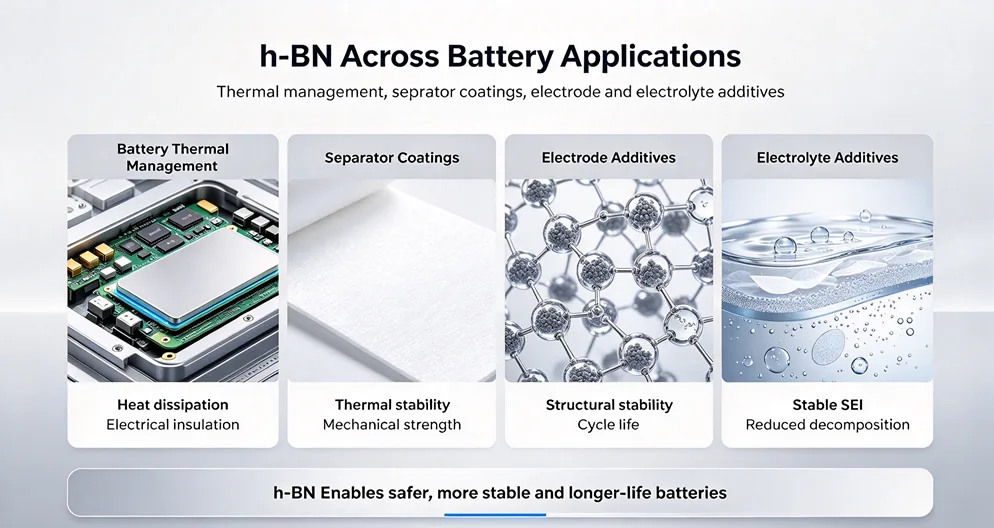
6.1 Battery Thermal Management Materials
Hexagonal Boron Nitride (h-BN) Powder is widely used as a functional filler in battery thermal management systems because of its excellent thermal conductivity and dielectric insulation properties. With thermal conductivity typically ranging from 100–600 W/m·K and electrical resistivity above 10¹² Ω·cm, h-BN can rapidly transfer heat generated during high-rate charging and discharging while preventing electrical leakage between battery components.
In thermal interface materials, Hexagonal Boron Nitride (h-BN) Powder particles are incorporated into polymer matrices such as silicone, epoxy, and polyurethane to improve heat dissipation efficiency. Depending on filler loading and orientation, the addition of 10 wt%–60 wt% h-BN can increase composite thermal conductivity by 2–10 times compared with pure polymers.
6.2 Separator Coatings for Enhanced Battery Safety
Hexagonal Boron Nitride (h-BN) Powder is an advanced ceramic coating material for lithium-ion battery separators due to its high-temperature resistance, mechanical strength, and electrolyte compatibility. By coating h-BN nanosheets onto polyolefin separators, glass fiber membranes, or ceramic separators, a protective inorganic layer is formed to improve separator stability under extreme operating conditions.
The h-BN coating layer typically has a thickness of approximately 1–20 μm, providing effective thermal protection without significantly increasing separator resistance. Due to its high melting point of approximately 3000°C and excellent oxidation resistance, h-BN can improve separator thermal stability and reduce shrinkage at elevated temperatures.
6.3 Electrode Material Additives
Hexagonal Boron Nitride (h-BN) Powder functions as a multifunctional additive in both cathode and anode materials, improving structural stability, thermal regulation, and long-term cycling performance.
In cathode systems such as LiFePO₄ (LFP), NCM, and lithium-rich materials, h-BN fills microscopic gaps between active particles and forms a stable inorganic reinforcement network. Typically added at 0.5 wt%–10 wt%, h-BN can improve electrode integrity, reduce particle cracking, and enhance capacity retention during repeated charge-discharge cycles.
For silicon-based anodes, Hexagonal Boron Nitride (h-BN) Powder provides a flexible protective framework to address the severe volume expansion of silicon materials, which can reach 300%–400% during lithiation and delithiation processes.
6.4 Electrolyte Functional Additives
Hexagonal Boron Nitride (h-BN) Powder can also be introduced into liquid electrolytes, polymer electrolytes, and solid-state electrolyte systems as a functional additive. Due to its chemically stable surface and nanoscale interface effect, h-BN can regulate ion distribution, improve electrolyte stability, and enhance electrode-electrolyte interactions.
When added at concentrations of approximately 0.1 wt%–5 wt%, Hexagonal Boron Nitride (h-BN) Powder particles can promote the formation of more stable interfacial layers on electrode surfaces, reducing electrolyte decomposition and improving cycling efficiency.
6.5 Advanced Composite Materials
Hexagonal Boron Nitride (h-BN) Powder can be integrated into polymer composites, ceramic composites, and hybrid materials to develop high-performance components with customized thermal and mechanical properties. Through surface modification and particle size optimization, h-BN can achieve improved dispersion in composite systems while maintaining excellent thermal conductivity and electrical insulation.
7. Common Misconceptions About Hexagonal Boron Nitride
7.1 “h-BN Is Just White Graphite”
While Hexagonal Boron Nitride (h-BN) Powder has a similar crystal structure to graphite, it is not simply “white graphite.” The two materials have fundamentally different electrical properties, chemical stabilities, and application ranges. h-BN is an electrical insulator, while graphite is a conductor.
7.2 “h-BN Is Only for High-Temperature Applications”
While Hexagonal Boron Nitride (h-BN) Powder has excellent high-temperature stability, it is also used in many room-temperature applications, including thermal interface materials, lubricants, and cosmetic products.
7.3 “h-BN Is Too Expensive for Most Applications”
While Hexagonal Boron Nitride (h-BN) Powder is more expensive than some conventional fillers, its unique combination of thermal conductivity and electrical insulation can justify the cost in demanding applications. The cost should be evaluated against the total cost of ownership, including performance, reliability, and service life.
7.4 “h-BN Is Difficult to Disperse”
Hexagonal Boron Nitride (h-BN) Powder can be difficult to disperse because of its layered structure and low surface energy. However, surface modification technologies can improve compatibility with polymer matrices and reduce agglomeration.
7.5 “h-BN Is Only for Battery Applications”
While Hexagonal Boron Nitride (h-BN) Powder is widely used in battery applications, it is also used in thermal interface materials, high-temperature lubricants, cosmetic products, and advanced composites. Its versatility is one of its key advantages.
8. Quick Evaluation Checklist
Before selecting Hexagonal Boron Nitride (h-BN) Powder for your application, verify the following key parameters:
- Thermal conductivity requirements
- Electrical insulation requirements
- Maximum operating temperature
- Chemical compatibility with the matrix
- Particle size and distribution
- Purity level (BN content, B₂O₃, carbon)
- Specific surface area
- Dispersion method and equipment
- Surface treatment requirements
- Supplier quality and technical support
9. Real-World Application Scenarios
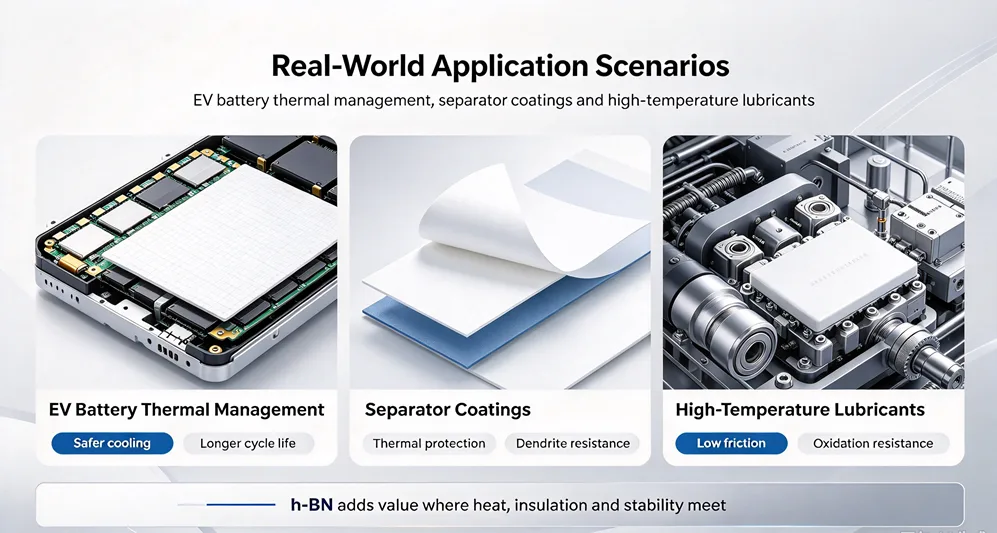
9.1 Battery Thermal Management for Electric Vehicles
An electric vehicle battery manufacturer used Hexagonal Boron Nitride (h-BN) Powder in thermal interface materials for battery modules. The h-BN filler provided high thermal conductivity for efficient heat dissipation, while its electrical insulation prevented short circuits between battery cells. The result was improved battery safety and longer cycle life.
9.2 Separator Coatings for Lithium-Ion Batteries
A battery separator manufacturer used Hexagonal Boron Nitride (h-BN) Powder as a coating material for polyolefin separators. The h-BN coating improved the thermal stability of the separator, reducing shrinkage at elevated temperatures and reducing the risk of internal short circuits. The coating also improved electrolyte wettability and mechanical strength.
9.3 High-Temperature Lubricants
A manufacturer of high-temperature lubricants used Hexagonal Boron Nitride (h-BN) Powder as a solid lubricant additive. The h-BN provided excellent lubricity at temperatures where conventional lubricants would degrade. The result was reduced friction and wear in high-temperature industrial applications.
10. Frequently Asked Questions (FAQs)
Q1: What makes nano-h-BN suitable for battery thermal management applications?
Hexagonal Boron Nitride (h-BN) Powder combines high thermal conductivity (100–600 W/m·K), excellent electrical insulation (>10¹²–10¹⁴ Ω·cm), and outstanding thermal stability in a single material. This makes it ideal for thermal interface materials, insulating films, battery module cooling layers, and encapsulation composites where both heat dissipation and electrical safety are required.
Q2: How does nano-h-BN improve battery separator performance?
When applied as a separator coating material, Hexagonal Boron Nitride (h-BN) Powder forms a uniform inorganic protective layer on traditional polyolefin separators. This coating improves separator performance by enhancing thermal stability, mechanical strength, electrolyte compatibility, and resistance against dendrite penetration. The thermal stability of conventional polymer separators is limited at elevated temperatures, where shrinkage may lead to direct contact between electrodes and cause internal short circuits.
Q3: What are the critical quality parameters for battery-grade nano-h-BN?
High-quality battery-grade Hexagonal Boron Nitride (h-BN) Powder typically requires a BN purity level of ≥99.0%–99.9% to minimize unwanted reactions with electrolytes and electrode materials. Impurity control is one of the most important quality factors. B₂O₃ content is generally controlled below 0.5%, because excessive oxide impurities may increase interfacial reactions and reduce chemical stability.
Q4: Can nano-h-BN be used in silicon-based anode materials?
Yes. Hexagonal Boron Nitride (h-BN) Powder is increasingly studied as a functional additive or protective component for silicon-based anode systems due to its excellent mechanical stability, chemical inertness, and layered structure. Silicon anodes can theoretically provide extremely high capacity, but their practical application is limited by severe volume expansion of approximately 300%–400% during lithium insertion and extraction.
Q5: What customization options are available for nano-h-BN products?
Hexagonal Boron Nitride (h-BN) Powder can be customized according to different battery manufacturing requirements, including particle size distribution, purity level, surface treatment, thermal performance, and packaging conditions. Typical customization parameters include BN purity from 99.0% to 99.9%, particle sizes ranging from 50 nm to 5 μm, specific surface areas of 5–50 m²/g, and controlled morphology such as nanosheets, flakes, or spherical particles.
Q6: Is h-BN safe to handle?
Hexagonal Boron Nitride (h-BN) Powder is generally considered safe to handle, but like all fine powders, it should be handled with appropriate personal protective equipment (gloves, mask, goggles) to avoid inhalation and skin contact. Good industrial hygiene practices should be followed.
Q7: How should h-BN powder be stored?
Hexagonal Boron Nitride (h-BN) Powder should be stored in a cool, dry, well-ventilated area with relative humidity below 60%. Due to its hygroscopic nature, reseal immediately after use to prevent moisture absorption and particle agglomeration. For long-term storage, desiccants or dry cabinets are recommended.
Q8: What is the shelf life of h-BN powder?
The shelf life of Hexagonal Boron Nitride (h-BN) Powder is 24 months from date of manufacture under recommended storage conditions. After the shelf life expires, key indicators including particle size distribution, BET surface area, moisture content, and soluble boron content must be re-evaluated before use.
11. What Hexagonal Boron Nitride Powder Means for Advanced Materials
Hexagonal Boron Nitride (h-BN) Powder represents a unique combination of properties that few other materials can match. Its structural similarity to graphite, combined with its electrical insulation and superior thermal stability, makes it the “white graphite” of advanced materials.
For battery manufacturers, Hexagonal Boron Nitride (h-BN) Powder offers a way to improve thermal management and safety without introducing electrical conductivity. For composite manufacturers, it provides a high-performance filler that improves thermal conductivity while maintaining electrical insulation. For high-temperature applications, it offers lubricity and chemical inertness where graphite would oxidize.
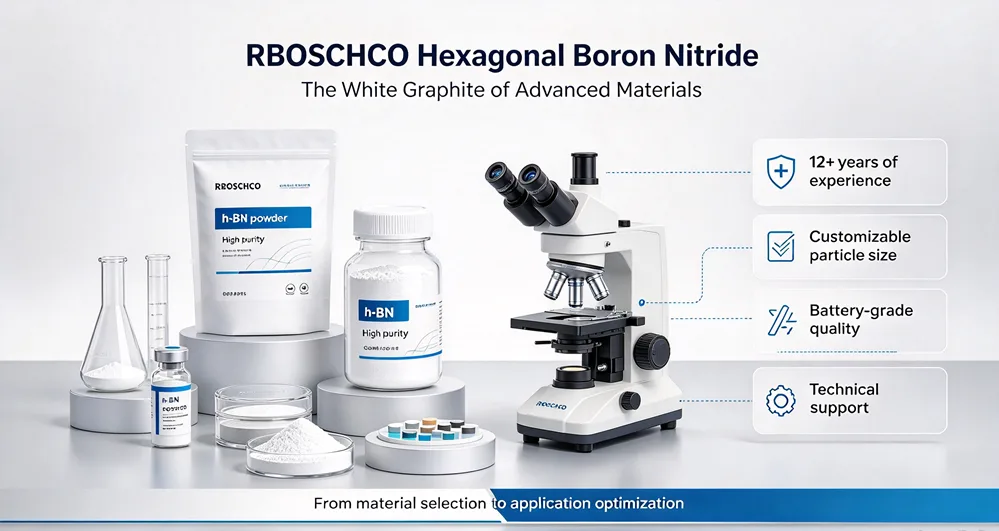
RBOSCHCO offers Hexagonal Boron Nitride (h-BN) Powder with high purity, controlled particle size, and consistent quality. For advanced applications in batteries, thermal management, and high-temperature materials, Hexagonal Boron Nitride (h-BN) Powder is a proven choice.
Supplier
RBOSCHCO is a trusted global chemical material supplier and manufacturer with over 12 years of experience in providing high-quality chemicals and nanomaterials, including boride powder, nitride powder, graphite powder, sulfide powder, and 3D printing powder. The company has a professional technical department and quality supervision department, a well-equipped laboratory with advanced testing equipment, and a dedicated after-sales customer service center. RBOSCHCO supplies Hexagonal Boron Nitride (h-BN) Powder worldwide, suitable for battery thermal management, separator coatings, electrode additives, electrolyte additives, and advanced composite materials. The company offers comprehensive technical support, from product selection to application guidance. If you are looking for high-quality Hexagonal Boron Nitride (h-BN) Powder for advanced applications, please feel free to contact us.
RELATED POSTS
Sodium Silicate vs. Potassium Silicate: Just One Potassium Ion, Why the Huge Performance Gap?

O3-Nax(FeyMn1-y)O2: A Promising Cathode Material for Sodium-Ion Batteries
Ceramic Plates: Features, Applications, Price, and Supplier Information
Nanoultrafine Molybdenum Disulfide MoS2 for Enhanced Lubrication and Antiwear Applications
Boron Powder and Boron Carbide: Performance and Application Comparison